Pursuing her passion around the world.
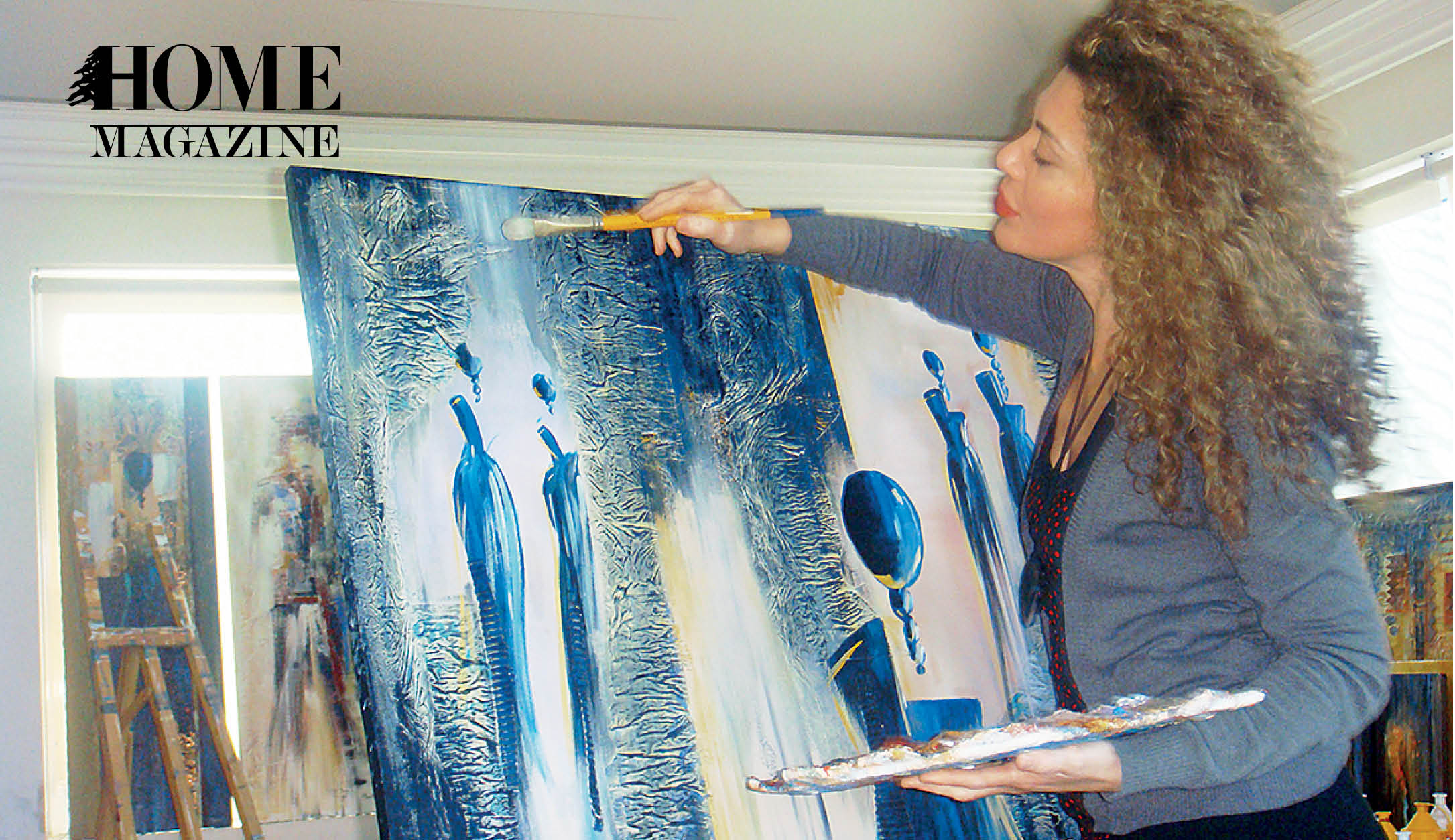
Sailing from the coast of Byblos, where she has painted the sea from her balcony since childhood, both Lydia Moawad and her paintings have crossed oceans and anchored themselves in major cities across the world – New York and Milan, Dubai and Paris, Hong Kong and Tokyo.
She has exhibited her work in the Florence Biennial at Fortezza da Basso and the European Art Fair in Rotterdam. Closer to home, her work has been displayed at Biel and in Jeddah. One of 12 artists selected in Milano in 2015 and one of 425 artists chosen out of 17,000 to exhibit in the Florence Biennial, doors began to open for Moawad across the globe – the Dictionnaire de l’Art in Germany, the Tokyo Art Fair and the Asia Contemporary Art Show in Hong Kong, to name a few.
“My recent participation in Hong Kong was of great importance. The gallery’s organizers made a documentary about me for their national television and they are publishing a book about my career,” said Moawad.
Moawad’s painting entitled Cristal Blue is featured in the Niagara Falls Museum Gallery, whose theme “Water for Life” is dedicated to global water preservation. In addition, she was invited to illustrate UNICEF’s book on children’s rights in 2000, an honor of which she is particularly proud.
“When the late Lebanese writer Dr. Mohamed Dakroub met me 12 years ago, he told me that history would remember me. His flattery was too much, but I feel I am on the right path. I still have a long journey ahead.”
Born to paint
“I was born a painter. Painting was and still is in my blood; it is my eternal passion,” said Moawad. Her Mother is an artist herself, who loves to give back to her community by donating the profits of her exhibitions to charitable causes. Her mother’s father was the renowned Lebanese artist and international jewelry designer Halim Akkawi.
“Painting is a spiritual need for me, the oxygen I breathe,” said Moawad. “It is not a duty or task at all. Painting allows me to express my deepest feelings.
“I was holding a paintbrush or a pencil since my childhood. When my father passed away, my mother found my drawings in his things. He had dated them, some from when I was 2 1|2 and 3 years old.”
Her joyful style
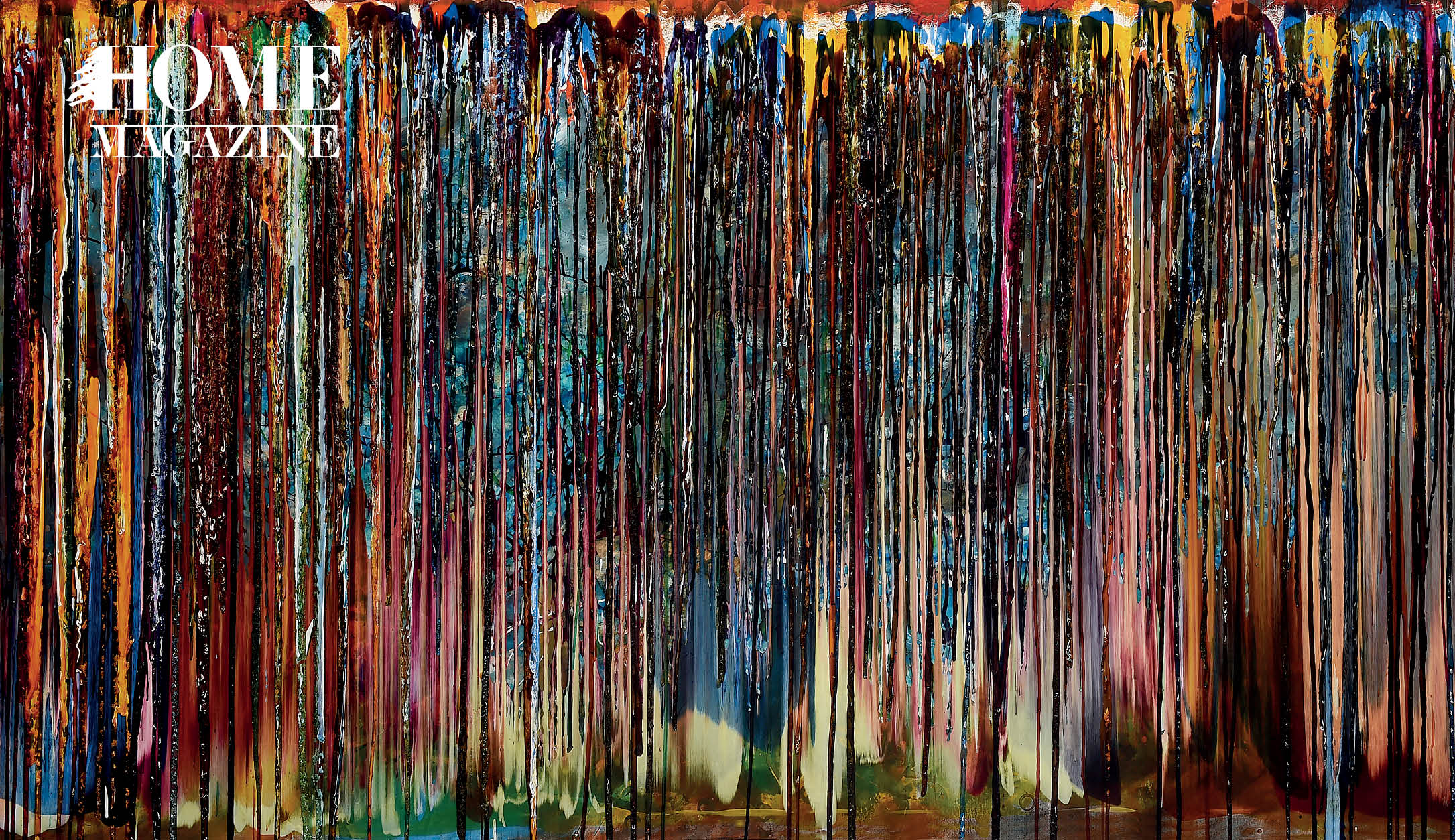
Moawad’s paintings are a free expression of sensations, as if her canvases show butterflies in continuous movement, captured in bright and dramatic colors.
It is after liberating oneself from artistic rules, “only at this point will he or she find new rules and ways of expression,” she said.
“My paintings are sadness-free, still a little hardness sometimes escapes into them unwillingly, due to the war I witnessed for 30 years and my fight against cancer in 2011. I see a softness in every hardship because I still keep hope and stay positive.”
At one point, Moawad included a woman captured from behind by her braid in many of her paintings. She was an elegant woman, always rising above materialism and life’s trials. “Armed with pride, she turned her attention to the future, while spreading culture and wealth around her,” she explained.
A place of her own
In September, Moawad will go back to Hong Kong to inaugurate her new collection Shapeless Energy in the Lydia Moawad Gallery, and in October she will be part of a live auction in the Historical Distillery District in Toronto. This event will support cancer research and benefit the Breast Cancer Society of Canada. Meanwhile, she welcomes visitors at her private gallery in Ain el-Rihaneh, Byblos and hopes to inaugurate the Lydia Moawad Gallery in Lebanon soon.
For more info:
http://www.lydiamoawad.com
https://www.facebook.com/lydiamoawadpage/
https://www.youtube.com/watch?v=apkqEx4P0pg
https://www.youtube.com/watch?v=6YdcWtb_y4E
HOMEland Magazine
We firmly believe that the internet should be available and accessible to anyone, and are committed to providing a website that is accessible to the widest possible audience, regardless of circumstance and ability.
To fulfill this, we aim to adhere as strictly as possible to the World Wide Web Consortium’s (W3C) Web Content Accessibility Guidelines 2.1 (WCAG 2.1) at the AA level. These guidelines explain how to make web content accessible to people with a wide array of disabilities. Complying with those guidelines helps us ensure that the website is accessible to all people: blind people, people with motor impairments, visual impairment, cognitive disabilities, and more.
This website utilizes various technologies that are meant to make it as accessible as possible at all times. We utilize an accessibility interface that allows persons with specific disabilities to adjust the website’s UI (user interface) and design it to their personal needs.
Additionally, the website utilizes an AI-based application that runs in the background and optimizes its accessibility level constantly. This application remediates the website’s HTML, adapts Its functionality and behavior for screen-readers used by the blind users, and for keyboard functions used by individuals with motor impairments.
If you’ve found a malfunction or have ideas for improvement, we’ll be happy to hear from you. You can reach out to the website’s operators by using the following email
Our website implements the ARIA attributes (Accessible Rich Internet Applications) technique, alongside various different behavioral changes, to ensure blind users visiting with screen-readers are able to read, comprehend, and enjoy the website’s functions. As soon as a user with a screen-reader enters your site, they immediately receive a prompt to enter the Screen-Reader Profile so they can browse and operate your site effectively. Here’s how our website covers some of the most important screen-reader requirements, alongside console screenshots of code examples:
Screen-reader optimization: we run a background process that learns the website’s components from top to bottom, to ensure ongoing compliance even when updating the website. In this process, we provide screen-readers with meaningful data using the ARIA set of attributes. For example, we provide accurate form labels; descriptions for actionable icons (social media icons, search icons, cart icons, etc.); validation guidance for form inputs; element roles such as buttons, menus, modal dialogues (popups), and others. Additionally, the background process scans all the website’s images and provides an accurate and meaningful image-object-recognition-based description as an ALT (alternate text) tag for images that are not described. It will also extract texts that are embedded within the image, using an OCR (optical character recognition) technology. To turn on screen-reader adjustments at any time, users need only to press the Alt+1 keyboard combination. Screen-reader users also get automatic announcements to turn the Screen-reader mode on as soon as they enter the website.
These adjustments are compatible with all popular screen readers, including JAWS and NVDA.
Keyboard navigation optimization: The background process also adjusts the website’s HTML, and adds various behaviors using JavaScript code to make the website operable by the keyboard. This includes the ability to navigate the website using the Tab and Shift+Tab keys, operate dropdowns with the arrow keys, close them with Esc, trigger buttons and links using the Enter key, navigate between radio and checkbox elements using the arrow keys, and fill them in with the Spacebar or Enter key.Additionally, keyboard users will find quick-navigation and content-skip menus, available at any time by clicking Alt+1, or as the first elements of the site while navigating with the keyboard. The background process also handles triggered popups by moving the keyboard focus towards them as soon as they appear, and not allow the focus drift outside it.
Users can also use shortcuts such as “M” (menus), “H” (headings), “F” (forms), “B” (buttons), and “G” (graphics) to jump to specific elements.
We aim to support the widest array of browsers and assistive technologies as possible, so our users can choose the best fitting tools for them, with as few limitations as possible. Therefore, we have worked very hard to be able to support all major systems that comprise over 95% of the user market share including Google Chrome, Mozilla Firefox, Apple Safari, Opera and Microsoft Edge, JAWS and NVDA (screen readers).
Despite our very best efforts to allow anybody to adjust the website to their needs. There may still be pages or sections that are not fully accessible, are in the process of becoming accessible, or are lacking an adequate technological solution to make them accessible. Still, we are continually improving our accessibility, adding, updating and improving its options and features, and developing and adopting new technologies. All this is meant to reach the optimal level of accessibility, following technological advancements. For any assistance, please reach out to