
HOMEland THEMES
Coming Soon
HOMEland Events & Collaborations
Coming Soon
 Signature Boutique

Salim Edde founded the MiM in 2013 to house his private collection of minerals and precious stones. Prepare to be bedazzled.
The limestone that makes up the majestic mountains in Lebanon, the marble stones that pile up on the seashore, the diamonds, rubies and emeralds found in the most decadent of jewelry. What do they all have in common? They are all minerals found in the earth.
Minerals are the constituents of all the solid matter that makes up our planet. All the rocks, mountains and metals consist of minerals, which are well-defined chemical compounds.
People are bewitched by their outer beauty, rarely stopping to wonder how beautiful they are on the inside.
Minerals are made up of billions of atoms, piled together in perfect order to create what we see on the outside, beautiful shiny rocks. For example, if you look at grains of salt under a microscope, you will find each one is a perfect cube. While some people only see the glitter, chemical engineer Salim Edde was able to see both sides.
One afternoon in February of 1997, he walked into a store in Paris and set his eyes on a rock that had been cracked open to reveal a world of glittering color. It was love at first sight. He walked out of the store with the desire and determination to start his own collection.
“I started collecting them for their sheer beauty, then I found out that each rock had its own story. You could tell a story about an entire civilization through just one rock. I discovered very important scientific backgrounds behind each one,” explained Edde.
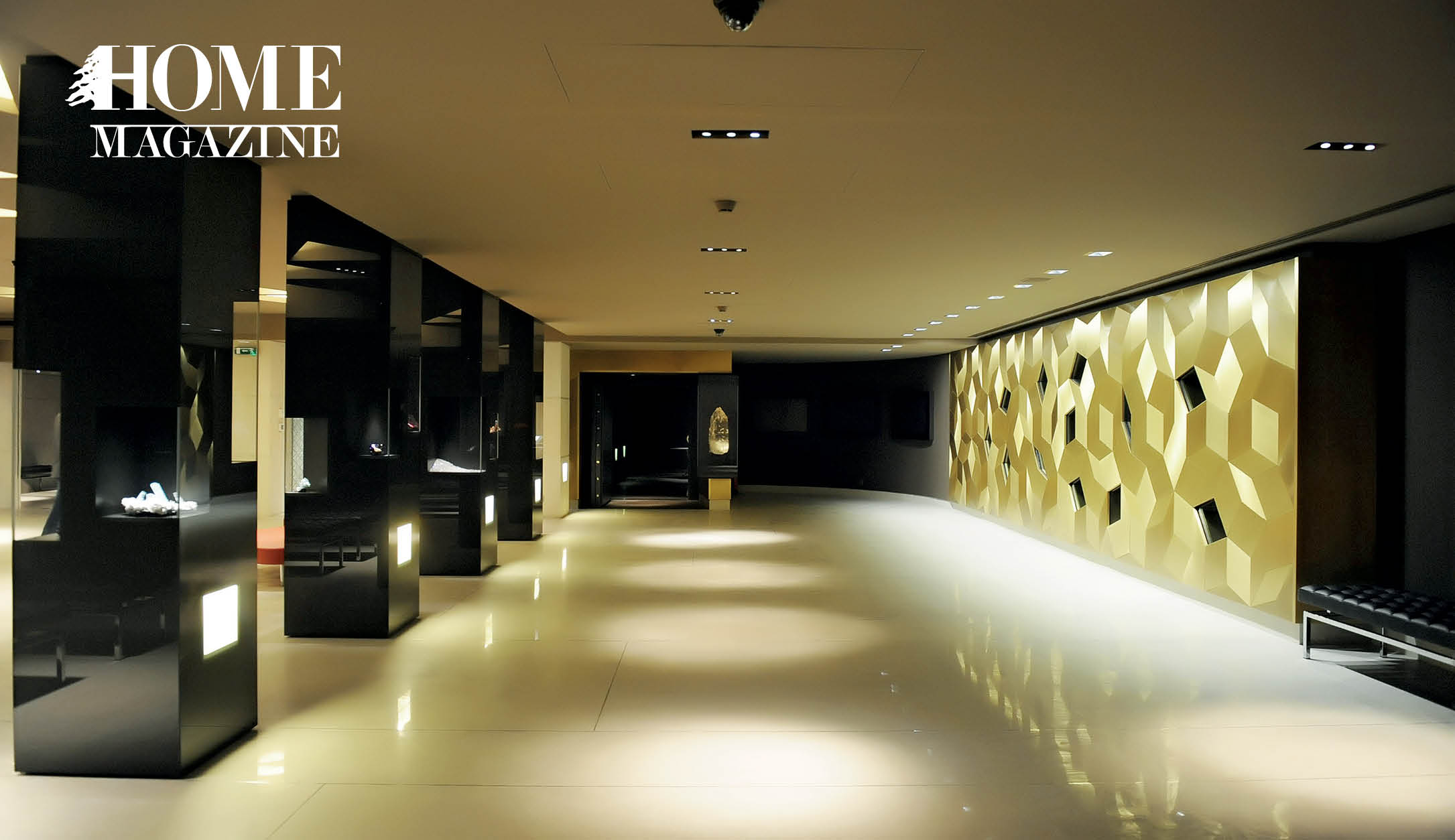
His passion for minerals, their beauty and importance to our world became the central reason for starting the MiM Museum, located within the Université Saint-Joseph campus in Sodeco.
The Museum
Built to the specifications of a bank vault, the museum houses more than 1,700 minerals, representing more than 300 different species from over 65 countries. Of the 4,500 minerals that exist in the world, 350 to 400 exist in this museum, and the collection continues to grow. In April 2015, 60 newly acquired minerals were added.
Its mission is to promote the aesthetic along with the scientific, industrial and economic aspects of mineralogy– until now unknown in the world of museums, both in Lebanon and in the Middle East.
“There are only 20-25 museums in the world dedicated to minerals. The museum was created to help people discover new kind of beauty in nature,” Edde said.
The most common questions he gets asked by visitors are, “Who sculpted these marvelous shapes and polished the incredible flat surfaces?” “Who composed this arrangement of different specimens?” and “Where do these colors come from?” “They are convinced that such things could only be formed by the hands of an artist.
They simply cannot believe that natural forces created them,” Edde said.
“The more you learn, the more you are frightened by your ignorance. For me it’s still a miracle, how disorderly our world is but how orderly matter is.”
For those who are interested in going deeper into the subject, the museum offers electronic support through interactive touchscreen tablets that contain the geographical, mathematical and chemical aspects behind the minerals.
A natural-born collector, Edde says his father, who collected rare coins, was his main influence. “You have to take risks and believe in what you’re doing and look at your collections as something you and others can enjoy. The people that think about minerals as investments are traders, not collectors. You have to collect without ‘counting beans.’ You have to have passion for it, it has to make your heart skip a beat. This is the most important thing.”
Aside from being a mineral enthusiast and running the museum, he is cofounder of Murex, a company that he started at age 27, which develops software for banks. He spends two-thirds of his time at Murex and the rest of the time at the museum, and both places fuel his ambition.
The Future
For the future of the MiM Museum, Edde would be happy to see it as one of the highlights of Beirut, bringing in students and curious people of all ages, and showing them a bright and shiny new world. The museum also offers space for conferences and exhibitions.
Edde believes that the many Lebanese living abroad are very important to Lebanon, and that there’s a possibility to do more to help the country. He says this can be done by improving its technology, taking better care of water resources and Lebanon’s creativity, like Ireland and Singapore, the latter which went from a third world to a first world country in less than three years.
When asked if he had any reservations about opening the museum in Lebanon, Edde remained optimistic.
“If you want to keep on thinking about the negative parts of a project, you’d never do anything in Lebanon or anywhere else. It’s a country full of opportunities, plagued with problems, but if it had no problems it would be very boring. It’s my country. Something I’m proud of.”
Signature Boutique 

HOMEland Magazine
We firmly believe that the internet should be available and accessible to anyone, and are committed to providing a website that is accessible to the widest possible audience, regardless of circumstance and ability.
To fulfill this, we aim to adhere as strictly as possible to the World Wide Web Consortium’s (W3C) Web Content Accessibility Guidelines 2.1 (WCAG 2.1) at the AA level. These guidelines explain how to make web content accessible to people with a wide array of disabilities. Complying with those guidelines helps us ensure that the website is accessible to all people: blind people, people with motor impairments, visual impairment, cognitive disabilities, and more.
This website utilizes various technologies that are meant to make it as accessible as possible at all times. We utilize an accessibility interface that allows persons with specific disabilities to adjust the website’s UI (user interface) and design it to their personal needs.
Additionally, the website utilizes an AI-based application that runs in the background and optimizes its accessibility level constantly. This application remediates the website’s HTML, adapts Its functionality and behavior for screen-readers used by the blind users, and for keyboard functions used by individuals with motor impairments.
If you’ve found a malfunction or have ideas for improvement, we’ll be happy to hear from you. You can reach out to the website’s operators by using the following email
Our website implements the ARIA attributes (Accessible Rich Internet Applications) technique, alongside various different behavioral changes, to ensure blind users visiting with screen-readers are able to read, comprehend, and enjoy the website’s functions. As soon as a user with a screen-reader enters your site, they immediately receive a prompt to enter the Screen-Reader Profile so they can browse and operate your site effectively. Here’s how our website covers some of the most important screen-reader requirements, alongside console screenshots of code examples:
Screen-reader optimization: we run a background process that learns the website’s components from top to bottom, to ensure ongoing compliance even when updating the website. In this process, we provide screen-readers with meaningful data using the ARIA set of attributes. For example, we provide accurate form labels; descriptions for actionable icons (social media icons, search icons, cart icons, etc.); validation guidance for form inputs; element roles such as buttons, menus, modal dialogues (popups), and others. Additionally, the background process scans all the website’s images and provides an accurate and meaningful image-object-recognition-based description as an ALT (alternate text) tag for images that are not described. It will also extract texts that are embedded within the image, using an OCR (optical character recognition) technology. To turn on screen-reader adjustments at any time, users need only to press the Alt+1 keyboard combination. Screen-reader users also get automatic announcements to turn the Screen-reader mode on as soon as they enter the website.
These adjustments are compatible with all popular screen readers, including JAWS and NVDA.
Keyboard navigation optimization: The background process also adjusts the website’s HTML, and adds various behaviors using JavaScript code to make the website operable by the keyboard. This includes the ability to navigate the website using the Tab and Shift+Tab keys, operate dropdowns with the arrow keys, close them with Esc, trigger buttons and links using the Enter key, navigate between radio and checkbox elements using the arrow keys, and fill them in with the Spacebar or Enter key.Additionally, keyboard users will find quick-navigation and content-skip menus, available at any time by clicking Alt+1, or as the first elements of the site while navigating with the keyboard. The background process also handles triggered popups by moving the keyboard focus towards them as soon as they appear, and not allow the focus drift outside it.
Users can also use shortcuts such as “M” (menus), “H” (headings), “F” (forms), “B” (buttons), and “G” (graphics) to jump to specific elements.
We aim to support the widest array of browsers and assistive technologies as possible, so our users can choose the best fitting tools for them, with as few limitations as possible. Therefore, we have worked very hard to be able to support all major systems that comprise over 95% of the user market share including Google Chrome, Mozilla Firefox, Apple Safari, Opera and Microsoft Edge, JAWS and NVDA (screen readers).
Despite our very best efforts to allow anybody to adjust the website to their needs. There may still be pages or sections that are not fully accessible, are in the process of becoming accessible, or are lacking an adequate technological solution to make them accessible. Still, we are continually improving our accessibility, adding, updating and improving its options and features, and developing and adopting new technologies. All this is meant to reach the optimal level of accessibility, following technological advancements. For any assistance, please reach out to