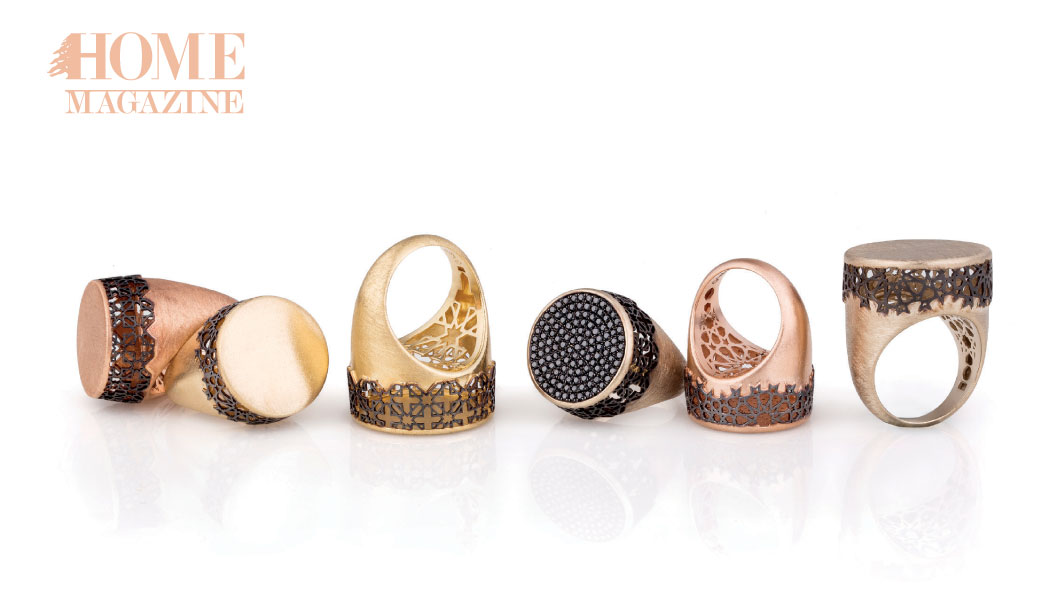
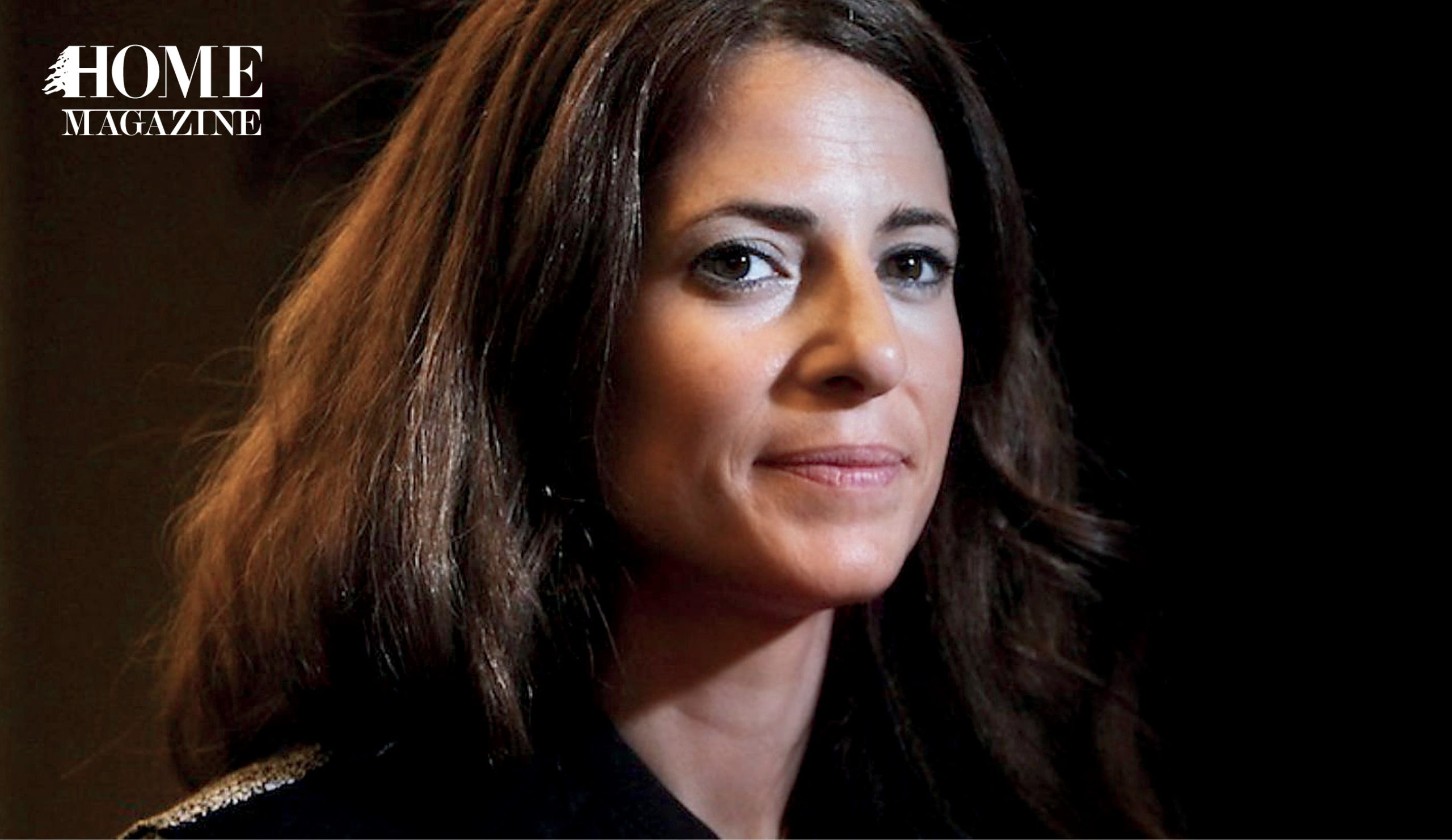
Driven by her passion for designing, Nada Ghazal quit a successful job to pursue her childhood dream. Her eye for detail helps her design timeless pieces of jewelry.
Following Her Intuition
From an early age jewelry designer Nada Ghazal wished to express herself through decorative means. As a child, Ghazal was more introverted and chose to embellish her outfits instead of talking as a way to convey her ideas. While in nursery school she insisted on wearing two different pairs of shoes, and convinced her mother with her choice. As she got older she found herself fascinated by crafts, needlework, sketching, and everything artistic that involved lots of handiwork. It was advertising, however, that became her first vocation after university and she spent a decade as the creative head of a leading advertising agency in Dubai. The time she spent on branding and art direction was a valuable lesson, she tells HOME, as it gave her a strong sense of communicating a brand, which she later applied to her eponymous jewelry line. For Ghazal, quitting her highly successful job in advertising to start her own brand in her native Lebanon was less about taking a risk and more about following her intuition.

“Advertising became too broad and I wanted to narrow my creative role to something that is more personal and has more connection with people,” explains Ghazal. After returning to Beirut in the early 2000s, she dabbled in a few creative projects before deciding on jewelry. One day, she rediscovered some rings she made with wires and beads as a child, which inspired her to make her first collection of rings. “I bought 18 carat gold wires from a workshop and used precious and semi-precious stones with them,” explains Ghazal. “I learned a lot from trial and error and later working closely with trained jewelry artisans.”

Design-driven Jewels
Driven by her passion, a love for designing and a strong work ethic, Ghazal was able to develop her jewelry line from scratch and grow her business. Initially, however, she hoped other well-known jewelry boutiques would sell her pieces. To her dismay, she noticed that these established stores at the time were more interested in high-end ‘special occasion’ jewelry and preferred to import Italian made jewelry to complement their own. In the meantime, Ghazal kept creating and selling to a fast growing fan base of clients – who appreciated her original designs and meticulous workmanship – and opened her first boutique in 2004, followed by two other points of sale in 2016, and one in 2017. Nada G’s jewels are bold, dramatic and unique. They have a strong identity, making them very hard to be compared to others. The way she sets and mixes different colored stones, introduces clever curvaceous and geometric shapes, and focuses on yellow gold makes her collections distinguished. “Yellow just blends with everyone and with every skin tone,” says Ghazal. “It’s the natural color of the metal, like the sun.” While yellow gold dominates, she also works with white, rose and even champagne-colored gold. Ghazal doesn’t see her pieces as “fashionable accessories” but as timeless pieces her customers can wear forever and at any age. First and foremost for her is ensuring that her pieces are well made. “If someone doesn’t like my collection that is okay, but if that person doesn’t like my workmanship then that is the worst insult for me,” she says emphatically. Ghazal does give credit to the great workmanship in the jewelry sector brought in by the Armenian craftsmen and what they taught the Lebanese over the years. “This is a great asset for jewelry made in Lebanon. We need to appreciate it more,” says Ghazal. However, what will ultimately distinguish one brand from another is the eye for detail she shares: “This is where the designer really has to put the extra effort and painstakingly guide the artisan.” Today, more Lebanese people are appreciating jewelry made locally and are ready to pay the same amount they pay for imported brands. “It took time, but customers are starting to appreciate the excellent work that is produced in Lebanon,” adds Ghazal. To date Ghazal has won several international jewelry awards and she hopes one day to be a reference in the jewelry sector, both in Lebanon and internationally.

Ghazal tells HOME that her new collection will be something that everyone will relate to. “Every country will also relate to it because of what they are all going through these days, although my inspiration is definitely Lebanon,” reveals Ghazal.
Twitter: NadaG_Jewelry
Instagram: nadagjewelry
Facebook: NadaGJewelry
HOMEland Magazine
We firmly believe that the internet should be available and accessible to anyone, and are committed to providing a website that is accessible to the widest possible audience, regardless of circumstance and ability.
To fulfill this, we aim to adhere as strictly as possible to the World Wide Web Consortium’s (W3C) Web Content Accessibility Guidelines 2.1 (WCAG 2.1) at the AA level. These guidelines explain how to make web content accessible to people with a wide array of disabilities. Complying with those guidelines helps us ensure that the website is accessible to all people: blind people, people with motor impairments, visual impairment, cognitive disabilities, and more.
This website utilizes various technologies that are meant to make it as accessible as possible at all times. We utilize an accessibility interface that allows persons with specific disabilities to adjust the website’s UI (user interface) and design it to their personal needs.
Additionally, the website utilizes an AI-based application that runs in the background and optimizes its accessibility level constantly. This application remediates the website’s HTML, adapts Its functionality and behavior for screen-readers used by the blind users, and for keyboard functions used by individuals with motor impairments.
If you’ve found a malfunction or have ideas for improvement, we’ll be happy to hear from you. You can reach out to the website’s operators by using the following email
Our website implements the ARIA attributes (Accessible Rich Internet Applications) technique, alongside various different behavioral changes, to ensure blind users visiting with screen-readers are able to read, comprehend, and enjoy the website’s functions. As soon as a user with a screen-reader enters your site, they immediately receive a prompt to enter the Screen-Reader Profile so they can browse and operate your site effectively. Here’s how our website covers some of the most important screen-reader requirements, alongside console screenshots of code examples:
Screen-reader optimization: we run a background process that learns the website’s components from top to bottom, to ensure ongoing compliance even when updating the website. In this process, we provide screen-readers with meaningful data using the ARIA set of attributes. For example, we provide accurate form labels; descriptions for actionable icons (social media icons, search icons, cart icons, etc.); validation guidance for form inputs; element roles such as buttons, menus, modal dialogues (popups), and others. Additionally, the background process scans all the website’s images and provides an accurate and meaningful image-object-recognition-based description as an ALT (alternate text) tag for images that are not described. It will also extract texts that are embedded within the image, using an OCR (optical character recognition) technology. To turn on screen-reader adjustments at any time, users need only to press the Alt+1 keyboard combination. Screen-reader users also get automatic announcements to turn the Screen-reader mode on as soon as they enter the website.
These adjustments are compatible with all popular screen readers, including JAWS and NVDA.
Keyboard navigation optimization: The background process also adjusts the website’s HTML, and adds various behaviors using JavaScript code to make the website operable by the keyboard. This includes the ability to navigate the website using the Tab and Shift+Tab keys, operate dropdowns with the arrow keys, close them with Esc, trigger buttons and links using the Enter key, navigate between radio and checkbox elements using the arrow keys, and fill them in with the Spacebar or Enter key.Additionally, keyboard users will find quick-navigation and content-skip menus, available at any time by clicking Alt+1, or as the first elements of the site while navigating with the keyboard. The background process also handles triggered popups by moving the keyboard focus towards them as soon as they appear, and not allow the focus drift outside it.
Users can also use shortcuts such as “M” (menus), “H” (headings), “F” (forms), “B” (buttons), and “G” (graphics) to jump to specific elements.
We aim to support the widest array of browsers and assistive technologies as possible, so our users can choose the best fitting tools for them, with as few limitations as possible. Therefore, we have worked very hard to be able to support all major systems that comprise over 95% of the user market share including Google Chrome, Mozilla Firefox, Apple Safari, Opera and Microsoft Edge, JAWS and NVDA (screen readers).
Despite our very best efforts to allow anybody to adjust the website to their needs. There may still be pages or sections that are not fully accessible, are in the process of becoming accessible, or are lacking an adequate technological solution to make them accessible. Still, we are continually improving our accessibility, adding, updating and improving its options and features, and developing and adopting new technologies. All this is meant to reach the optimal level of accessibility, following technological advancements. For any assistance, please reach out to