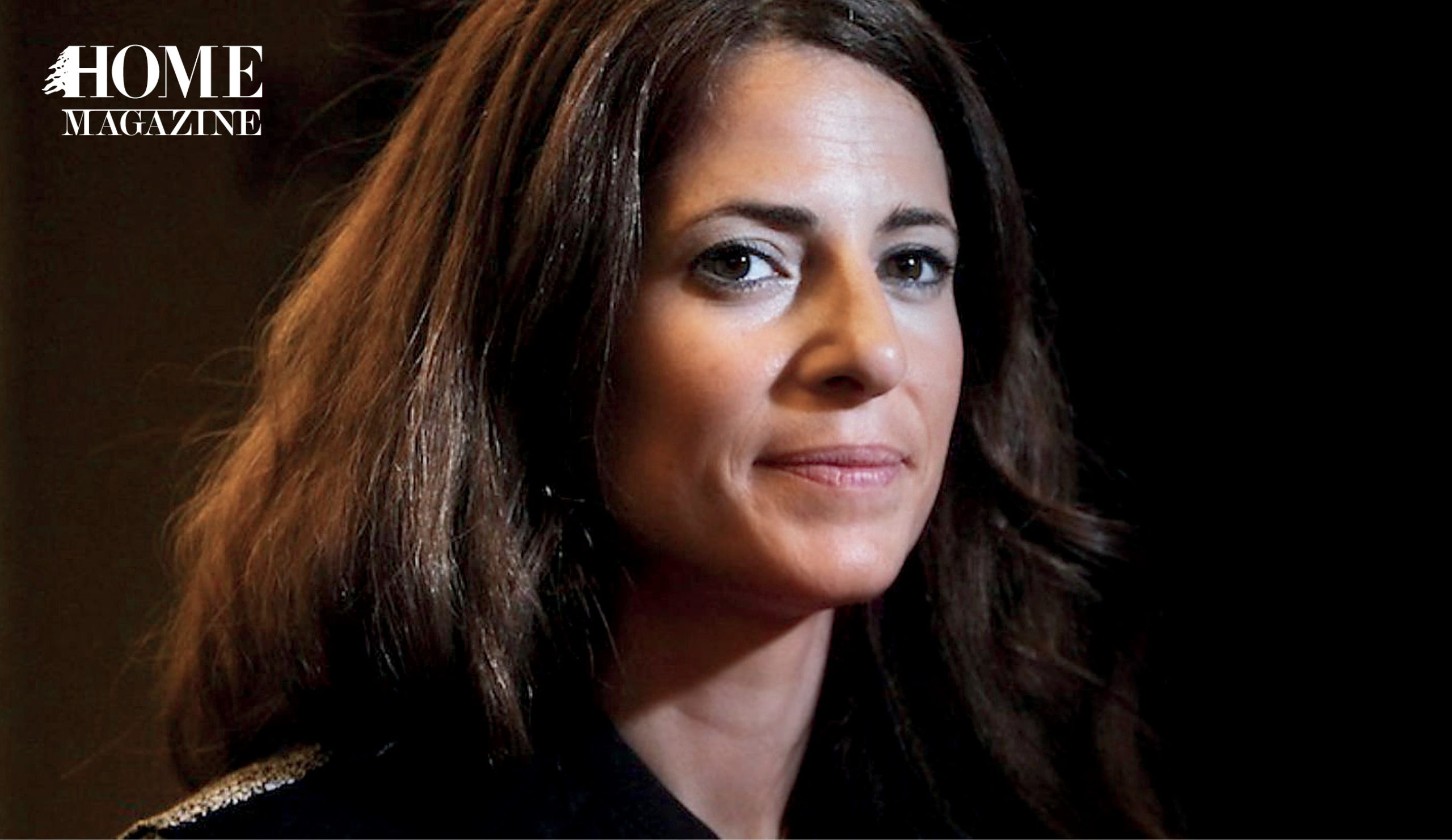
Nada Zeineh followed her bliss; it led her to create unique hand-crafted jewelry and a beautiful life.
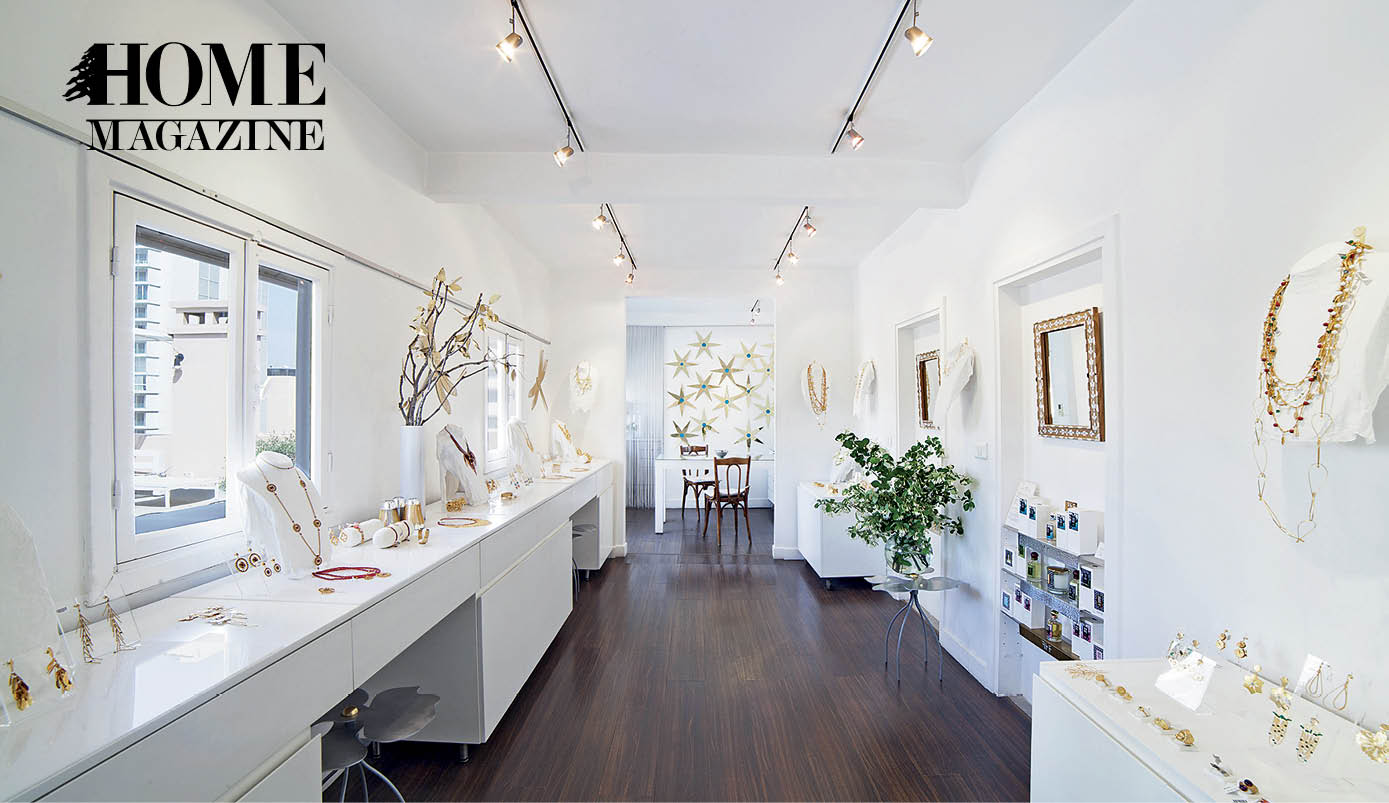
“Nature brings you back to what you really are,” said Nada Zeineh, architect by training, jewelry designer in practice. Her interest in nature is evident in her bright showroom on the fifth floor of the Kassir Building in Sursock, Beirut.
“Nature brings you back to what you really are.”
Its white walls are punctuated by golden leaves and natural olive branches, reflecting the Greco-Roman style of ancient times. Golden dragonflies and stylized gold stars with turquoise centers sparkle, along with the simple display of elegant jewelry.

In a one-on-one interview with HOME Magazine, Zeineh talked about what attracted her to jewelry design and how nature inspires her.
Zeineh’s journey to jewelry design started as an architectural student at the American University of Beirut. She is still inspired by abstract geometrical shapes inherent to her training as an architect.
After living for 10 years in France, she came back to Lebanon in 1994 and signed several projects, including the Soap Museum in Saida and the AUB Museum, where she has worked with her husband, the architect Youssef Haidar.

Through the years, Zeineh realized architecture was not the career for her. “I used to be very stressed because architects need a lot of patience, tolerance and dedication to work with people.” Even the idea of pursuing a career in interior architecture feels constraining, she said. The designer is limited by people’s choices. “People should do their own interior. Dealing directly with clients and their specific needs, I can’t be free to work the way I want to.”
But her years in the architectural field were a stepping stone that provided a strong foundation for her jewelry design, she said. “It helps me when I think about designing. I think about 3D, comfort and affordability.”
“I drive for him and he cooks for me.”
When designing jewelry, Zeineh feels free, she said. Enchanted with the world of handmade jewelry, she creates objects with joy. She is not market driven, but rather she follows her art – and her heart.
Since the beginning, 32 years ago when she first started designing, Nada enjoyed working with her hands and creating pieces out of nothing. Success came as a result of this pleasure and at one point she worked hard to develop her work and improve it. So, developing her craft became her main focus back then.
“I want to take time to live.”
Zeineh has not only learned how to create beautiful jewelry; she has learned to create a beautiful life. “I could have grown my business much more, but I decided not to because there are priorities in life. I don’t want work to take from the pleasure of life. I want to take time to live, such as sharing memorable moments with people – walks in the mountains, enjoying nature, dreaming and not being stressed by time.”

As her love for design has grown, so has her passion for nature. She and her husband Haidar bought and restored an old peasant house in the wilderness of the Chouf region, where they are surrounded by nature and coyotes. As a couple, they enjoy making honey and planting thyme. “I drive for him and he cooks for me,” she said about their mutually agreeable arrangement.
“My luxury is to be able to do exclusively what I like to do.”
Zeineh said she enjoys disconnecting herself from people and connecting with nature and its magical beauty.
One of her latest collections, “Spring of Bkerzay,” was created out of her love for the wilderness where she spent her time; it later became known as Bkerzay village. “Many of my collections are inspired by Bkerzay’s charm, the beauty of its nature, its tiny flowers and insects.”

“My luxury is to be able to do exclusively what I like to do,” she said. “I am privileged. I like the process of creating and designing and specifically working with my own hands.” This made her fall in love with pottery that she is still enjoying and practicing until now.
“We as humans, we are nothing.”
“I needed to go back to basics, to the trees, planting and sound of birds.”
“Finally, we as humans, we are nothing.”
For more info: http://noun-zein.com/
HOMEland Magazine
We firmly believe that the internet should be available and accessible to anyone, and are committed to providing a website that is accessible to the widest possible audience, regardless of circumstance and ability.
To fulfill this, we aim to adhere as strictly as possible to the World Wide Web Consortium’s (W3C) Web Content Accessibility Guidelines 2.1 (WCAG 2.1) at the AA level. These guidelines explain how to make web content accessible to people with a wide array of disabilities. Complying with those guidelines helps us ensure that the website is accessible to all people: blind people, people with motor impairments, visual impairment, cognitive disabilities, and more.
This website utilizes various technologies that are meant to make it as accessible as possible at all times. We utilize an accessibility interface that allows persons with specific disabilities to adjust the website’s UI (user interface) and design it to their personal needs.
Additionally, the website utilizes an AI-based application that runs in the background and optimizes its accessibility level constantly. This application remediates the website’s HTML, adapts Its functionality and behavior for screen-readers used by the blind users, and for keyboard functions used by individuals with motor impairments.
If you’ve found a malfunction or have ideas for improvement, we’ll be happy to hear from you. You can reach out to the website’s operators by using the following email
Our website implements the ARIA attributes (Accessible Rich Internet Applications) technique, alongside various different behavioral changes, to ensure blind users visiting with screen-readers are able to read, comprehend, and enjoy the website’s functions. As soon as a user with a screen-reader enters your site, they immediately receive a prompt to enter the Screen-Reader Profile so they can browse and operate your site effectively. Here’s how our website covers some of the most important screen-reader requirements, alongside console screenshots of code examples:
Screen-reader optimization: we run a background process that learns the website’s components from top to bottom, to ensure ongoing compliance even when updating the website. In this process, we provide screen-readers with meaningful data using the ARIA set of attributes. For example, we provide accurate form labels; descriptions for actionable icons (social media icons, search icons, cart icons, etc.); validation guidance for form inputs; element roles such as buttons, menus, modal dialogues (popups), and others. Additionally, the background process scans all the website’s images and provides an accurate and meaningful image-object-recognition-based description as an ALT (alternate text) tag for images that are not described. It will also extract texts that are embedded within the image, using an OCR (optical character recognition) technology. To turn on screen-reader adjustments at any time, users need only to press the Alt+1 keyboard combination. Screen-reader users also get automatic announcements to turn the Screen-reader mode on as soon as they enter the website.
These adjustments are compatible with all popular screen readers, including JAWS and NVDA.
Keyboard navigation optimization: The background process also adjusts the website’s HTML, and adds various behaviors using JavaScript code to make the website operable by the keyboard. This includes the ability to navigate the website using the Tab and Shift+Tab keys, operate dropdowns with the arrow keys, close them with Esc, trigger buttons and links using the Enter key, navigate between radio and checkbox elements using the arrow keys, and fill them in with the Spacebar or Enter key.Additionally, keyboard users will find quick-navigation and content-skip menus, available at any time by clicking Alt+1, or as the first elements of the site while navigating with the keyboard. The background process also handles triggered popups by moving the keyboard focus towards them as soon as they appear, and not allow the focus drift outside it.
Users can also use shortcuts such as “M” (menus), “H” (headings), “F” (forms), “B” (buttons), and “G” (graphics) to jump to specific elements.
We aim to support the widest array of browsers and assistive technologies as possible, so our users can choose the best fitting tools for them, with as few limitations as possible. Therefore, we have worked very hard to be able to support all major systems that comprise over 95% of the user market share including Google Chrome, Mozilla Firefox, Apple Safari, Opera and Microsoft Edge, JAWS and NVDA (screen readers).
Despite our very best efforts to allow anybody to adjust the website to their needs. There may still be pages or sections that are not fully accessible, are in the process of becoming accessible, or are lacking an adequate technological solution to make them accessible. Still, we are continually improving our accessibility, adding, updating and improving its options and features, and developing and adopting new technologies. All this is meant to reach the optimal level of accessibility, following technological advancements. For any assistance, please reach out to