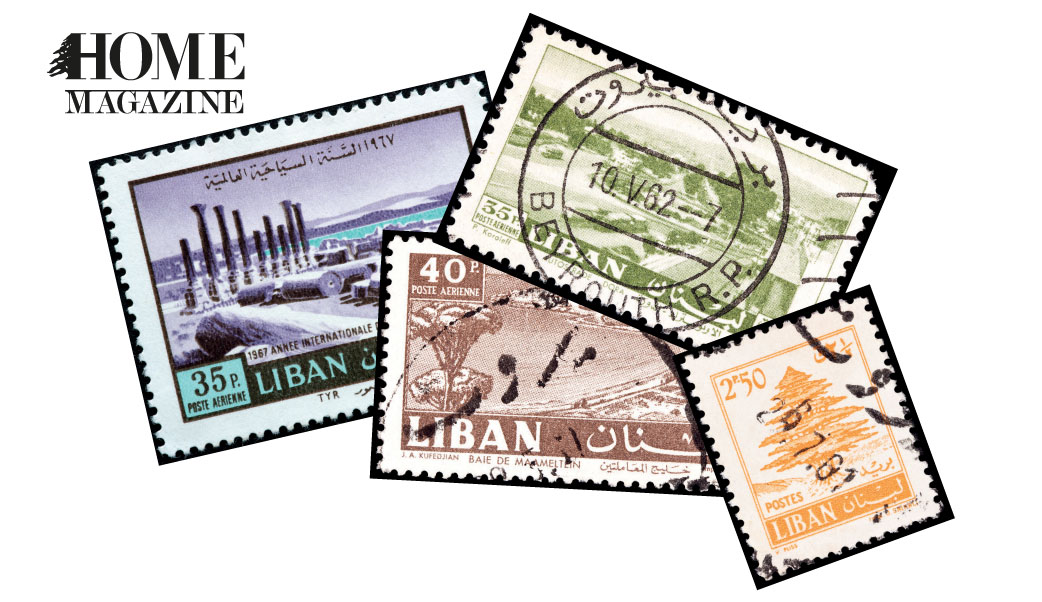
Every stamp is a chapter of the history of Lebanon; each one is a passionate guardian of a time that has vanished. Pierre Ahmaranian, author, philatelist, Arabic teacher, and presenter- producer.
Stamp collecting is a very lonely activity; however, if shared with others, it spreads the message of beauty, achievement, culture, history, and so much more. It is an inspiring way to promote the distinctiveness of a country through tiny squares. Stamps are miniature works of art; it’s also impossible to get involved with them without learning a lot from them.
Pierre Ahmaranian is surely aware of all this. That is why he decided to connect his two passions: Lebanon, and philately, in a delightful exhibition. Lebanese born and living in Montreal since 1979, he paid homage to his roots by embellishing the walls of the Consulate General of Lebanon in Montreal to awaken visitors to the splendor, the magic, the traditions, the history, the cities, and the talents of the country of milk and honey. It narrated a tale of Lebanon and captured its soul through the illustrations on postage stamps.
As guests walked through the display, one could feel the sense of pride in front of these little tapestries but, most especially, the love. It is true that for centuries, mail was carried by horse and carriage before the use of vans, ships, and later airplanes.
However, no matter the content of the correspondence or that of the parcels, the stamps carried messages of their own – historical, political, cultural, and even humorous – to our pure delight.
The exhibition was inaugurated by His Excellency, Fadi Ziadeh, Consul General of Lebanon in Montreal in the presence of the former President of the Lebanese Republic, his Excellency Cheikh Amine Gemayel.
The exhibition offered many panels classified by subject: crucial historical events, artistic and sports episodes, towns and cities, and presidents. A special section was dedicated to the Lebanese army.
The stamp display highlighted major events including the United Nations Charter with the Arab Summit in Beirut in 1956. It also featured stamps from the end of the Ottoman Empire and from the state of the Greater Lebanon era. A vast section was dedicated to Lebanon’s artistic production, reflecting its personage and milestones.

Pierre Ahmaranian explained that usually the collections are spread out chronologically. However, he thought it would be more interesting to regroup the little tapestries into themes. He added: “One can see the beauty and the talent inherent to the land but also catch the spirit of Lebanon.” He particularly mentioned the panel presenting Lebanon’s presidents and the first stamps in 1943: the stamps were overprinted with Republique Libanaise. After the Constitution of Lebanon was adopted in May 1926, it was only a few years later that new stamps were marked simply Liban.”
His eyes sparkled when he told us: “Stamps have tales and secrets worth hearing.”
As honorary guests and others left the exhibition mesmerized, and some misty-eyed, the soul of Lebanon was alive in the heart of Montreal.
It is important to mention that ever since he was a little boy, Pierre Ahmaranian had a passion for stamp collection. He recalls spending hours with his father, from whom he inherited his interest for philately. It is his father who introduced him to this hobby that would later become a real passion. His father used to explain the context of each stamp, and very often it led to a real history lesson. Pierre recalls discovering some countries that no longer exist and some eminent political figures.
The passion was to grow even more. After leaving Lebanon in 1978 to live in Montreal, compiling the stamps of his homeland became a way to love Lebanon from afar. Pierre pursued stamp collecting while building a career and raising his family. Simultaneously, he started a collection of Canadian stamps.
“Stamp collecting dispels boredom, enlarges our vision, broadens our knowledge and makes us better citizens, and in countless ways enriches our lives,” wrote Franklin Delano Roosevelt. In an era of increased electronic leisure, one wonders what place stamp collection still holds? Maybe the answer is that reality never vanishes; it continues to recreate itself.

HOMEland Magazine
We firmly believe that the internet should be available and accessible to anyone, and are committed to providing a website that is accessible to the widest possible audience, regardless of circumstance and ability.
To fulfill this, we aim to adhere as strictly as possible to the World Wide Web Consortium’s (W3C) Web Content Accessibility Guidelines 2.1 (WCAG 2.1) at the AA level. These guidelines explain how to make web content accessible to people with a wide array of disabilities. Complying with those guidelines helps us ensure that the website is accessible to all people: blind people, people with motor impairments, visual impairment, cognitive disabilities, and more.
This website utilizes various technologies that are meant to make it as accessible as possible at all times. We utilize an accessibility interface that allows persons with specific disabilities to adjust the website’s UI (user interface) and design it to their personal needs.
Additionally, the website utilizes an AI-based application that runs in the background and optimizes its accessibility level constantly. This application remediates the website’s HTML, adapts Its functionality and behavior for screen-readers used by the blind users, and for keyboard functions used by individuals with motor impairments.
If you’ve found a malfunction or have ideas for improvement, we’ll be happy to hear from you. You can reach out to the website’s operators by using the following email
Our website implements the ARIA attributes (Accessible Rich Internet Applications) technique, alongside various different behavioral changes, to ensure blind users visiting with screen-readers are able to read, comprehend, and enjoy the website’s functions. As soon as a user with a screen-reader enters your site, they immediately receive a prompt to enter the Screen-Reader Profile so they can browse and operate your site effectively. Here’s how our website covers some of the most important screen-reader requirements, alongside console screenshots of code examples:
Screen-reader optimization: we run a background process that learns the website’s components from top to bottom, to ensure ongoing compliance even when updating the website. In this process, we provide screen-readers with meaningful data using the ARIA set of attributes. For example, we provide accurate form labels; descriptions for actionable icons (social media icons, search icons, cart icons, etc.); validation guidance for form inputs; element roles such as buttons, menus, modal dialogues (popups), and others. Additionally, the background process scans all the website’s images and provides an accurate and meaningful image-object-recognition-based description as an ALT (alternate text) tag for images that are not described. It will also extract texts that are embedded within the image, using an OCR (optical character recognition) technology. To turn on screen-reader adjustments at any time, users need only to press the Alt+1 keyboard combination. Screen-reader users also get automatic announcements to turn the Screen-reader mode on as soon as they enter the website.
These adjustments are compatible with all popular screen readers, including JAWS and NVDA.
Keyboard navigation optimization: The background process also adjusts the website’s HTML, and adds various behaviors using JavaScript code to make the website operable by the keyboard. This includes the ability to navigate the website using the Tab and Shift+Tab keys, operate dropdowns with the arrow keys, close them with Esc, trigger buttons and links using the Enter key, navigate between radio and checkbox elements using the arrow keys, and fill them in with the Spacebar or Enter key.Additionally, keyboard users will find quick-navigation and content-skip menus, available at any time by clicking Alt+1, or as the first elements of the site while navigating with the keyboard. The background process also handles triggered popups by moving the keyboard focus towards them as soon as they appear, and not allow the focus drift outside it.
Users can also use shortcuts such as “M” (menus), “H” (headings), “F” (forms), “B” (buttons), and “G” (graphics) to jump to specific elements.
We aim to support the widest array of browsers and assistive technologies as possible, so our users can choose the best fitting tools for them, with as few limitations as possible. Therefore, we have worked very hard to be able to support all major systems that comprise over 95% of the user market share including Google Chrome, Mozilla Firefox, Apple Safari, Opera and Microsoft Edge, JAWS and NVDA (screen readers).
Despite our very best efforts to allow anybody to adjust the website to their needs. There may still be pages or sections that are not fully accessible, are in the process of becoming accessible, or are lacking an adequate technological solution to make them accessible. Still, we are continually improving our accessibility, adding, updating and improving its options and features, and developing and adopting new technologies. All this is meant to reach the optimal level of accessibility, following technological advancements. For any assistance, please reach out to