Cultural heritage is one of Lebanon’s most abundant resources. The identity of future generations depends on the preservation of a collective past. It was with this noble pursuit in mind that the Lebanese Foundation for the National Library collaborated with SV Gallery, a Beirut-based art gallery to produce a lineup of a series of exhibitions to be unveiled throughout the year.
The Lebanese Foundation for the National Library (LFNL), spearheaded by Randa Daouk, launched a muchneeded initiative at SV Gallery (formerly Pièce Unique) in Saifi Village: the preservation and celebration of Lebanon’s rich literary archive.
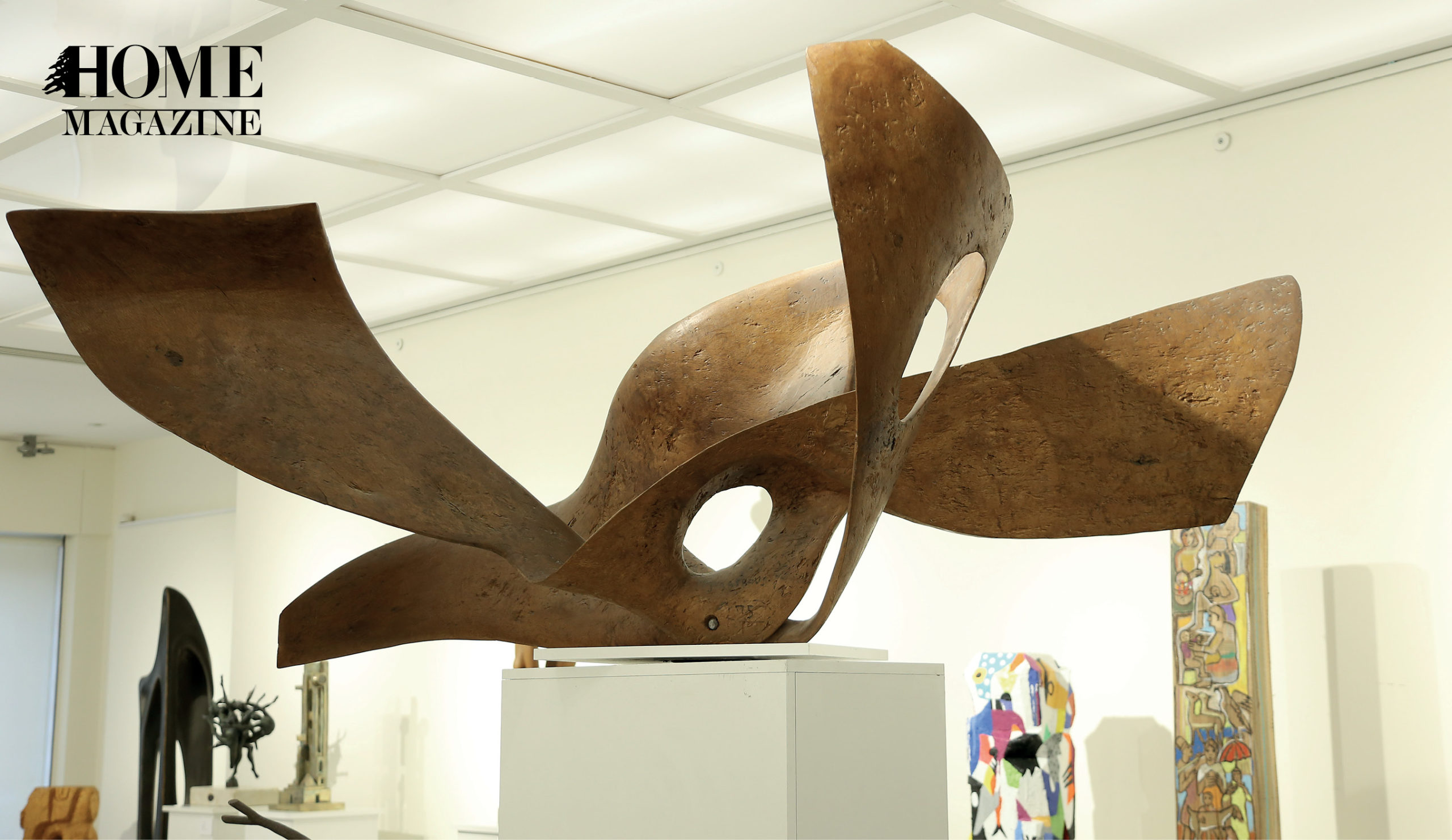
Kickstarting the series of exhibitions was “Artbook and Modern Sculpture,” which was curated by Cesar Nammour, founder of the Modern and Contemporary Art Museum.
Thirty sculptures from his museum and private collection were exhibited.
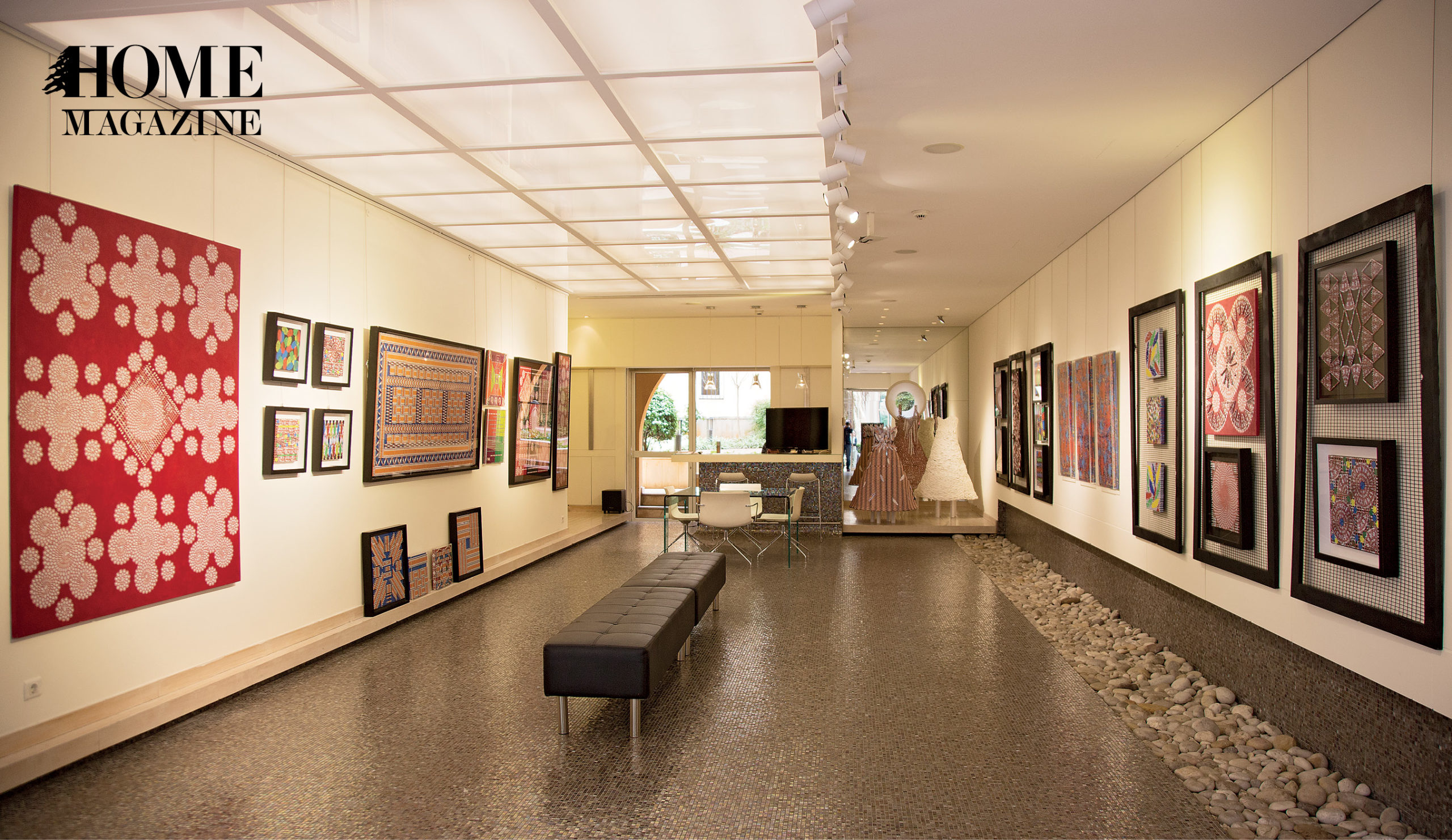
Liane Rabbath’s exhibition, “Paper Dreams,” opened at the beginning of April. In this kaleidoscopic retrospective, the Luxembourgian- Lebanese artist manifests her creative vision using an idiosyncratic material: Waraq al-Sham (natural Arabic tobacco rolling paper). Blue and orange packets conspire to create elaborate collage pieces while wedding gowns produced out of the ever-so-delicate rolling paper fold into hypnotic flowers.
Art and culture aficionados flocked to Ghaleb Hawila’s two-month show that opened on July 2. Through his homage to and inventive spin on the history of calligraphy and print, the artist’s contribution to the project will delight visitors. To collectors’ dismay, none of the exhibited creations will be for sale. Rather than a money-making venture, the foundation’s commitment toward benefiting the cultural sphere maintains its non-profit status.
SV Gallery, showcases these fledgling and established artists to the public in one of Beirut’s high-end art and design districts: The Quartiers des Arts. Situated in Saifi Village, it amasses a gaggle of boutiques, delicatessens, salons, and eateries dispersed throughout a perfectly-manicured neighborhood. Visitors and pedestrians often report feeling as if they were suddenly somewhere far outside of Lebanon while venturing through the area.
Prior to her alliance with this space, Daouk, in collaboration with Galerie Janine Rubeiz, showcased 55 Lebanese artists of all walks of life, including giants like Etel Adnan and Jamil Molaeb, to showcase their creativity at the Lebanese National Library. The book, One Hundred Years of the Press in Lebanon 1858-1958 was unpublishable due to an error made during printing. Spotting an opportunity, Daouk asked the artists to creatively reinterpret this long-forgotten book. The diverse creations resulted in the 2016 group show, Betasarof , which graced the official re-opening of the library.
“The identity of future generations depends on the preservation of a collective past.”
Now that the library has awakened from its extended slumber and reopened its doors to the public once again, questions linger with regards to its past. When and how did the library enter the public sphere? And by whose efforts? In 1919, Lebanese philanthropist Philippe de Tarrazi donated an astounding 200,000 documents for public consumption. This act of generosity was the debut of the public library, initially based within his own household. Once his residence exceeded its holding capacity, the then-called Dar Al Kitab was relocated underneath the Parliament.
For half a century, this robust literary hub enjoyed a position of cultural prominence until the Lebanese Civil War brought the establishment to a screaming halt. During this extended break, the space remained abandoned and in a state of abandon. Meanwhile, the library’s hefty collection — one of the region’s largest — remained hidden away, fated to collecting dust in storage.
The renaissance of Beirut’s only public library has been made possible through a generous donation by Qatar, and the unyielding support of the LFNL since the early 2000s. Since the turn of the millennium, the non-profit has been supporting the rehabilitation of the library.
Since its reopening in November 2018, the relocated spacious venue offers city-dwellers a quiet corner to read, study, or pore through the treasure trove of literature — away from the cacophony of the city. The library shelves a reported 7 million books. Situated in Hamra, the National Library now resides in the former Lebanese University Law School. More specifically, this Ottoman-style establishment flanks the Ministry of Interior and Sanayeh garden. Despite its strategic location, many remain unaware of this haven for bibliophiles, which contains reading rooms, an event venue, and conference halls.
HOMEland Magazine
We firmly believe that the internet should be available and accessible to anyone, and are committed to providing a website that is accessible to the widest possible audience, regardless of circumstance and ability.
To fulfill this, we aim to adhere as strictly as possible to the World Wide Web Consortium’s (W3C) Web Content Accessibility Guidelines 2.1 (WCAG 2.1) at the AA level. These guidelines explain how to make web content accessible to people with a wide array of disabilities. Complying with those guidelines helps us ensure that the website is accessible to all people: blind people, people with motor impairments, visual impairment, cognitive disabilities, and more.
This website utilizes various technologies that are meant to make it as accessible as possible at all times. We utilize an accessibility interface that allows persons with specific disabilities to adjust the website’s UI (user interface) and design it to their personal needs.
Additionally, the website utilizes an AI-based application that runs in the background and optimizes its accessibility level constantly. This application remediates the website’s HTML, adapts Its functionality and behavior for screen-readers used by the blind users, and for keyboard functions used by individuals with motor impairments.
If you’ve found a malfunction or have ideas for improvement, we’ll be happy to hear from you. You can reach out to the website’s operators by using the following email
Our website implements the ARIA attributes (Accessible Rich Internet Applications) technique, alongside various different behavioral changes, to ensure blind users visiting with screen-readers are able to read, comprehend, and enjoy the website’s functions. As soon as a user with a screen-reader enters your site, they immediately receive a prompt to enter the Screen-Reader Profile so they can browse and operate your site effectively. Here’s how our website covers some of the most important screen-reader requirements, alongside console screenshots of code examples:
Screen-reader optimization: we run a background process that learns the website’s components from top to bottom, to ensure ongoing compliance even when updating the website. In this process, we provide screen-readers with meaningful data using the ARIA set of attributes. For example, we provide accurate form labels; descriptions for actionable icons (social media icons, search icons, cart icons, etc.); validation guidance for form inputs; element roles such as buttons, menus, modal dialogues (popups), and others. Additionally, the background process scans all the website’s images and provides an accurate and meaningful image-object-recognition-based description as an ALT (alternate text) tag for images that are not described. It will also extract texts that are embedded within the image, using an OCR (optical character recognition) technology. To turn on screen-reader adjustments at any time, users need only to press the Alt+1 keyboard combination. Screen-reader users also get automatic announcements to turn the Screen-reader mode on as soon as they enter the website.
These adjustments are compatible with all popular screen readers, including JAWS and NVDA.
Keyboard navigation optimization: The background process also adjusts the website’s HTML, and adds various behaviors using JavaScript code to make the website operable by the keyboard. This includes the ability to navigate the website using the Tab and Shift+Tab keys, operate dropdowns with the arrow keys, close them with Esc, trigger buttons and links using the Enter key, navigate between radio and checkbox elements using the arrow keys, and fill them in with the Spacebar or Enter key.Additionally, keyboard users will find quick-navigation and content-skip menus, available at any time by clicking Alt+1, or as the first elements of the site while navigating with the keyboard. The background process also handles triggered popups by moving the keyboard focus towards them as soon as they appear, and not allow the focus drift outside it.
Users can also use shortcuts such as “M” (menus), “H” (headings), “F” (forms), “B” (buttons), and “G” (graphics) to jump to specific elements.
We aim to support the widest array of browsers and assistive technologies as possible, so our users can choose the best fitting tools for them, with as few limitations as possible. Therefore, we have worked very hard to be able to support all major systems that comprise over 95% of the user market share including Google Chrome, Mozilla Firefox, Apple Safari, Opera and Microsoft Edge, JAWS and NVDA (screen readers).
Despite our very best efforts to allow anybody to adjust the website to their needs. There may still be pages or sections that are not fully accessible, are in the process of becoming accessible, or are lacking an adequate technological solution to make them accessible. Still, we are continually improving our accessibility, adding, updating and improving its options and features, and developing and adopting new technologies. All this is meant to reach the optimal level of accessibility, following technological advancements. For any assistance, please reach out to