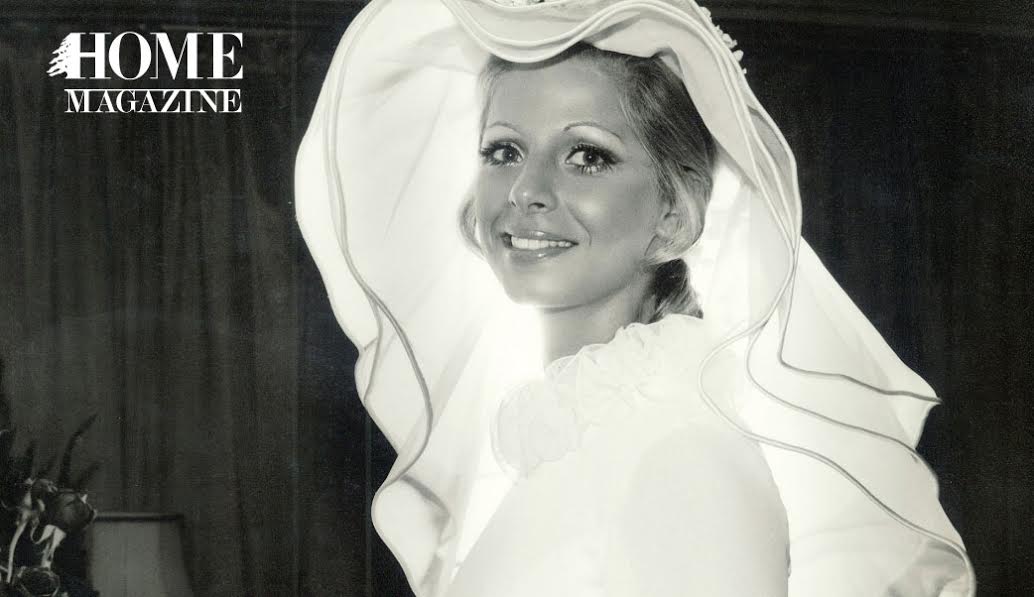
As graceful as ever, prominent Brazilian-born Lebanese socialite and charity patron Regina Fenianos sits beside the Christmas tree illuminating her always-open HOME in Jounieh, while she reminisces about her younger years with a charming smile.
Fenianos is known for being the founder and president of the Bal International des Débutantes and Green Garden Group (GGG) among many other initiatives. She arrived to Lebanon in 1971 as a glowing Brazilian beauty with her sun-kissed skin and ever-present youthful spirit.
But this is only a small fraction of her story, which she passionately shares with HOME, through a picturesque series of flashbacks, starting with her father’s emigration to Brazil when he was just 17 and her own childhood, returning to Lebanon to start a family and the impact she has had on the community.
A Father’s Unexpected Journey
Searching for a brighter future, Fenianos’ father, Karam Zgheib, who holds an incredibly special place in her heart, left Lebanon, as many did, to Marseille in the 1920s with the hope of getting to the United States and waited three months to get a boat to his dream destination: America.
“After months of sailing, everyone on board thought they were finally going to land in the United States as expected but it turned out the sailors’ definition of ‘America’ was slightly more inclusive and they ultimately found themselves in Brazil,” Fenianos told HOME.
From a 17-year-old boy who does not know anything about the country or speak the language, her father grew to start his own small business, selling coffee, confectionery and miscellaneous goods until one day a customer who could not afford paying for his purchases proposed to pay him with semi-precious stones instead.
“Since then, he was fascinated by the beauty of these stones and gradually turned his passion into a trade, first in Rio de Janeiro where he became a famous semi-precious stones and emerald trader and then across many cities around the world including New York, Geneva, London, Germany and Honk Kong,” she explained.
His wife, also of Lebanese origins, gave birth to three beautiful girls, the youngest one being Regina Fenianos, who spent her childhood studying at a private Jesuits’ school during the week and playing on Brazil’s breathtaking sandy beaches at the weekend.
An assiduous and hardworking student, she went on to earn her diploma in pedagogy from the Universidade Federal do Rio de Janeiro when she was 20, although she had already been teaching in various schools since she was 19. Her dreams of pursuing an education in Germany were interrupted when her father decided to return to Lebanon for the second time in 45 years and asked her to come with him, noting that he had always lived his life in Brazil as if he were in Lebanon, following the same gregarious lifestyle and love for life.
Lebanon: A Land of Many Wonders
“When we were still in Rio, our house was always open to Lebanese emigrants, just like a hotel, and my sisters and I would hear Lebanese people talk about Lebanon in a remarkably superlative tone,” Fenianos noted. “One grape could measure up to one finger, they would say.”
But then she got to experience the reality of it when she first visited her HOMEland alongside her father in the summer of 1971 as she helped him set up his first Lebanese office and toured many different areas, visiting relatives and friends between her native city of Byblos (Jbeil) and her hotel in Beirut.
When she returned to Brazil after her three-month visit, her elder sister was very curious to know whether Lebanese grapes really measured up to one finger each. “I thought about it for a second and quickly said ‘yes’!” That’s when her sister told her: “Regina, you now have become truly Lebanese, after just three months,” Fenianos recalled.
“We were invited to a cocktail party as part of the Lions emigrants’ conference by my mother’s cousin and ended up taking a group photo and my sister saw the picture and started asking me about each of the people in the photo. I recognized them all with the exception of one. “Little did I know that this unknown man would become my husband.” The young man was the prominent lawyer Camille Fenianos.
A RELATIONSHIP HANGING BY A SECOND
Fenianos’ father had to travel again for work and her mother returned to Brazil, making her the only one still in Lebanon. She decided to leave the hotel and join the three Brazilian-Lebanese girl friends in YWCA in Ain El Mreisseh and a love story was beginning to unfold between Camille, Lebanon and herself.
“I then had to accompany my father to Geneva but Camille would always show up at the right moment.”
She returned from Hong Kong to see him in December 1972, but she did not want to be swayed by emotions so she didn’t want to get engaged right away and asked to go back to Brazil to think clearly about it and make a decision.
He ended up sending her the engagement ring shortly after and they agreed to marry in Rio de Janeiro a few months after in presence of her family.
THE BIRTH OF THE BALL
“Out of all the memories I kept from Brazil, the debutantes ball was one of the dearest to my heart,” Fenianos explained. “It was a traditional ceremony that girls participated in once they turn 15. They wear long white dresses and dance the waltz with their fathers, it was also the first time a girl would put on makeup and wear heels.”
Constantly reminiscing about this idea, she decided to launch the first ever Ball International des Débutantes in 1998 despite the instability in the country and formed a diverse committee for this newly founded NGO made up of Lebanese women from all regions and religious confessions to run the project. Since then, the social event has grown into an eagerly awaited yearly tradition, and will celebrate its 20th anniversary in 2017.
ROYALTY
“From the first year I wanted the event to be on a large scale and was determined to have it under the patronage of a royal family member and had Prince of Habsburg from Vienna in mind. I tried using my connections to reach to House of Habsburg and ultimately found my way through the Consul of Austria Mr. Khalil Fattal who introduced me to the personal doctor of the royal family who was of Lebanese origin and got an appointment with the prince,” she explained.
“The prince called me a week prior to the event to notify me of the tragic death of his sister in a car accident. I almost collapsed, but then he said that he will still come, despite deep sorrow. He gave his word and the word of royalty is not to be reversed.”
Besides convincing the prince, she had to work hard to convince girls to participate because it was a new concept to the Lebanese society and most Lebanese fathers were not keen on the idea of getting up on stage to dance the waltz.
“In 1998, I launched the ‘Ball International des Débutantes’ , a non-profit philanthropic organization, which was registered and licensed by the Lebanese competent authorities. I decided to present all proceeds of the ball to the Lebanese Red Cross, because when I was in Brazil, my uncle was the president of Red Cross in Rio de Janeiro, and he used to organize an annual dinner to support this humanitarian organization.

Till now, the Committee of the Ball has been able to purchase 13 ambulances, each worth around $50,000 that we offered to the Lebanese Red Cross in different areas in Lebanon,” Fenianos noted.
“We have been able to purchase 13 ambulances, each worth around $50,000 that we distributed to the Red Cross in different areas in Lebanon.”
MORE THAN AN EVENT
Beside the humanitarian function of the ball, there is a strong psychological and emotional factor that comes into play when it comes to the father- daughter relationship. Many prominent men in Lebanon, including businessmen, ambassadors and ministers have taken the stage with their daughters across the years. This year the event is witnessing the second generation of debutantes for the first time.
“It is always a pleasure to me to hear fathers who have participated share their experience. It gives me great joy and delight, especially since this is a difficult age for young girls,” Fenianos told HOME. “I received the first kiss from my daughter in three years!” one father commented. It is an unforgettable bonding experience for many.
“What adds to its impact is the feedback of royals who patronize the glamorous event and then leave carrying a beautiful image of Lebanon to the world. We carefully organize their visits to Lebanon taking in all its beautiful areas and we have never had a ball without the patronage and the presence of a prince, princess or a royal couple. Even in the middle of conflicts, they always left touched by Lebanon’s warm welcome and carried the best images of this land back to where they came from.”
“We have never had a ball without the patronage and the presence of a prince, princess or a royal couple even in the middle of conflicts.”
For instance, during 2006 we did not stop the event from happening but rather transformed it into a platform for unity and solidarity. “We had a diverse group of girls from all areas in Lebanon as usual and placed a large map of the country and each girl had to place a candle on her native area as she walked in. It was a truly emotional experience proving that nothing can tear us apart as a population despite all the circumstances,” Fenianos explained. “2017 will be a special edition since we are celebrating the 20th anniversary of the ball and preparations for the event have already started. We promise to deliver something huge and continue to serve our cause and support the Red Cross.”
“Nothing can tear us apart as a population despite all the circumstances.”
In addition to working on the ball from start to finish and following up on everything from the setup to the design of the girls’ outfits, Fenianos also finds time to contribute to a better environment by creating public spaces for children through her association Green Gardens Group.
“Having studied pedagogy, I’ve always wanted to do something for children and when I had my three sons, I realized there were no public places to take them, unlike Brazil, and decided to do something about it. Green Gardens Group has so far established 19 children gardens in different areas across Lebanon and the mission continues,” she concluded.
Due to her perpetually active lifestyle, Fenianos has learned to manage her time perfectly well and still adheres to coherent sleep and travel schedules. By 7 am she’s done reading her newspaper, and her active day continues until 2am most of the time. Dreaming and realizing her dreams are her daily mottos of a healthy life.


HOMEland THEMES
Coming Soon
HOMEland Events & Collaborations
Coming Soon
 Signature Boutique