Samantha Howick Issa: Born in Montreal and living in Lebanon, she leads teacher training sessions and classes internationally. Alongside her yoga activities, she holds a BFA in Fine Arts from France and works as a painter and sculptor.
A sacred tremor is found at the core of everything. The emanating vibrations from sound help to soothe our nervous system and align us to our original nature.
{mprestriction ids=”1″}
In order to understand the idea of sound and its effect on us, we must first explore the yogic understanding of the universe, the human being and the relationship between the two.
Central to yoga philosophy is the existence of an inner pulse as the basic building block of every living particle. A life current, pulse or energy which expands in a vibrating form, which underlies and unifies our physical bodies, the activities of our mind and emotions, and all forms of consciousness.
It is the continuous expansion, the creative force, expressed as the world of matter. This pulsation continuously moves and exists as a resonance in the physical plane. It is the foundational substratum of everything in the manifested world.
A complete view of the individual self must include our physical bodies as well as our memories, thoughts, feelings, ideas, desires and impressions. Within our brain activity, there can exist areas which are not in synchronicity; for example, when we experience a trauma or have memories of anger or sadness. This causes a denser area. Energy cannot pass in a fluid, life-giving way. The result is a blocked space. The communication between our inner spaces can become blurred and muddled. These blockages may stay in the realm of memory and cause the formation of other thoughts flowing from the seeds of discomfort, or they may make their way into the physical body in the form of physical discomfort, pain or even disease.
The entire body naturally gravitates towards homeostasis. This inner harmony can be disrupted by internal or external factors. Without the harmony that occurs when the outer body synchronizes with the inner pulsation of the universe, we experience varying degrees of fragmentation. Stress causes degrees of fragmentation. Joy and love cause a movement towards harmony and synchronization of the inner landscape. They produce feelings of well-being and ease, being in tune with the inner, natural, vibratory field of the universe.

Resonance occurs when an oscillating system is driven (made to oscillate from an outside source) at a frequency which is the same as its own natural frequency.
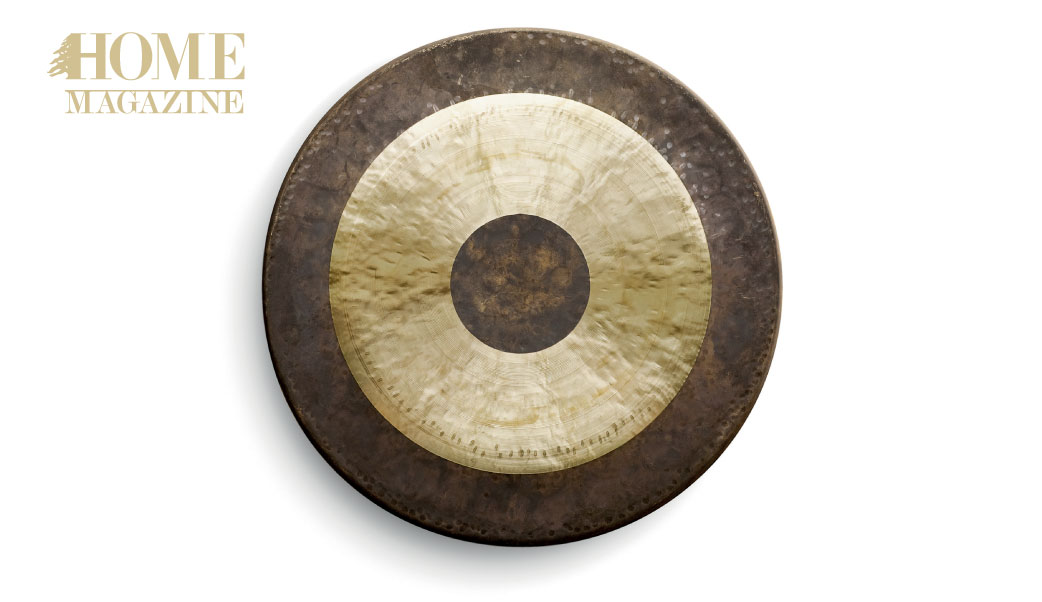
Sound not only helps with inducing relaxation, but also has a way of moving through areas of blockage. It does this by the deep sound of the gong, merging and joining the vibrations of the inner landscape of the body. So, the outer vibration of the gong joins in resonance with the pulse of the inner vibration and the block gets released by the entrance of the pulse.
Sound can produce shifts in our brainwave activity including synchronizing our brainwaves to reach a theta or a delta state where internal healing can happen. The gong is the most sublime instrument. I use it as a healing tool which soothes the nervous system and allows you to open up and develop an awareness of your true nature. The vibrations and tones will release your mind from the torrent of thoughts and stimulate your glandular system to a higher level of functioning.
“You have no resistance against this sound. It is the master sound” – Y. Bhajan
The gong is a sacred threshold. It is a portal that links the finite and the infinite.
When the cells in the body “hear” or synchronize with the rhythmical pulse of the gong, they are able to re-establish a lost sense of unity and connectedness to the perfection of their natural state. This is healing. In the mind field, the gong allows a shift in our perspective and allows us to optimize our decision-making process; therefore, we are able to lead happier lives.
Things flow more beautifully when every aspect of our self is dancing to the same grand tune of the universe. Singing bowls have a similar sound and effect to the gong, although the way they are “played” differs slightly. A gong is struck by a mallet and sometimes the mallet sweeps over certain areas to carry the sound. A singing bowl is struck for a vibration or its edges are continuously pressed in a circular motion in order to allow the bowl to “sing.” One of the largest gongs (6ft in diameter), made by Paiste, can be found in Beirut.
HOMEland Magazine
We firmly believe that the internet should be available and accessible to anyone, and are committed to providing a website that is accessible to the widest possible audience, regardless of circumstance and ability.
To fulfill this, we aim to adhere as strictly as possible to the World Wide Web Consortium’s (W3C) Web Content Accessibility Guidelines 2.1 (WCAG 2.1) at the AA level. These guidelines explain how to make web content accessible to people with a wide array of disabilities. Complying with those guidelines helps us ensure that the website is accessible to all people: blind people, people with motor impairments, visual impairment, cognitive disabilities, and more.
This website utilizes various technologies that are meant to make it as accessible as possible at all times. We utilize an accessibility interface that allows persons with specific disabilities to adjust the website’s UI (user interface) and design it to their personal needs.
Additionally, the website utilizes an AI-based application that runs in the background and optimizes its accessibility level constantly. This application remediates the website’s HTML, adapts Its functionality and behavior for screen-readers used by the blind users, and for keyboard functions used by individuals with motor impairments.
If you’ve found a malfunction or have ideas for improvement, we’ll be happy to hear from you. You can reach out to the website’s operators by using the following email
Our website implements the ARIA attributes (Accessible Rich Internet Applications) technique, alongside various different behavioral changes, to ensure blind users visiting with screen-readers are able to read, comprehend, and enjoy the website’s functions. As soon as a user with a screen-reader enters your site, they immediately receive a prompt to enter the Screen-Reader Profile so they can browse and operate your site effectively. Here’s how our website covers some of the most important screen-reader requirements, alongside console screenshots of code examples:
Screen-reader optimization: we run a background process that learns the website’s components from top to bottom, to ensure ongoing compliance even when updating the website. In this process, we provide screen-readers with meaningful data using the ARIA set of attributes. For example, we provide accurate form labels; descriptions for actionable icons (social media icons, search icons, cart icons, etc.); validation guidance for form inputs; element roles such as buttons, menus, modal dialogues (popups), and others. Additionally, the background process scans all the website’s images and provides an accurate and meaningful image-object-recognition-based description as an ALT (alternate text) tag for images that are not described. It will also extract texts that are embedded within the image, using an OCR (optical character recognition) technology. To turn on screen-reader adjustments at any time, users need only to press the Alt+1 keyboard combination. Screen-reader users also get automatic announcements to turn the Screen-reader mode on as soon as they enter the website.
These adjustments are compatible with all popular screen readers, including JAWS and NVDA.
Keyboard navigation optimization: The background process also adjusts the website’s HTML, and adds various behaviors using JavaScript code to make the website operable by the keyboard. This includes the ability to navigate the website using the Tab and Shift+Tab keys, operate dropdowns with the arrow keys, close them with Esc, trigger buttons and links using the Enter key, navigate between radio and checkbox elements using the arrow keys, and fill them in with the Spacebar or Enter key.Additionally, keyboard users will find quick-navigation and content-skip menus, available at any time by clicking Alt+1, or as the first elements of the site while navigating with the keyboard. The background process also handles triggered popups by moving the keyboard focus towards them as soon as they appear, and not allow the focus drift outside it.
Users can also use shortcuts such as “M” (menus), “H” (headings), “F” (forms), “B” (buttons), and “G” (graphics) to jump to specific elements.
We aim to support the widest array of browsers and assistive technologies as possible, so our users can choose the best fitting tools for them, with as few limitations as possible. Therefore, we have worked very hard to be able to support all major systems that comprise over 95% of the user market share including Google Chrome, Mozilla Firefox, Apple Safari, Opera and Microsoft Edge, JAWS and NVDA (screen readers).
Despite our very best efforts to allow anybody to adjust the website to their needs. There may still be pages or sections that are not fully accessible, are in the process of becoming accessible, or are lacking an adequate technological solution to make them accessible. Still, we are continually improving our accessibility, adding, updating and improving its options and features, and developing and adopting new technologies. All this is meant to reach the optimal level of accessibility, following technological advancements. For any assistance, please reach out to