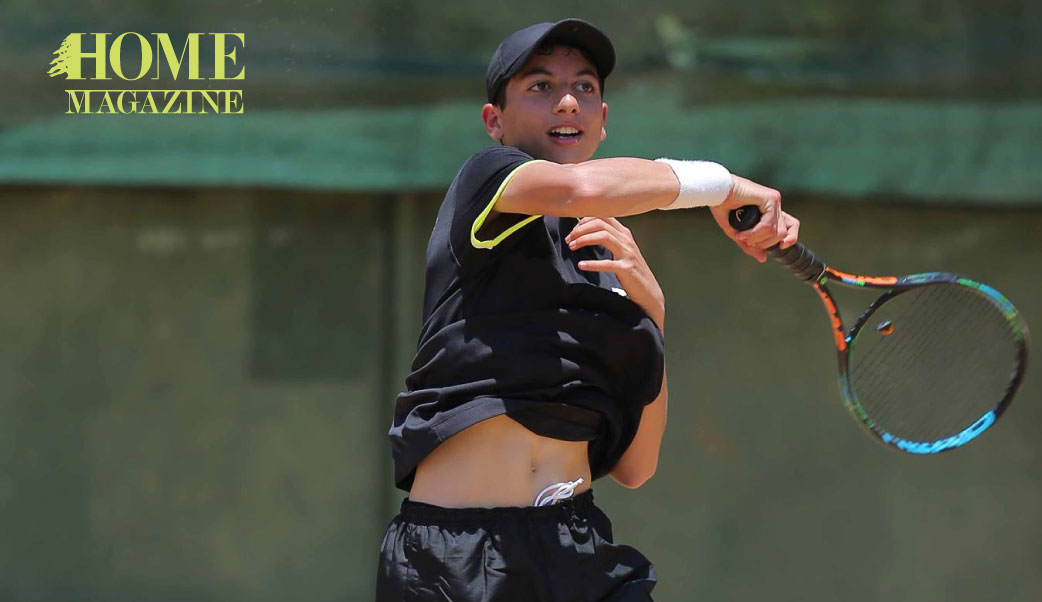
Roy Tabet is a 14 year old Lebanese tennis champion.
Driven by his passion and commitment, Roy Tabet was selected by the Lebanese Tennis Federation to represent Lebanon in the Junior Davis Cup which was held in Sri Lanka from 12 to 17 March 2016. Roy Tabet was also victorious in the Mont La Salle Under 18 Tennis Tournament in April 2016 as well as in the ATCL inter-members tournament in the men’s single and doubles categories where he won 1st place in both competitions. Juggling between his professional athletic life and his academic life, Roy Tabet is a great example of how one can achieve his/her dreams if one puts their all into it.
Your trophies have started accumulating since the age of 12. What initiated your love for tennis at such an early age?
When I was 2 years old I used to watch my father play tennis; he is a decent club player. I started to secretly imitate him at home by hitting lemons with kitchen utensils. The coach at the club, Roger Saliba, sensed my passion for the game and convinced my parents to get me started at an unusually early age. So I had the chance to acquire the proper technique from the start. However usual coaching for children stressed on keeping the ball in play; that was not enough for me. I wanted to hit hard and I wanted my shots to look good. Of course at the beginning I was hitting all over the place. Gradually, I learned to tame my shots and at 12 I was playing more aggressively than most kids of my age. That probably made the difference at this point.
How difficult is it for you to juggle between your academic life and your athletic life?
It’s very difficult. You know how elitist the education system is in Lebanon. And you know how demanding and stressful our curriculum can be. I have to juggle constantly between the two. It’s all a matter of priorities. And sometimes negotiation with the school that is not always aware of the level of commitment any sport requires from my part. You can visually describe it as juggling on a highwire all at the same time. I am inclined to scientific subjects, so that helps me with my results at school.
Do you think of pursuing tennis as your main occupation after you graduate from school or do you want to pursue a traditional path in education?
That is the question. I want to pursue a professional career. However I am realistic about it. Only a few players can successfully make a living from tennis and it is getting extremely competitive. So the smart choice at this age is to keep my options open. Keep on training hard, and we’ll see.
Where do you see yourself in ten years?
I see myself integrating in a good American university where it is easier to study and keep playing high level tennis. The right decision will probably come at the right time. I cannot, nor anyone else for that matter, guess where I will be in 10 years. However if you train as hard as I do and are passionate about it, well the sky is the limit. This is not arrogance, this is passion.
What hobbies do you have other than tennis, and do you have time to nurture those hobbies?
I used to be good at football. But it’s best not to dilapidate time nor effort in too many directions. If I want to be competitive I have to concentrate on my main sport. So I play tennis, watch tennis, dress tennis, dream tennis, breathe tennis.

Do you have time to see your friends? How do you cope with staying in touch?
Some of my friends are excelling at different sports. So we kind of have the same schedules and time constraints. But we still manage to get together from time to time. Social media helps me to stay in touch when sometimes each of us is in a different country.
What advice would you give for teenagers your age who have an infatuation for a certain hobby?
Dream big. Train hard and let the sky be the limit. Otherwise it’s not worth it.
Did you always receive support and encouragement towards your professional pursuit of tennis?
When results started to show, I received more and more encouragement. I am of course weighing professional advice from my coaches very heavily. Their opinion is the one that matters. They can spot talent, they can sense passion, they can judge the effort put into training and they alone can clearly evaluate the rate of progress.
What did your family offer you that you think contributed to the success you are having?
Everything. Absolutely everything. Starting with the means to get the best training, to the logistics of getting there and on time. But most importantly, their belief in me. My father being himself a tennis addict recognized my predispositions for the game and also my sheer passion for it. But being my father, he was afraid of being biased in his assessment. So he made sure to confirm his opinion with the help of knowledgeable professionals. When they did confirm his views he made sure to open all the doors for me to pursue my dream. At that point my mother, who was rather reluctant at first, “he’s not studying enough”, joined the cheerers. She is now, along with my sister, my most supportive fan base joining me in all tournaments whether at home or abroad. So my family’s trust in me and their unwavering support is the essential ingredient in my success.

In times of failure, did you ever think to quit being a tennis player?
Absolutely not. In any competitive sport environment, it’s in times of failure that your determination to improve gets heightened. Learning from your mistakes is the best way to move ahead. The saying “what doesn’t kill you makes you stronger” applies superbly in tennis. So definitely not. Challenge helps me keep the focus on the longer run.
Do you have an idol that you look up to or that made a difference in your life?
I used to idolize Roger Federer. His talent, elegance and court demeanor. He makes tennis looks so easy! This is actually quite misleading. One forgets how much effort he put in order to get there. He did not just wake up one morning and start playing this way. However lately I came to appreciate Novak Djokovic. He does not have the innate talent and “touch” as we say in tennis jargon, but he compensated for it with hard work and willpower. Discipline, determination and amazing mental strength. So at this stage of my career, he is my idol. Especially after being to Serbia and knowing how much he is idolized over there not only for his tennis achievements but also for his humility, humanity and all the social good he undertakes. So he really sums up what my father taught me in Latin: “Mens sana in corpore sano”, which means, a sound mind in a sound body. This is what sport is all about. A school of life.
HOMEland THEMES
Coming Soon
HOMEland Events & Collaborations
Coming Soon
 Signature Boutique