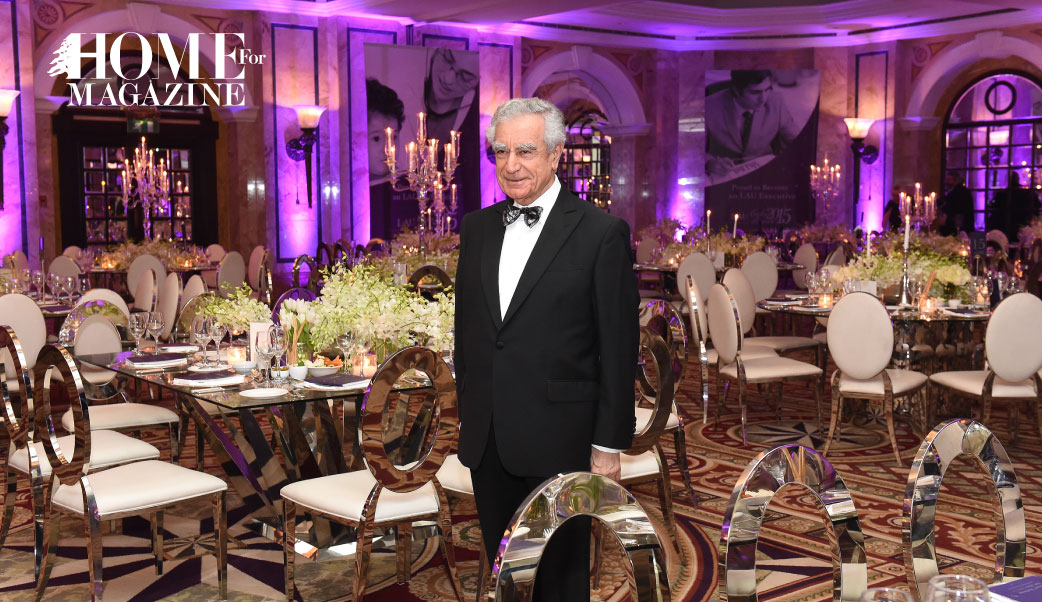
“Wherever you are, whatever you do, don’t forget LAU.” This slogan is known among Lebanese American University students and alumni as something LAU President Joseph G. Jabbra often says. He never forgot Lebanon and came back HOME after 40 years abroad to lead the expansion era of one of its leading universities.
“I always had the idea of coming back HOME not only in the back of my mind but in my heart as well,” said Dr. Joseph G. Jabbra, president of the Lebanese American University, who lived and worked in Canada and the United States for much of his adult life. “I was born and raised here. I went to school here. I really want to serve this country that has given me the best gift in life, which is life itself,” said Jabbra, in an interview in his office at LAU’s Byblos campus, where on-going construction and renovation attest to the university’s growth under Jabbra’s lead.
LEAVING LEBANON
“When I graduated (from Universite Saint–Joseph with a degree in law), the war was raging here,” said Jabbra. He decided to enroll in a Ph.D. program in political science at the Catholic University of America in Washington, D.C. “When I went to the U.S., I didn’t speak a word of English and at the end of the first semester, I received a full scholarship for my Ph.D.,” said Jabbra.
He said he has been blessed with an incredible memory that has been key to his academic success. The ability to “carry an incredible amount of knowledge in my head” has also led to him being known as one of Lebanon’s best orators. From his early school days, he was often chosen to speak, a talent that has shown throughout his life. Coming from a Bekaa village near Zahle, Jabbra’s family had land and properties and his uncles had expected him to take on the responsibility of caring for them.
However, academia was in his future. In the Catholic schools he attended as a child, the Sisters insisted Jabbra pursue education.
“I loved the classics,” said Jabbra. “I was enamoured with Greek, Latin and Roman civilizations. In highschool, we studied Roman law and that is when I fell in love with law.”
Studying in both Lebanon and the U.S. proved to be very beneficial, Jabbra said. Comparing the two educational systems, he noted the American system gives more attention to the growth of an individual and the education of the whole person. That approach has influenced him as an educator. “I care for young people. They are very fragile and they need to realize that someone is listening to them, someone who cares about their future,” explained Jabbra.
After completing his Ph.D., Jabbra decided to dedicate his life to teaching. He taught full-time for two years before he was recruited into administration. He soon rose to be Vice President of Academics and Research at St. Mary’s University in Halifax, Nova Scotia, Canada, from 1980 to 1990. He also continued teaching. In 1990, he and his wife Nancy moved to Los Angeles, California where Jabbra served as Academic Vice President at Loyola Marymount University from 1990 to 2004. In his 40 years abroad, Jabbra and his family visited Lebanon almost every year for about two weeks.
The thought of returning was always in his mind, he said, but in the meantime he was developing ties with his new home. “In America, no one said, ‘You are not American.’ They would give you a chance because you deserved it, without any discrimination. That’s the secret of America. It is like a sponge. Anyone who is qualified, will find a place in the U.S. to contribute to building the society.”

COMING HOME
In 2004, a search committee from LAU contacted Jabbra. “I was happy in California, but when they mentioned that the position was in Lebanon, my ears perked up,” he said. He met with the committee in New York and by the time he arrived back in California, his wife told him there was a message for him. It was an invitation to visit LAU in Lebanon.
“I’ve been here for 12 years now, working with my colleagues. We built the university up through our collective determination and because of a vision to serve. We consider ourselves part of this society. We provide the opportunities for young people to excel and the university has really become an empire,” said Jabbra.
LAU has two campuses in Lebanon, one in Byblos and the other in Beirut. It also has a major center in New York, only two blocks away from the United Nations Headquarters.
Its School of Pharmacy is the only one outside the United States accredited by the Accreditation Council for Pharmacy Education (ACPE). Other internationally accredited programs include five of its engineering programs, its computer science program, its School of Architecture and Design (in France) and its nursing program. In addition, LAU as an institution is accredited by the New England Association of Schools and Colleges (NEASC), a U.S. accrediting agency.
“LAU is an institution that has standards recognized by international agencies in the world, and you should see our alumni. This is the spirit we were able to instill in our people; the spirit of really caring for others and giving back,” said Jabbra.

LAU Model United Nations
According to Jabbra, LAU has many things to be proud of and he highlighted the Model United Nations program as one of them. It brings a culture of global awareness; it allows students to take the roles of ambassadors and negotiate world problems with other delegates and seek solutions.
“We have 25,000 to 30,000 students coming to our campus to be trained in negotiation and diplomacy.”
“In the media, Lebanon is presented to the world as a country of killing and destruction. But here our Lebanese students are teaching students from all over the world the art of diplomacy, and negotiation.”
Jabbra has been invited twice to speak at the U.N. “I went into the General Assembly of the United Nations and I looked at the walls. They were all covered by the Lebanese and the LAU flags, and I cried,” he said. It was the first time a president of a university would give a speech at the U.N. General Assembly. He gave his second one not too long ago.
Looking forward
Education is service, said Jabbra. “We are not living for ourselves; we are here to serve others.” We need to adopt this philosophy in Lebanon to build our future, Jabbra suggested. “We need to keep the interests of our country in mind before all other interests. I’m sorry to say, we are not doing that in Lebanon.”
This where the rule of law comes in. According to Jabbra, it is absolutely essential for the success of any society. ”No one should be above the law”. This policy is very important in nation building. “We do so well individually, all over the world”, Jabbra said of the Lebanese. But our future success depends on what we can do together.
”No one should be above the law”
“It doesn’t really matter whether you are a Christian or Muslim, Sunni or Shia. What is really important is whether or not you have contributed to the building of the society or the community. I think all schools and families need to guide their sons and daughters towards this very important direction.”
Jabbra described himself as the eternal optimist. “In spite of all the problems we live with, it is still a beautiful country.“ His hope, he said, lies in “the young people. They are bright and intelligent.” Working together with young people is a way to improve this country, he added.
“In LA, I was at peace but not happy, in Lebanon I am not at peace but I am happy” Jabbra concluded.



HOMEland THEMES
Coming Soon
HOMEland Events & Collaborations
Coming Soon
 Signature Boutique