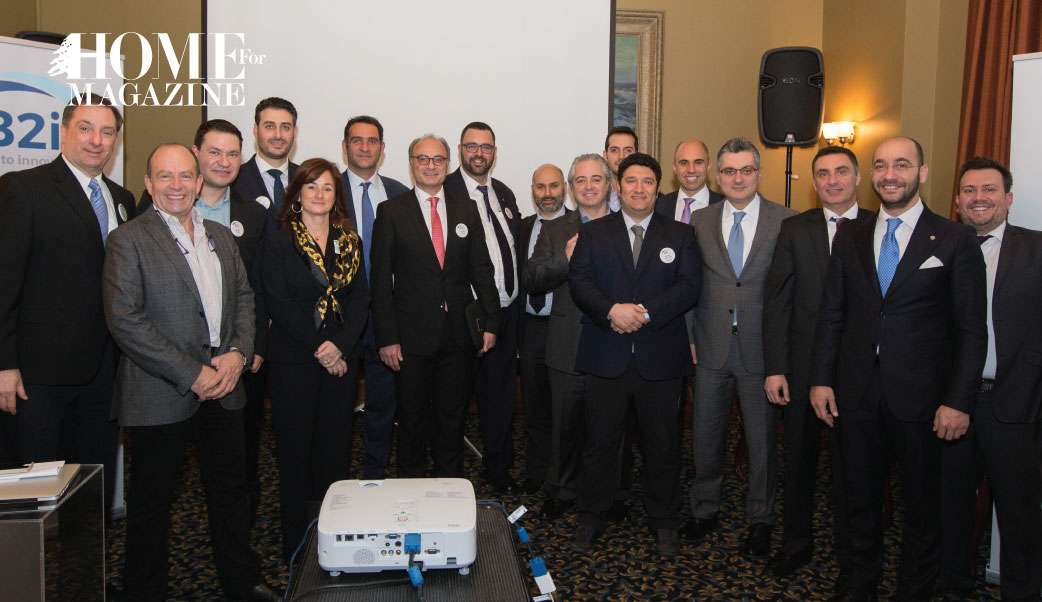
A new initiative was launched to incite partnerships between Canadian and Lebanese businesses.
There is approximately 8,685 Km between Beirut and Montreal. It was somehow abolished on March 9, 2016. As if by a magic wand this distance was metaphorically, if not physically, removed by determination and commitment, which have fostered fertile links between the native country and the new homeland.
Under the roof of the Montreal city hall, Berytech (Lebanon) signed a Memorandum of Understanding for the Bridge to Innovation (B2i) Program with the Lebanese-Canadian Information Technology Association in Montreal. Berytech has partnered with the Lebanese-Canadian Information Technology Association to help spark teamwork between businesses in IT, innovation and new media sectors. Berytech is a leading organization in the entrepreneurial ecosystem in Lebanon offering a vibrant environment for entrepreneurs to create and develop startups and small to medium enterprizes (SMEs).

“Bridge to Innovation’’ is an initiative launched by The Lebanese-Canadian Information Technology Association back in June 2015 under the patronage of the Lebanese Minister of Foreign Affairs and in collaboration with Mr. Fadi Ziadeh, the Consul General of Lebanon in Montreal. The purpose is to incite partnerships between Canadian and Lebanese businesses through the transfer of knowledge and technology. The Canadian-based association has been active since 2008 with its activities ranging from networking, integration to coaching and mentoring.
‘’The consulate general of Lebanon in collaboration with B2I, aims to promote Lebanon as a digital hub and help Lebanese and Canadian entities engage with each other in view of potential future cooperation. The interaction expected from this event here in Montreal will act as a catalyst to this objective by bringing people together and offering the chance of direct contact and eventual engagement,’’ declared Mr. Fadi Ziadeh, Consul General of Lebanon in Montreal in his opening speech. The Berytech delegation of 11 Lebanese entrepreneurs participated, during their stay, in a series of networking activities. They visited a high tech data center in Montreal and the “Centre d’entreprises et d’innovation de Montréal”. Canadian and Lebanese startups discussed upcoming opportunities and market needs in view of future collaborations. The Lebanese group was also hosted by the Canadian Lebanese Chamber of Commerce & Industry – Ottawa Section in Montreal.
On March 9, as the guests savoured Lebanese wine and Canadian cheese, Montreal city hall buzzed with potential partnerships on virtual and non-virtual projects. Powerful synergies were in motion between both Lebanese groups; a series of possibilities were explored with tremendous excitement and sincerity.
With Montreal being a “smart” city as stated by Harout Chitilian, Vice President of the City’s Executive Committee responsible for information technologies, and Beirut being a niche for talent, innovative collaborations should kick off very soon.
Anyone can build a structure. Nonetheless, when this structure has a soul nurtured by the roots of belonging to Lebanon, the bridge will undoubtedly become a rocket.

A FEW FACTS
Courtesy of the Consulate General of Lebanon in Montreal
“Lebanon occupies the fifth place worldwide for quality of math and sciences education.”
- Lebanon has an active start-up environment, marked by the proliferation of clusters, incubators, accelerators, Venture Capital funds, financial, legal and development initiatives, and the emergence of a number of promising Lebanese start-ups going global.
- Lebanon’s ICT sector is fast-growing, with a 2014 market size of $400 million that is expected to reach $550 million by 2017. The sector has grown by an average annual rate of 7.5% over the period 2009-2015, and is expected to grow at a compound annual growth rate of 8% from 2015 to 2018.
- The Lebanese Central Bank issued in 2013, Circular 331 which created a financial platform of potentially $400 Million of equity financing for start-ups, incubators, accelerators and any company working in the knowledge economy.
- Lebanon provides companies engaged in the technology sector with a set of fiscal and financial incentives including tax exemptions on corporate income tax along with administrative and facilitation services.
- The Lebanese Ministry of Telecommunications launched the “Lebanon 2020 Digital Telecom Vision”. This project is a five year plan which aims to revamp the telecom infrastructure in the country. It aims to make fiber-optic connectivity as well as 5G connections available throughout the country by the year 2020.
- Lebanon occupies the fifth place worldwide for quality of math and sciences education while it ranks 28th worldwide for the quality of its overall educational system and has the highest concentration of universities in the region with 41 universities.
- Lebanon’s innovative power depends on its human capital, a well-educated, skilled, trilingual and creative workforce, accessible at a competitive cost; The Lebanese workforce enjoys competitive labor prices nearly 50% lower than in selected developed economies.



HOMEland THEMES
Coming Soon
HOMEland Events & Collaborations
Coming Soon
 Signature Boutique