The roads of China and the Mediterranean countries are converging once again. Some 2,200 years extend from the era of the Han Dynasty in China until the fourth industrial revolution and information age of the 21st century. Yet, the jingles and chimes of ancient trade and commerce still resonate loudly today for modern China as the country’s past glory still looms large.
The ancient Silk Road dates back to the Han Dynasty. It is argued that the 16 centuries of trade between East and West have had an immense impact on the development of world civilizations. As such, its consequences reached far beyond economics and trade, going so far as shaping the cultural landscape of that epoch — to some extent. The thought-provoking question here is: Will the recent Chinese Belt and Road Initiative (BRI) — the modern version of the Silk Road — play a similar role in shaping the global supply chain, and other social and political arrangements established since World War II?
The BRI, introduced by China in 2013, seems so pervasive that it engulfs nations all the way from Southern Asia to Western Europe. This ambitious effort aims to foster regional cooperation and connectivity on a trans-continental scale. China also wishes to strengthen its trade and investment links with nearly 70 countries that collectively account for over 30 percent of global output, 62 percent of population, and 75 percent of world energy reserves, according to World Bank estimates.
The BRI’s spillover effects are surely expected to be far reaching with implications to various industries and economic sectors. This will require a massive overhaul of existing trade, financial, and transport infrastructure. For instance, it is estimated that average shipping time would be drastically reduced, thereby lowering trade transaction costs and boosting trade. The end result of this endeavor is hoped to create jobs, reduce poverty, and foster regional and global economic growth and prosperity. However, the initial cost for involving that many countries could reach an astronomical $8 trillion, mainly in infrastructure investments.
Besides economic growth, the BRI is said to confer other benefits like encouraging environmental sustainability, increased transparency, open procurement, and better risk assessment in project selection. The positive impact has already been felt in a number of countries, such as Kazakhstan and Senegal.
For obvious geopolitical reasons, the BRI initiative is not welcomed by the United States. Such an arrangement would introduce further challenges to America’s trade, economic, and political interests globally. Recent BRI forums have attracted noticeable global attention. In fact, the second forum held in China in April 2019 was attended by representatives of 150 countries, including 37 presidents, nearly a dozen countries from Latin America, as well as prominent international organizations. The International Monetary Fund (IMF), which was also present, launched the China-IMF Capacity Development Center in 2018 to train country officials in implementing the next phase of the BRI.
But, what’s in it for the Arab region, including Lebanon? What benefits can the region reap? And what challenges will it encounter in view of this new initiative?
The BRI is touted as a mutually-beneficial undertaking to China and the Arab region alike. The Levant is set to become China’s West-Asia economic corridor. The Gulf Arab countries, and the UAE in particular, will serve as a pathway to Africa’s markets. Moreover, the Suez Canal in Egypt is central for China’s maritime shipping, with more than 60 percent of exports to Europe traversing this passageway.
Overall, many economic sectors are expected to benefit from the sea route that will connect China’s coastal regions to Europe passing through the Middle East and North Africa (MENA) region. Establishing this route is an estimated $1 trillion endeavor — of which the transport and telecommunication related sectors, including road networks, ports, railways, and airports, will be the main potential beneficiaries.
Trade
China is the second-largest trading partner for the Arab region with an estimated $190 to $200 billion trade turnover. Around 16 percent of the region’s total imports come from China, according to Arab Monetary Fund’s data. In addition, 10 percent of total regional exports go to China alone. For scale, the region exports a similar share to all 28 countries of the European Union combined. Further, more than half of China’s oil imports come from the MENA region, with trade between them estimated to skyrocket from its current $300 billion to $500 billion by 2020.
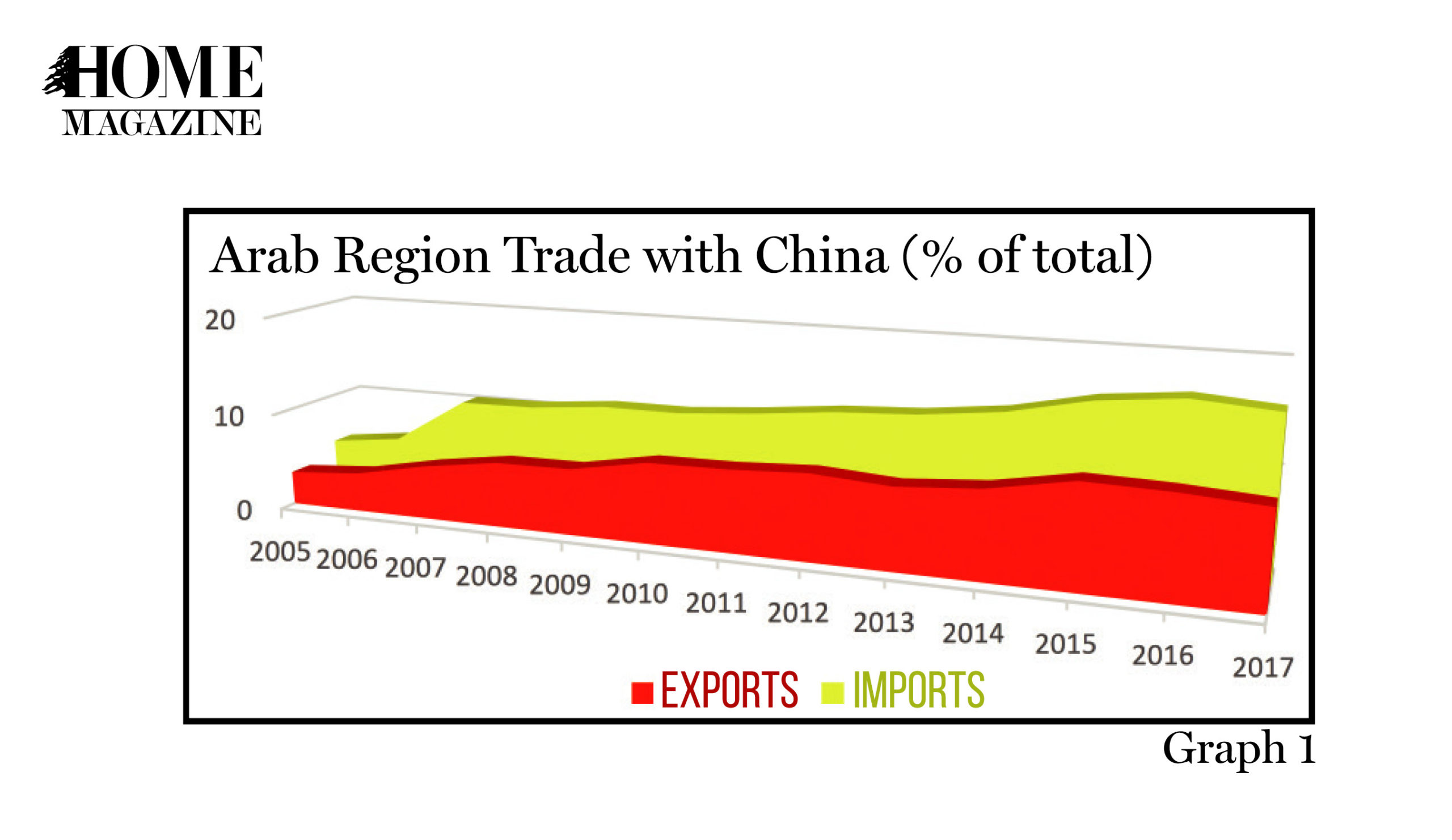
As shown in Graph 1, the Arab region’s trade with China has been steadily increasing in the past recent years, with imports from China consistently higher. For instance, China’s share of the region’s total exports rose to 9.5 percent in 2017, compared with a mere 3.4 percent in 2005. Likewise, nearly 16 percent of the region’s imports in 2017 were sourced from China, compared with about 5 percent in 2005.
Investment
China is considered the largest investor in the Middle East with its direct investment in Arab countries estimated at $1.26 billion in 2017.
Figures of the Arab Investment Export Credit Guarantee Corporation reveal that China now holds nearly a third of the FDI stock in the Arab world. Further, the Economist magazine reports that the Chinese money is behind some of the Arab world’s biggest projects from ports in Oman, factories in Algeria, and skyscrapers in Egypt. According to the same source, China pledged $23 billion in loans and aid to Arab states and signed another $28 billion in investment and construction deals in 2018. Chinese venture capitalists and other investors are already investing heavily in hospitality, tourism, technology, logistics, and financial technology sectors.
In order to foster economic and trade ties, the two parties have been elevating their level of cooperation in the past few years. The China-Arab States Cooperation Forum (CASCF) held in 2018 emphasized that the strategic partnership will include economic as well as human capital and will parlay economic development to tackle the security and humanitarian issues of the region. During the second China-Arab Forum on Reform and Development held in April 2019 in Shanghai, most Arab countries clinched BRI deals with China.
Closer to HOME, China is eyeing the reconstruction of Syria, expecting to take a relatively sizable share of the $400 billion reconstruction cost. Lebanon is poised to benefit handsomely if it grasps the opportunity. The China Council for the Promotion of International Trade (CCPIT), has already opened an office in Lebanon to improve ties with the country. For one, Tripoli is targeted to be a special economic zone and a trans-shipment hub for the eastern Mediterranean. Plans to reconstruct the Tripoli-Homs railway network are in the works. Lebanon sits at a crossroads on the modern Silk Road. The right path is very clear and Lebanon can no longer tiptoe into realizing economic prosperity.


HOMEland THEMES
Coming Soon
HOMEland Events & Collaborations
Coming Soon
 Signature Boutique