
HOMEland
Coming Soon
HOMEland Events & Collaborations
Coming Soon
 Signature Boutique


Last week I was in Paris, walking near the Champs-Élysées, and suddenly I heard a familiar tune blaring on loudspeakers. I veered off my path to get closer. It was unmistakable. The Lebanese national anthem was playing. I looked around. Lebanese and French flags were everywhere along the Champs for several miles and the street was blocked to traffic. Cops were everywhere. I sent videos to my friends and asked them, “Did you tell the French government I was coming?” They gently let me down by saying that actually the Lebanese president was visiting.
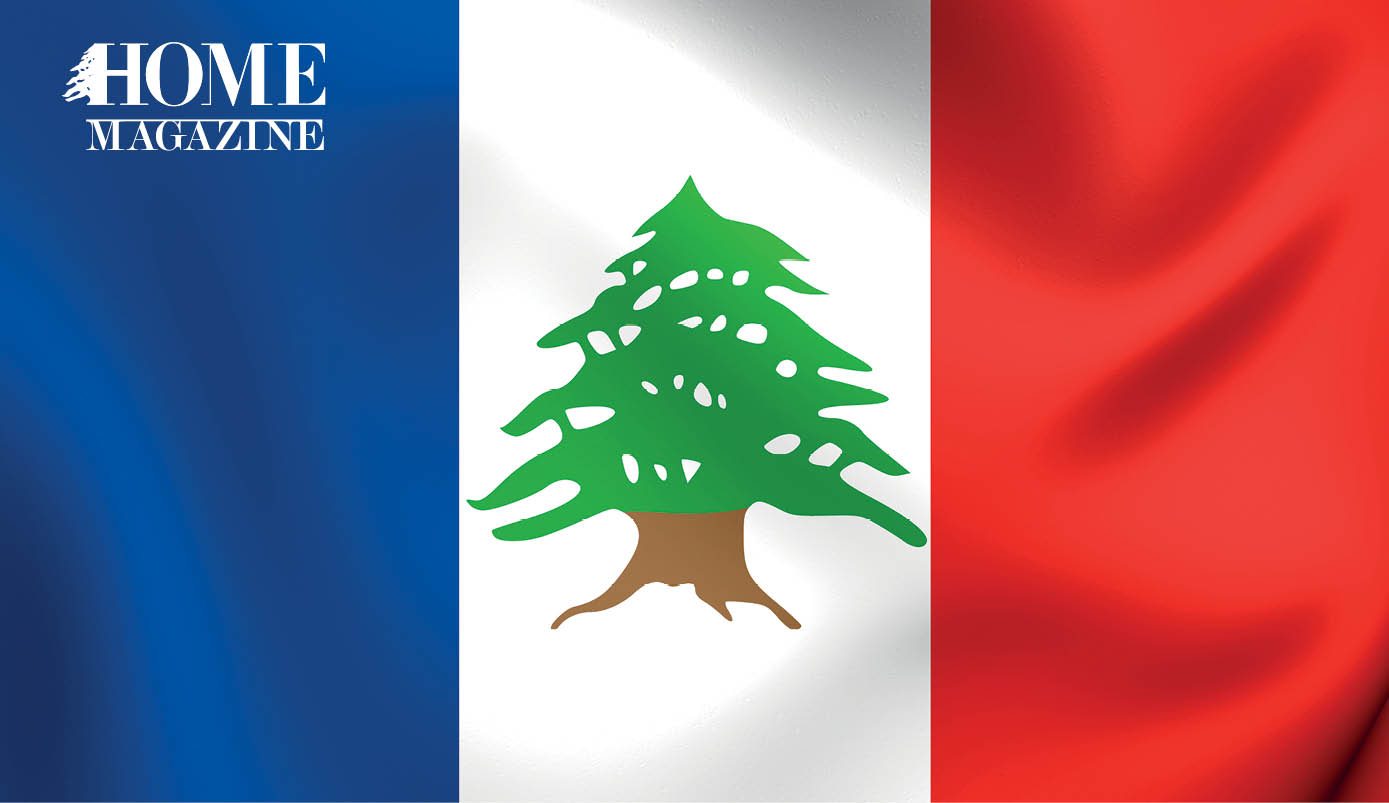
There is a long and close relationship between Lebanon and France that goes back to the colonial days a century ago. The French didn’t consider it colonial — they called it a mandate. In fact, the first Lebanese flag in the 1920s was an exact replica of the French blue, white and red vertical stripes, with a green cedar tree in the middle. The current Lebanese president had spent 15 years in exile in France, so his reception in France rivaled that of a leader of any of the most important nations.
Hundreds of soldiers marched in tight formation. Others were on horseback. I couldn’t help but beam at the whole brouhaha. Despite the approximately 100,000 Lebanese living in France, only a dozen people were carrying the Lebanese flag. Maybe they were too busy that day. I soon lost interest as well and went to my regular café-trottoir in the Étoile area. As I sat there, I saw a familiar face sitting on the sidewalk. I remembered her from a previous trip a couple of years ago.
“Having grown up in Beirut in the turmoil of the Civil War, we just adapted and carried on living our lives.”
Life sometimes hits you with bad timing. Like when I was in Paris in 2015 after a brutal terrorist attack. Soldiers with full battle gear were all over the city, near the Eiffel Tower, the Arc de Triomphe, the Champs-Élysées … everywhere.
Of course, it was not the absolute worst timing. I could have been one of the dead victims, for example, or survived it but ended up with a lifelong disability. Maybe a vegetable, plugged into a medical device, while my loved ones decide if they should pull the plug on me.
Having grown up in Beirut in the turmoil of the Civil War, we just adapted and carried on living our lives, as some brave Vermonter might after an especially strong snow storm.
During the Lebanese Civil War, a reported 3,641 car bombs went off, an average of about one a day, seven days a week — the Car Bomb god didn’t rest on the seventh day. Since the end of the war, this type of thing occurs far less frequently, but just enough to disrupt any illusion you might have had that you’re living in a normal country.
The day before the attack in Paris, we had one here in Beirut. Four suicide bombers tried to blow themselves up in the dense ghetto in a southern suburb of the capital. Two succeeded.
The day before the attack in Paris, we had one here in Beirut. Four suicide bombers tried to blow themselves up in the dense ghetto in a southern suburb of the capital. Two succeeded.
In Paris, I still wanted to do the touristy stuff, like taking pictures in front of their beautiful landmarks. The armed soldiers didn’t find that in good taste. They didn’t say anything, but I could feel it. I couldn’t really blame them. They had their priorities and I had mine. I was even tempted to go shopping in a mall, so the terrorists don’t win, as we had been instructed when I lived in New York 14 years earlier.
Later that afternoon, I had a meeting at HEC, the top business school in Paris. They had unarmed security personnel at the door, searching bags. They reminded me of Tony the Tiger on Frosted Flakes cereal boxes. I asked the guy searching my backpack what he would do if he found a bomb or gun in my bag. Would he tell me, “Excusez-moi, Monsieur. You’re not allowed to bring that in here.” He laughed and said they were conducting searchers to make people feel safer.
“But I knew better — Paris would be just fine.”
I found that logic weird, although in Lebanon we do something similar. In all the mall parking lots, unarmed security guards carry a hand-held electronic device with a large antenna that is supposed to detect explosives or weapons. They point it parallel to the car and walk by slowly. It’s supposed to beep or become erect or something when it detects explosives. People who know better call it the “magic wand” because it doesn’t really work.
The security guards in my old office used the magic wand every morning when I drove into the parking lot, to show that they don’t make exceptions for anyone, no matter how senior.
Except when it was raining — when they would just stay under the concrete canopy on the side of the parking entrance, surfing on their smartphones.
That evening, I was sitting in my regular café-trottoir in Étoile, people watching. Paris is such a cosmopolitan city. You see people from all over the world, speaking every conceivable language, going about their business, hanging out in coffee shops or having dinner. A good proportion of veiled women and their men were walking around, freely speaking their native tongue, with guttural sounds in sharp contrast to the polished French. Nobody gave them a second look.
There were no ubiquitous French flags, neither on apartment windows nor on baseball caps. The French don’t even wear T-shirts with their “Grandes Écoles” insignia, their counterparts of Ivy League schools. Had you not heard the news earlier and seen the armed presence, you might not have even realized what had just occurred.
One veiled woman was sitting on the ground against a tree on the opposite side. She was on a narrow part of the sidewalk, blocking half of it, slowing pedestrian traffic in an ambush attempt at the resulting bottleneck. She was begging for change as people passed. I couldn’t help but notice that the people who looked like her, including me, just kept on walking by. The “real French” would stop and give her a coin or two.
Several months later, elections for president of France would come up. After Brexit and Trump, people were afraid that France would go the way of Great Britain and the United States, and then a domino effect would break up the European Union. But I knew better — Paris would be just fine.
 Signature Boutique
Lebanon, in your inbox

HOMEland Magazine
We firmly believe that the internet should be available and accessible to anyone, and are committed to providing a website that is accessible to the widest possible audience, regardless of circumstance and ability.
To fulfill this, we aim to adhere as strictly as possible to the World Wide Web Consortium’s (W3C) Web Content Accessibility Guidelines 2.1 (WCAG 2.1) at the AA level. These guidelines explain how to make web content accessible to people with a wide array of disabilities. Complying with those guidelines helps us ensure that the website is accessible to all people: blind people, people with motor impairments, visual impairment, cognitive disabilities, and more.
This website utilizes various technologies that are meant to make it as accessible as possible at all times. We utilize an accessibility interface that allows persons with specific disabilities to adjust the website’s UI (user interface) and design it to their personal needs.
Additionally, the website utilizes an AI-based application that runs in the background and optimizes its accessibility level constantly. This application remediates the website’s HTML, adapts Its functionality and behavior for screen-readers used by the blind users, and for keyboard functions used by individuals with motor impairments.
If you’ve found a malfunction or have ideas for improvement, we’ll be happy to hear from you. You can reach out to the website’s operators by using the following email
Our website implements the ARIA attributes (Accessible Rich Internet Applications) technique, alongside various different behavioral changes, to ensure blind users visiting with screen-readers are able to read, comprehend, and enjoy the website’s functions. As soon as a user with a screen-reader enters your site, they immediately receive a prompt to enter the Screen-Reader Profile so they can browse and operate your site effectively. Here’s how our website covers some of the most important screen-reader requirements, alongside console screenshots of code examples:
Screen-reader optimization: we run a background process that learns the website’s components from top to bottom, to ensure ongoing compliance even when updating the website. In this process, we provide screen-readers with meaningful data using the ARIA set of attributes. For example, we provide accurate form labels; descriptions for actionable icons (social media icons, search icons, cart icons, etc.); validation guidance for form inputs; element roles such as buttons, menus, modal dialogues (popups), and others. Additionally, the background process scans all the website’s images and provides an accurate and meaningful image-object-recognition-based description as an ALT (alternate text) tag for images that are not described. It will also extract texts that are embedded within the image, using an OCR (optical character recognition) technology. To turn on screen-reader adjustments at any time, users need only to press the Alt+1 keyboard combination. Screen-reader users also get automatic announcements to turn the Screen-reader mode on as soon as they enter the website.
These adjustments are compatible with all popular screen readers, including JAWS and NVDA.
Keyboard navigation optimization: The background process also adjusts the website’s HTML, and adds various behaviors using JavaScript code to make the website operable by the keyboard. This includes the ability to navigate the website using the Tab and Shift+Tab keys, operate dropdowns with the arrow keys, close them with Esc, trigger buttons and links using the Enter key, navigate between radio and checkbox elements using the arrow keys, and fill them in with the Spacebar or Enter key.Additionally, keyboard users will find quick-navigation and content-skip menus, available at any time by clicking Alt+1, or as the first elements of the site while navigating with the keyboard. The background process also handles triggered popups by moving the keyboard focus towards them as soon as they appear, and not allow the focus drift outside it.
Users can also use shortcuts such as “M” (menus), “H” (headings), “F” (forms), “B” (buttons), and “G” (graphics) to jump to specific elements.
We aim to support the widest array of browsers and assistive technologies as possible, so our users can choose the best fitting tools for them, with as few limitations as possible. Therefore, we have worked very hard to be able to support all major systems that comprise over 95% of the user market share including Google Chrome, Mozilla Firefox, Apple Safari, Opera and Microsoft Edge, JAWS and NVDA (screen readers).
Despite our very best efforts to allow anybody to adjust the website to their needs. There may still be pages or sections that are not fully accessible, are in the process of becoming accessible, or are lacking an adequate technological solution to make them accessible. Still, we are continually improving our accessibility, adding, updating and improving its options and features, and developing and adopting new technologies. All this is meant to reach the optimal level of accessibility, following technological advancements. For any assistance, please reach out to
