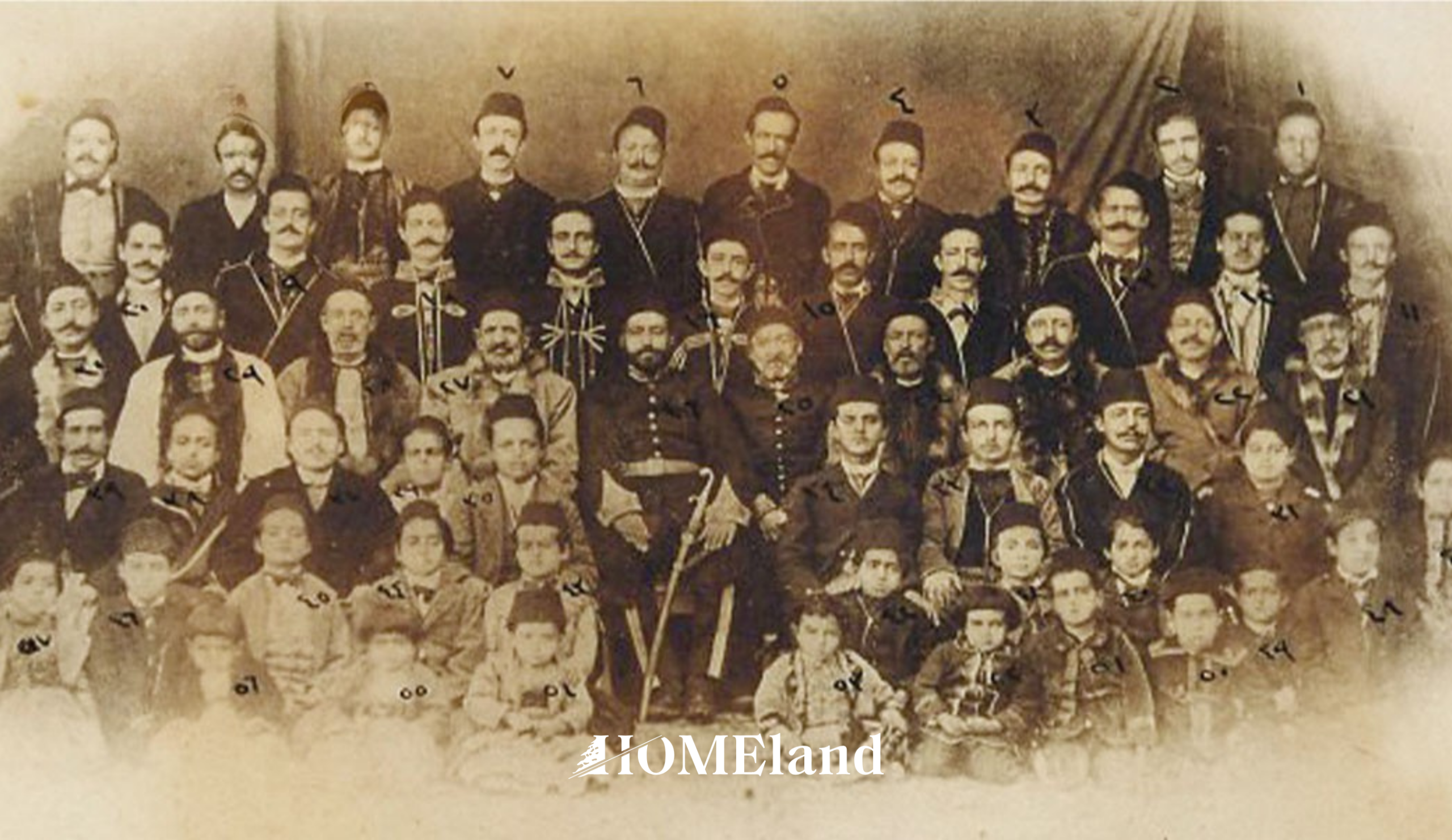
We have chosen to feature the شهابيون (Chehab/Shihab family) for this issue of HOME for Magazine because of the depth of its documented history tracing the family from the fifth century in the Arabian Peninsula, to Syria and on to Lebanon. Even their title as emir can be traced back to the seventh century.
While some Lebanese family names have over 20 spelling variations in the Latin alphabet in different parts of the world, there seem to be only two main variations of شهاب – the Francophone Chehab and the Anglophone Shihab. And since most of the family in Lebanon uses the spelling Chehab, this is the spelling we have used here.
According to historical records, the Chehab family was one of the many families of the Banu Makhzoum clan, of the Quraish tribe, tracing its heritage to Hareth ibn Hisham ibn Yakza ibn Mourrat ibn Louay ibn Fahr. Hareth’s son Malik was nicknamed Chehab, meaning “meteor” or “shooting star” and the name stuck. Hareth was one of the companions of the Prophet Muhamad, making the Chehabs one of the first 10 families to convert to Islam.
In A.D. 634, the first Caliph Abu Bakr made Hareth the emir of the Banu Makhzoum clan to fight against the Byzantine Empire. The second Caliph Omar ibn al Khattab appointed Hareth’s son, Emir Malik Chehab, ruler of the province of Hawran in what is now Syria, which the family ruled from A.D. 636-1173.
In 1173, the Chehabs, under the leadership of Emir Munqiz Chehab defeated the Crusaders (Franj) in Wadi Taym, in what is now south Lebanon, and were given the fiefdom by
King Nur al-Din in Damascus, ruling it from the 11th-century citadel of Hasbaya for the next seven centuries.
In A.D. 1697, the last emir of the Shouf from the Maan dynasty died without a male heir. The notables of the Shouf, with Ottoman approval, chose his nephew Bashir Chehab to succeed him, despite the fact that the Maans were Druze and the Chehabs were Sunni.
The territory ruled by the Chehabs was further extended in 1711, when Emir Haydar Chehab consolidated his reign over Lebanon largely through alliances with families of the region, especially the Jumblatt and the AbiLama’a families.
In the 18th century, members of the Chehab family in Mount Lebanon began to gradually convert from Sunni Islam to Maronite Christian. And in 1788 Bashir II became the first Maronite ruler of the Emirate of Mount Lebanon, most of whose inhabitants were Druze and Maronites. The Maronite Chehabs are generally from Deir al-Qamar, Beiteddine, Baabda, Hadath, Wadi Chahrour and Ghazir, while those who stayed in Hasbaya remain Sunni.
During his reign, Bashir II sided with Muhammad Ali, the founder of modern Egypt, in efforts to break away from the Ottoman Empire, but the principal European powers of the time opposed this move, and when Muhammad Ali’s forces retreated, Bashir II surrendered to the British and went into exile. In 1840, Bashir Chehab III was appointed in his place, but two years later, the sultan deposed him and abolished the Lebanese Emirate. Efforts to restore the emirate were made in 1918 with the fall of the Ottoman Empire, but the French mandatory authorities opposed the idea.
Chehabs in modern Lebanese politics
It is noteworthy that because of the political leadership of both Sunni and Maronite members of the Chehab family, they have the distinction of being the only Lebanese family that has had both a president and a prime minister. Emir Fuad Chehab was the fourth generation descendant of Prince Hasan, the brother of Prince Bashir II. An important legacy of Fuad Chehab was the establishment of the Lebanese Army, which he developed on a non-sectarian basis, demanding loyalty to Lebanon above loyalty to religious sect. In 1952 he served four days as provisional president. And in 1958, he was formally elected as the third president of Lebanon after independence, pressing for that same sense of national unity as president that he had as head of the army. Emir Khaled Chehab, was the prime minister of Lebanon for two terms in 1938 and again in 1952-1953, both times for less than a year. He also held many different ministerial positions between 1938 and 1953.
Protecting Lebanon’s heritage
One member of the family has been honered for his important role in preserving lebanese cultural history. Emir Maurice Chehab, considered the father of modern Lebanese archaeology, served as curator of the Lebanese National Museum for 33 years. His foresight and courage, along with that of his wife and a small staff, were responsible for protecting most of the museum collection during the Lebanese Civil War from both damage and looting. They packed and hid much of the collection and created cement and wood encasements for the larger objects as well as the mosaic floor tiles.
Chehabs in the diaspora
The Chehabs, like other Lebanese families, have emigrated to many countries around the world. It is not easy to identify which Chehabs are from this family, but it is clear that with the establishment of diplomatic relations between Brazil and Lebanon in 1945, many took refugee in Brazil, including the brothers emirs Anis, Bahige and
Samir Chehab. One of their descendants, Alfredo Chehab became one of Rio de Janeiro’s lawyer, founded St. Vincent de Paul Hospital and the Darcy Vargas Regional Hospital, and was owner of the newspaper Impartial.
Other prominent members of the family
Abdel Aziz Chehab, member of the Parliament
Adel Chehab, minister of defense and commander of the Lebanese Army in the 1960s
Col. Alfred Shihab, prominent member of the U.S. armed forces, among those who landed in Lebanon in 1958
Aref Chehab, lawyer and journalist, one of the martyrs of the May 6, 1916, tragic executions in the Martyrs’ Square in Beirut’s Downtown
Farid Chehab, general director of the General Security in the 1950s and vice president of Interpol
Imad Chehab, magistrate, assassinated on June 8, 1999, at the Court of Saida along with three other judges
Jamil Chehab, finance minister (1955)
Suheil Chehab, member of Parliament representing Hasbaya
Tareq Chehab, vice president of the Progressive Socialist Party in the 1970s and 1980s, lawyer and prominent figure of Hasbaya
Wael Chehab, president of New York-based Cedar Capital Management; a premier financial manager and active supporter of the AUB.
NOTE: There are other Chehab families in Lebanon and abroad who do not have a common lineage with the Chehab emirs so that it is difficult to be sure if those who have the name Chehab abroad are part of this same family.
HOMEland
Coming Soon
HOMEland Events & Collaborations
Coming Soon
 Signature Boutique