
How can you nurture a child’s appreciation of nature? How can they learn that when a mountain is destroyed, it’s irreversible? One answer is to teach them.
For parents and teachers who want Lebanese children to understand what a wonder the Lebanese Mountains are, the Lebanon Mountain Trail Association has created a new online learning tool with virtual games and offline activities – Mountain Explorers.
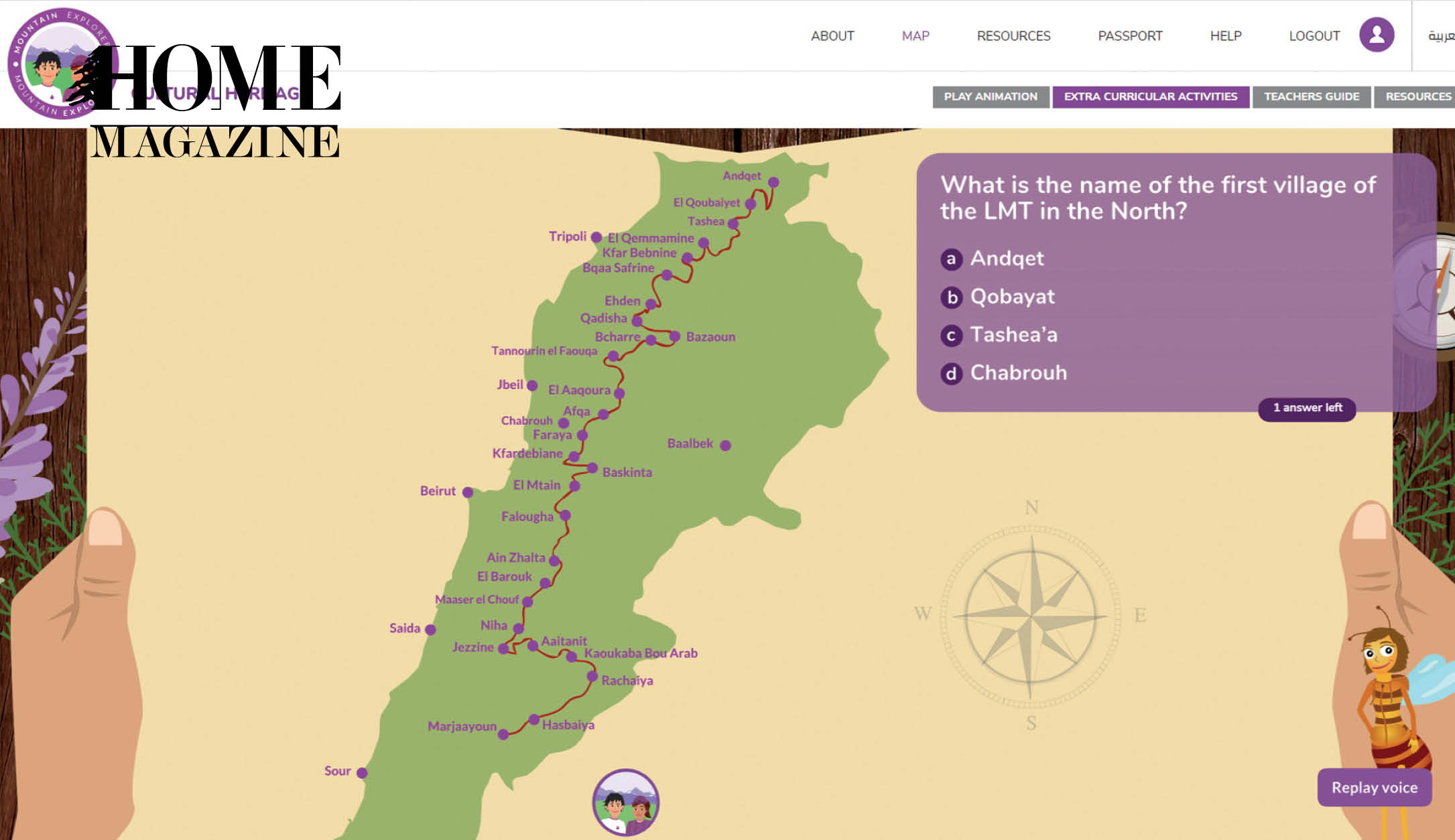
Talk to practically anyone in the Lebanon Mountain Trail Association (LMTA) about the Lebanese mountains and you’ll get a passionate earful. You’ll learn that the trail through the Lebanese mountains runs more than 470 kilometers, from Andqet in the north to Marjayoun in the south; and about 75 villages along the way, ranging in elevation from 570 to 2,011 meters above sea level; about Ottoman bridges and old silk factories; the smells of fresh za’atar and pine; panoramic views, natural springs and fields of wildflowers. Most of all you will hear voices filled with enthusiasm for the Lebanese mountains’ natural beauty and cultural wealth – our national heritage – one to pass on to the next generation.
“The trail through the Lebanese mountains runs more than 470 kilometers, from Andqet in the north to Marjayoun in the south; and about 75 villages along the way, ranging in elevation from 570 to 2,011 meters above sea level.”
But without an appreciation of its value, this marvelous inheritance may be squandered. The Ministry of Education and Higher Education, with support from the Swiss Embassy, decided it’s time to start teaching children about the importance of our mountains. They called on the LMTA to help.
What resulted is an online platform to be used in schools, but available to everyone, in which players explore the Lebanese mountains and solve problems that threaten them. Children learn to understand their own interactions with nature and the impacts they have. The game has six themes, each representing a resource: air, agriculture, biodiversity, cultural heritage, forests and deforestation, and water (issues of scarcity and pollution).
It’s free, in English, Arabic and French, and comes with plenty of content specific to the Lebanese mountains. Originally developed for 8–12 year olds, users of all ages say they find it fun and enriching.
In an interview with HOME, LMTA President and Education Committee Head Maya Karkour explained, “We want them to understand how preserving our natural resources not only keeps our country beautiful, but also provides us with a healthy ecosystem that supports us in everything we do – from the air we breathe, to the water we drink, to the food we eat and the everyday things we use.”
Why a game? “So kids will enjoy learning about the mountains in a fun way, using a modern, online platform, while still pursuing experiential outdoor activities,” she said.
“The Ministry of Education and Higher Education, with support from the Swiss Embassy, decided it’s time to start teaching children about the importance of our mountains. They called on the LMTA to help.”
Let the game begin
LMTA’s education team, working in collaboration with the Swiss FDDM (Fondation pour le Développement), brought in Cre8mania, a digital agency based in Lebanon and Dubai, that creates digital strategies, website design, mobile applications and animations. “As online learning is beginning to take off in Lebanon, we thought an interactive tool would be a good idea,” said Stephanie Audi, LMTA’s environmental education officer. “Children learn more when you’ve got their attention, when they are engaged.”
“At the same time, we want them to go outside.” Outdoor activities include things like measuring a tree, doing research on traditional cultures or food heritage in mountain villages, or filtering pond water in a glass jar.
Audi joined the LMTA in August 2016, specifically to develop this project, which had started two months earlier. An outdoor enthusiast with a master’s degree in environmental geosciences, and subspecialties in risk analysis, sustainable lifestyles and social development, she had the background needed to develop content for the game.
She also brought the understanding that comes from life experience. “I grew up in these mountains. We had a house near the slopes and I started skiing when I was 4.” As a child and teen, she was always out in the mountains, rock climbing, hiking and biking with friends.
Audi’s research and work, combined with the support of Karkour, also an environmental specialist who had developed LMTA’s Environmental Championship Program from which many outdoor experiential activities were taken, created a clever story line and rich content for the platform. “We were targeting 8–12 years old, but we are starting to see that even adults are enjoying it because it has a lot of information.”
For example, when a player solves a problem, a small information box pops up that will show details about the area being explored – like the number of inhabitants, the altitude, its geography and history. Lively animations for each theme provide context and background.
In addition, the Teacher’s Guides provide more complex explanations and detailed information to support them and parents.
“We have tried hard to collect data about the local conditions in Lebanon and the current situation of the villages, problems and possible solutions,” Audi said.
After its official launch in November 2017, the LMTA coordinated the implementation of the platform in a pilot project with five public schools in mountain villages “where the children learned the value of their own environment,” said Audi. It expanded in 2018 to 12 public schools, most in Akkar and North Lebanon, but also in Mtein and Jezzine. “By playing the game, Lebanese kids learn about the value of what they have and hopefully will be inspired to conserve it.”
There are plans to collaborate with private schools as well.
Let’s play
Anyone can play for free by registering through an online account that is either for a class or for an individual. Indeed, educators may also register their classes to use the platform throughout the school year, allowing for online interactive classroom discussions and activities.
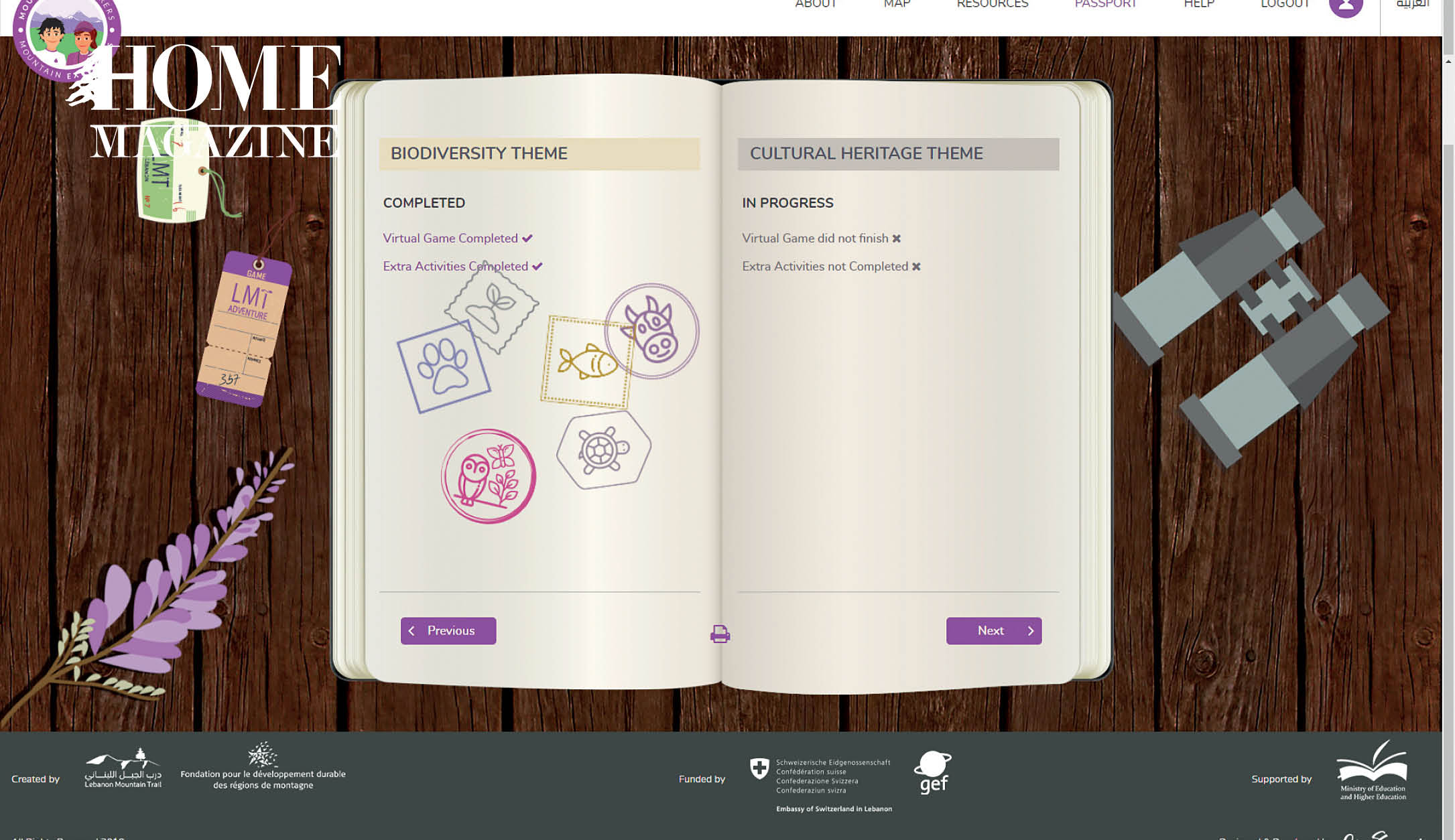
The way to win is to successfully complete the virtual games as well as the offline activities and earn stamps in a virtual “green” passport. Teachers have the ability to validate the stamps of their students. Class scores can be compared for more competitive fun. Passports are printable.
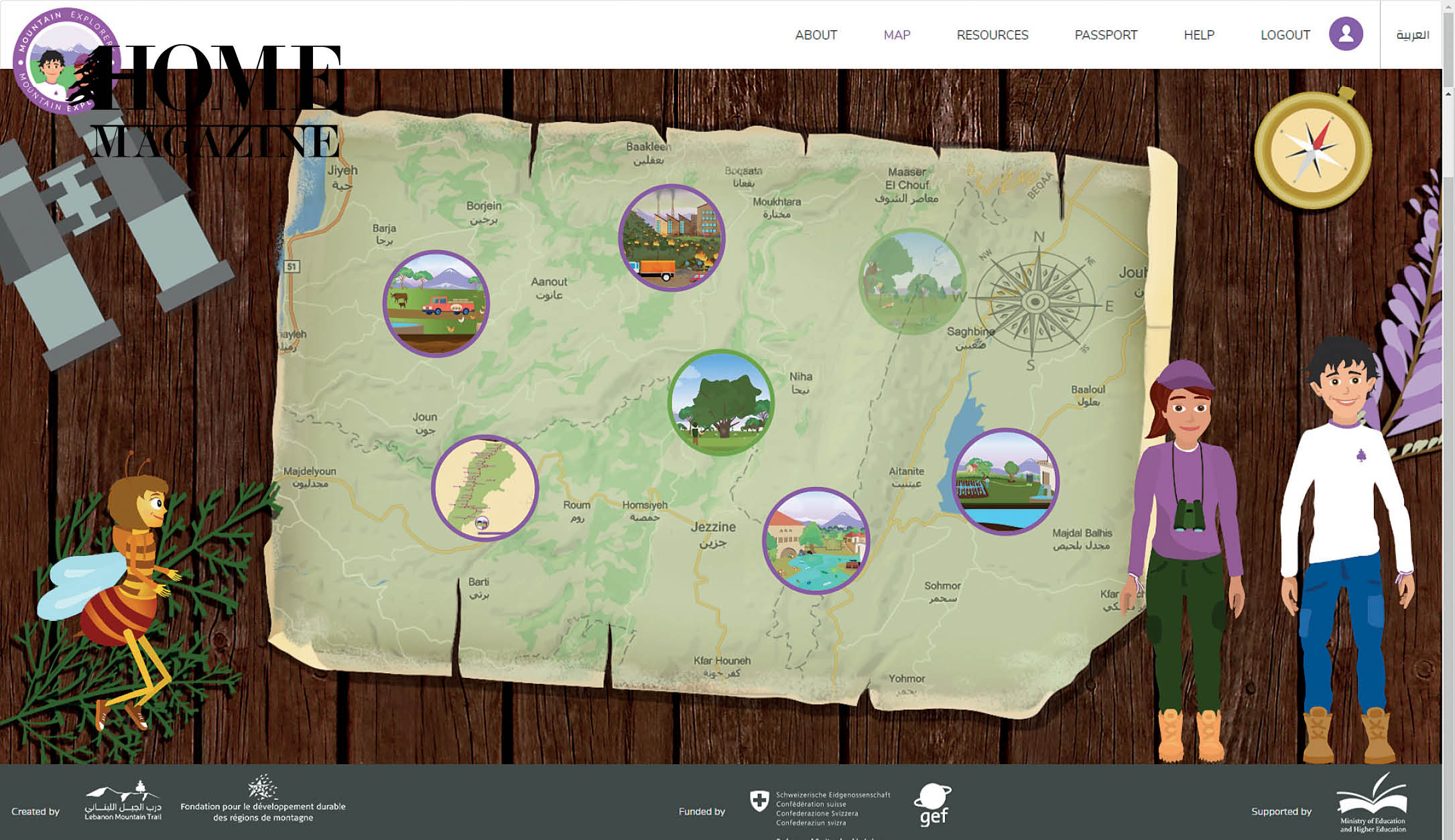
Players explore the six themes by traveling across an interactive map. Each theme begins with an animation involving three characters: Jad, Yasmine and Nahlati (a bee), Mountain Explorers’ mascot. Reminiscent of Jiminy Cricket in Pinocchio, Nahlati buzzes around the characters and in her, female Lebanese voice, serves as an environmental conscience – giving hints and explaining impacts of actions.
Let’s win
The LMTA plans followup research in the future to determine if the game and its activities change behaviors in children, like turning off the water faucet to conserve water when brushing one’s teeth, or recycling. To do so, the association committed to implement Mountain Explorers in at least 30 public schools along the Lebanon Mountain Trail, while training educators from various public and private schools to use the platform.
In the end, this is not a game; the Lebanese Mountains are at stake!
For more info:
http://www.mountainexplorerslebanon.org
http://www.lebanontrail.org/
Facebook: http://www.facebook.com/lebanonmountaintrailassociation
Instagram: http://www.instagram.com/lebanontrail
Youtube: https://www.youtube.com/channel/UCuskyGIV8tF_tla6-hPhXYQ/featured

HOMEland
Coming Soon
HOMEland Events & Collaborations
Coming Soon
 Signature Boutique