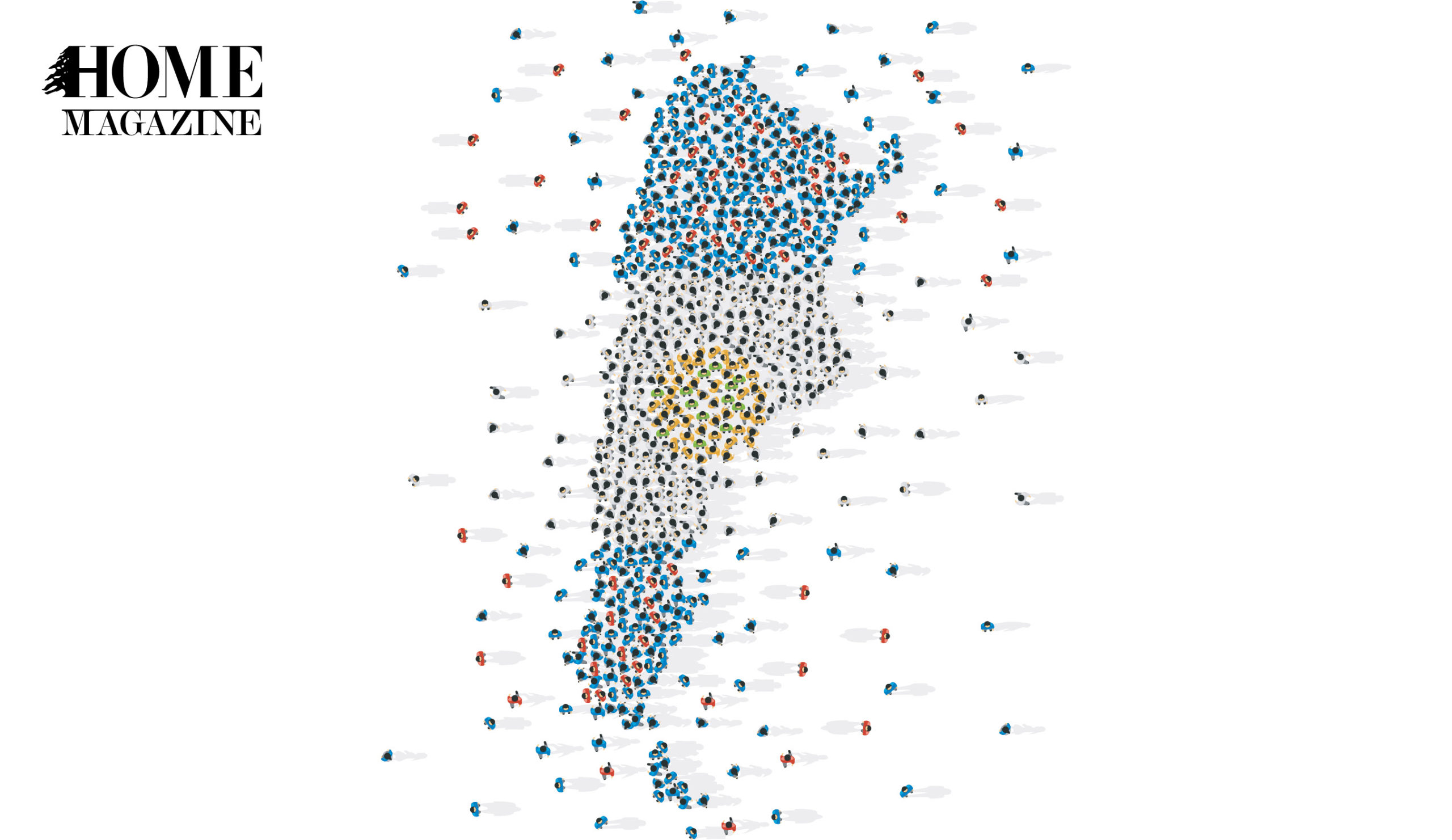
South America is an established hotspot for the Lebanese diaspora; Argentina alone boasts 1.5 million of them. Immigration to the country began in the 19th century and has continued, fostering a bona fide bond between the Middle Eastern country and its South American counterpart. As Walter Muller Moujir, an Argentinian of Lebanese descent says, “All of Lebanon is in Argentina.” Moujir’s grandfather emigrated from the village of Deir Antar, near Tyre, to Argentina in 1913, setting down the roots for their family tree to grow.
The history professor and committed researcher of the Lebanese diaspora has been practicing his vocation for nearly 20 years. In 2010, Moujir founded the Argentine Center for Research on Lebanese Immigration (CAIIL), becoming the first research center outside of Lebanon dedicated to Lebanese immigration. To date, the center has compiled an archive of 150,000 digitized images on Lebanese immigration. Reconnecting members of the Lebanese diaspora with their heritage has been the pillar of his career, earning him the Certificate of Honour by the Ministry of Culture.
His involvement with the Lebanese Emigration Research Center (LERC) and Lebanese Diaspora Energy (LDE) further cemented the Lebanese- Argentinian friendship.
Art and culture hold central importance in constructing a collective identity — a fact that Moujir understands all too well. As president of the Lebanese Society of Rosario (2015 to 2017), the scholar extended his reach beyond the academy. His background in museology and museography allowed him to oversee cultural events that center on the immigrant experience. During this period, the Lebanese Immigrant Day was elevated from obscurity into a wellknown tradition. Moujir teaches us what he knows about these two countries and their unique bond.
What is the purpose of the CAIIL?
How do immigrants integrate into their new society? Will they return to Lebanon? What will happen to their kids? Will they be linked to Lebanon? These are the types of questions that we try to answer at CAIIL. As the director, I lead a team of 20 professionals of Lebanese descent toward preserving the history of Lebanese immigration. Our expansive digitized archive of photographs, documents, letters and objects preserve the memory for future generation. Each relic is like a piece of a puzzle. We collect the historical memory of the community through the oral history of immigrants. I am also part of the team of researchers at LERC at the University of Notre Dame – Louaize in Lebanon and have the privilege of being named the official link for Argentina.
What are the main contributions of Lebanese emigrants to Argentina?
Lebanese immigrants have integrated very well into Argentinean society. They have founded more than 150 social institutions all across the Argentinean Republic, including schools, many enterprises, and provided great service to the community in general. Many have become main players in different public sectors and politics in the highest positions.
I can assure you, there is no place in the 2,800,000 square kilometers of Argentinean territory where there is no descendent of Lebanese. Also there is no town of Lebanon that is not represented in Argentina, such as Amioun, Kousba, Kartaba, Kalhat, Zgarta, El-Bireh, Tripoli, Bcharre, or cities from the south like Rmeich, Debel, Ain Ebel, Deir Antar, Tebnin, Abra, Nabatiye, Bent Jbeil, as well as Rachaya, Marjeyoun, Hermel, Ras Baalbeck. I could go on and on.
What does the research about Lebanese-Argentinean relations tell us?
By 2015, Lebanon and Argentina had enjoyed 70 years of diplomatic relations. On this anniversary, the Lebanese Embassy in Argentina asked me to map out the relationships between both countries to learn what makes such a strong friendship possible. We discovered that many of the immigrants that arrived to Argentina since 1890 still identify as Lebanese. Argentina has been one of the first countries to give recognition to Lebanon. The visit of Camille Chamoun to Argentina in 1954 was a seal of friendship that is kept until today.
“I can assure you, there is no place in the 2,800,000 square kilometers of Argentinean territory where there is no descendent of Lebanese. Also there is no town of Lebanon that is not represented in Argentina.”
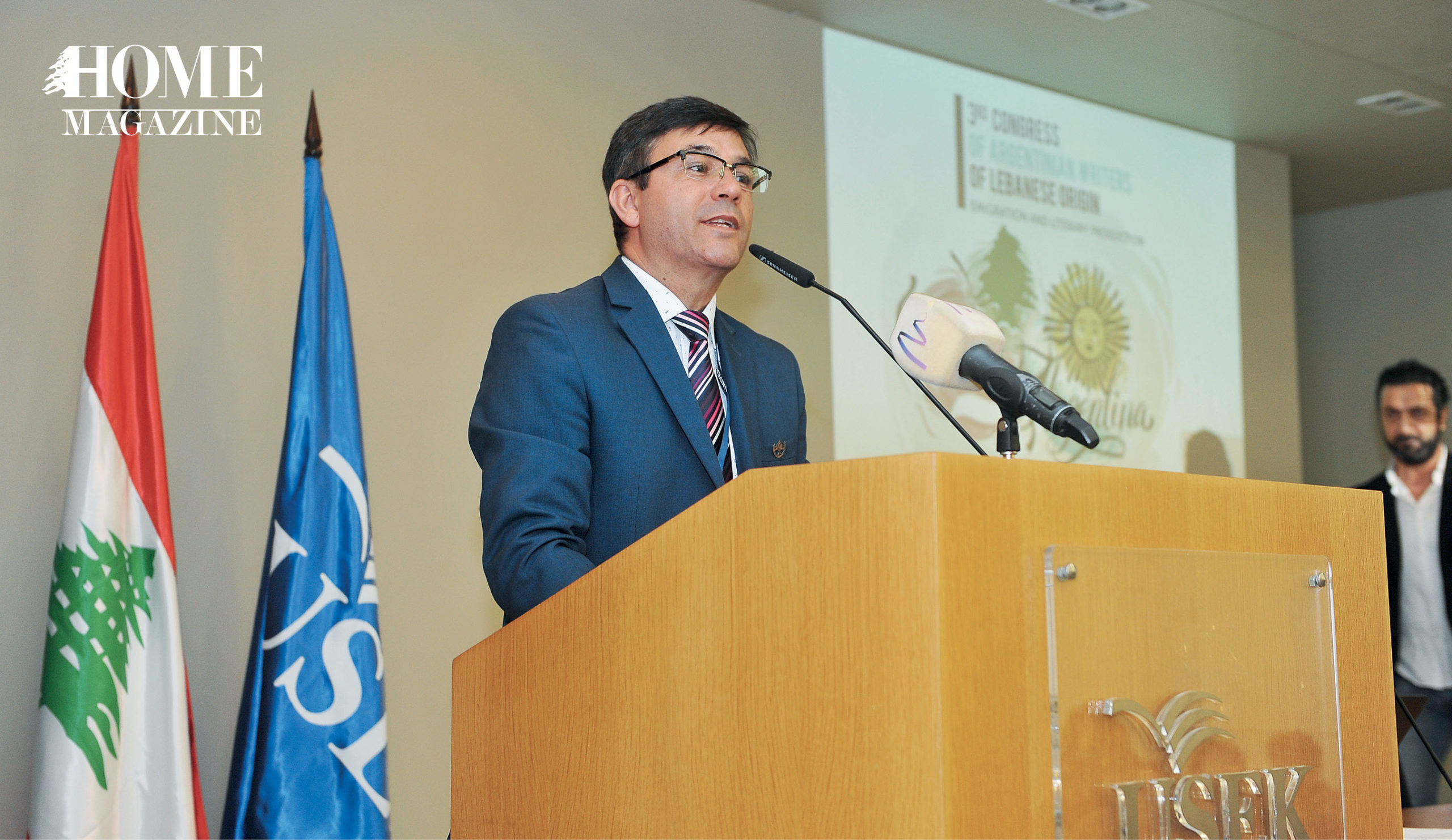
You attended to the The Third Congress of Writers and Readers for Lebanon at the Holy Spirit of University of Kaslik (USEK) in October 2018. What was the goal of the event?
To allow the descendants of Lebanese to diffuse the literary works of Lebanon.
To celebrate the legacy left behind by Lebanese immigrants when they emigrated to a very different and distant country from their HOMEland. To gather writers and readers in an environment where Lebanese culture is the common denominator.
Can you tell us about your book?
Lebanese Diaspora: The Road of the Lebanese Immigrant (2018) narrates the journey of the Lebanese, from The Cedars to Rio de la Plata. It covers every detail that Lebanese immigrants have to go through: passing through European ports, boarding ships, and finally reaching new soil which becomes their new HOME. Good historians will claim that they look objectively to relay what really happened. However, historical testimonies are narrated and are therefore filtered through subjective experience and memory. Personal experience and family biography leave an imprint on the telling of history. My case is no exception.
What inspired your story, “Re-encountering my Lebanese grandfather” (2018)?
My father told stories about my grandfather who escaped Turkish domination in 1913 and could never return to Lebanon. As a young boy, he had to deal with life in an unfamiliar country with no family or friends and worked his way up from nothing. Throughout it all, he never forgot his origins. Knowing about the life of an emigrant as well as his accomplishments, difficulties, resilience, and fearlessness pushed me to search for other Lebanese emigrants like him. His story had remained in my family, until I submitted it in the form of an essay to a contest in Buenos Aires. To my surprise, after publishing the story, I was invited to the Congress of the Nation to receive an award for it! I have two wonderful daughters, 12-year-old Iazmín and seven-year-old Suhaima, and my wife, Ariela. Getting our Lebanese citizenship in 2015 has been the best tribute to our family history.
For more info: https://www.facebook.com/caiil.libaneses


HOMEland THEMES
Coming Soon
HOMEland Events & Collaborations
Coming Soon
 Signature Boutique