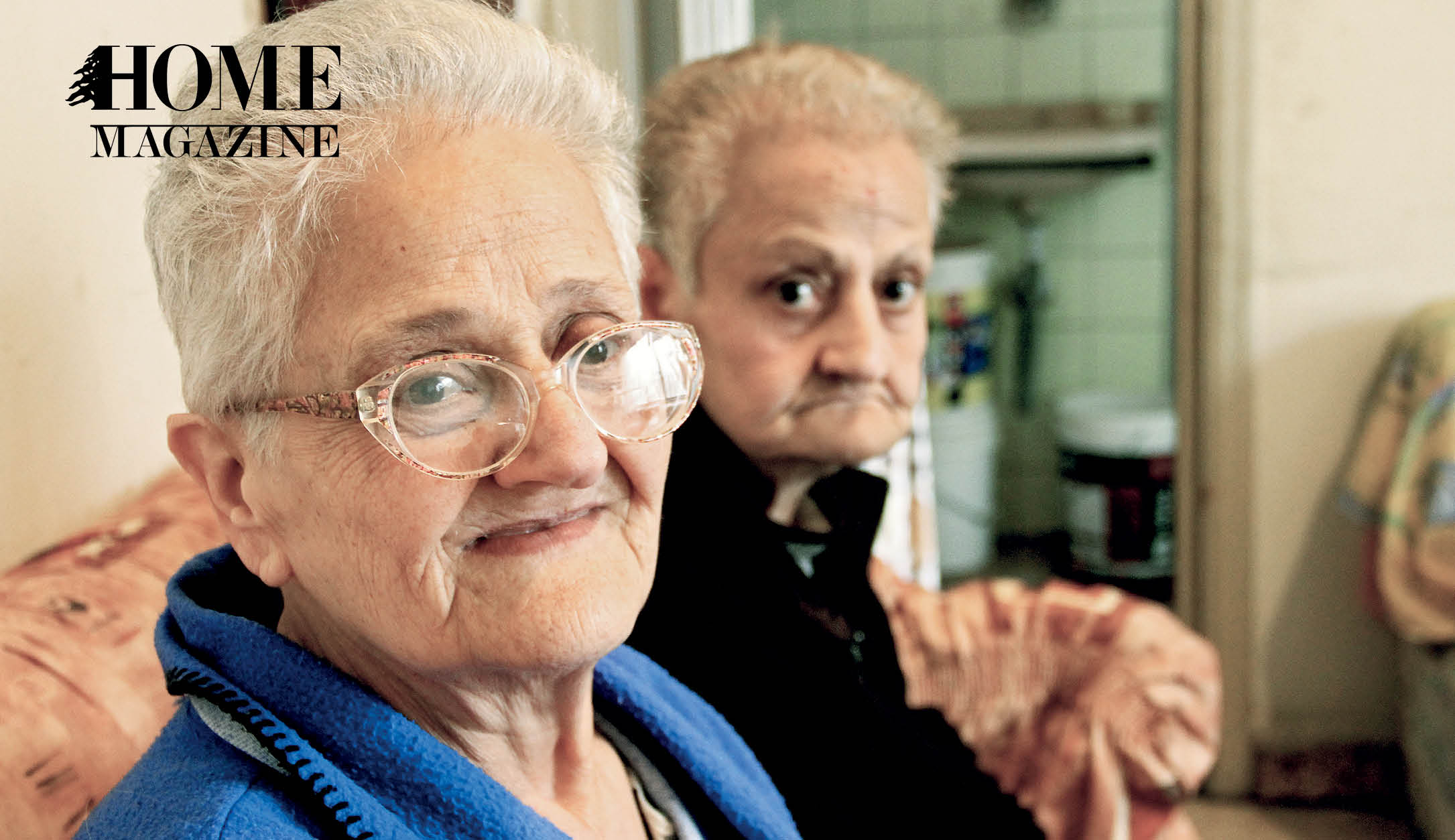

Sometimes you have to experience the lives of others to really understand how they live and just how much they are in need. This is the story of two women and their determination to help the elderly of Lebanon, starting with Karm El Zeitoun.
We often get so involved in our own lives, we fail to look closer, to open our eyes and our hearts to see our own neighbors in need. Sometimes we just need a push into the unfamiliar to open our hearts a little more, and to help. Sandra A. Mansour’s daughter gave her mom that push.
“Mom you have to do something!” Sandra’s daughter pleaded, because mothers have the magical power to help people, or that’s what their children believe. Sandra did do something. With the help of friend Diana Tannoury they started a program in Karm El Zeitoun to help the elderly in need. During the Christmas season of 2013, Diana and Sandra met Sister Ann Sauve, an American who has been living in
Lebanon for over 50 years in charge of a medical clinic in Karm El Zeitoun that provides basic care to people with low or no income. Out of this clinic, the two friends delivered 150 boxes of food, donated from friends to the elderly in Karm El Zeitoun. This initial act of charity developed into the Adopt an Elderly program.
How did this get started, and why the elderly? Isn’t it ingrained in Lebanese culture and society, as a duty, to take care of family, especially aging parents? After coming back from a school trip to the hilly, quaint Beirut residential area of Karm El Zeitoun, a place that hipsters and European backpackers find appealing in its beautiful melancholy, with narrow, winding streets crawling up, down and in between aged apartment buildings and single family HOMEs, and large overgrown trees pushing up through concrete. It’s an old, somewhat forgotten part of Beirut, much like many of the people who reside there.
Sandra’s sensitive daughter witnessed deprived elderly people, most of whom were sick and perhaps worst of all, lonely.
They are currently helping 10 elderly in the area. “Each person has a story,” explains Diana. “There was a woman with a handicapped older child. We met two sisters undergoing chemotherapy, another family of a mother and her daughters, one of whom needed dialysis.” There are limited resources from the charitable community, which provides limited help because a lack of any government-funded program such as welfare or social security.
Sandra and Diana discussed with Sister Ann a better, enduring solution. “We decided to come up with a program to adopt a granny or grandpa, same way you adopt a child, in order to help them seek or continue medical treatment, pay rent and buy food, whatever they need. Some have no money for electricity or water. Some can’t clean their houses nor take care of their personal hygiene,” Diana says.
“I would wish for them to be able to spend these old years in dignity, security, well taken care of, and not to have to worry about anything, and not to die of a disease,” adds Sandra.
Certainly, their human right is to live out their lives contentedly. “We wish that the government would look into this issue. Our government turns its back on the elderly, it’s sad.”
There are plenty of large charities, NGOs and U.N. organizations that provide assistance in Lebanon, and have large fundraisers that rake in huge amounts of money, but when we write a check to these organizations or drop cash into a bucket during the holiday season, we remain emotionally removed from the people who are in need. However, “when we are able to see and live their pain, we feel that we have to do something about it,” says Sandra, and that is a very different kind of charity because we are actually reaching out to people in need.
Diana contemplates the crucial idea of awakening our senses, witnessing the need in our communities, and then doing something about it. “We would like to awaken people to these matters, reach people personally, to see the suffering of others and be able to help them, not just pass them by.
We, as Lebanese need to do more to fill the void our government has left.
Many organizations have begun to take more action to put more pressure on our government, such as those protecting women’s rights. We should continue in this direction. Lebanon is a country that is beginning to awaken from a long, dormant, phase and with the help of its citizens, it’s on its way.”
Hope becomes hopelessness if we cannot stir something inside of us that would make at least the tiniest bit of difference in our world, our communities, and our HOME.
According to Diana, “everything starts small and grows big.”
To help people in the Karm El Zeitoun area or to join the Adopt an Elderly program contact Sandra A. Mansour at sandroun@ yahoo.com or Diana Tannoury at diana.tannoury1@gmail.com.
HOMEland Magazine
We firmly believe that the internet should be available and accessible to anyone, and are committed to providing a website that is accessible to the widest possible audience, regardless of circumstance and ability.
To fulfill this, we aim to adhere as strictly as possible to the World Wide Web Consortium’s (W3C) Web Content Accessibility Guidelines 2.1 (WCAG 2.1) at the AA level. These guidelines explain how to make web content accessible to people with a wide array of disabilities. Complying with those guidelines helps us ensure that the website is accessible to all people: blind people, people with motor impairments, visual impairment, cognitive disabilities, and more.
This website utilizes various technologies that are meant to make it as accessible as possible at all times. We utilize an accessibility interface that allows persons with specific disabilities to adjust the website’s UI (user interface) and design it to their personal needs.
Additionally, the website utilizes an AI-based application that runs in the background and optimizes its accessibility level constantly. This application remediates the website’s HTML, adapts Its functionality and behavior for screen-readers used by the blind users, and for keyboard functions used by individuals with motor impairments.
If you’ve found a malfunction or have ideas for improvement, we’ll be happy to hear from you. You can reach out to the website’s operators by using the following email
Our website implements the ARIA attributes (Accessible Rich Internet Applications) technique, alongside various different behavioral changes, to ensure blind users visiting with screen-readers are able to read, comprehend, and enjoy the website’s functions. As soon as a user with a screen-reader enters your site, they immediately receive a prompt to enter the Screen-Reader Profile so they can browse and operate your site effectively. Here’s how our website covers some of the most important screen-reader requirements, alongside console screenshots of code examples:
Screen-reader optimization: we run a background process that learns the website’s components from top to bottom, to ensure ongoing compliance even when updating the website. In this process, we provide screen-readers with meaningful data using the ARIA set of attributes. For example, we provide accurate form labels; descriptions for actionable icons (social media icons, search icons, cart icons, etc.); validation guidance for form inputs; element roles such as buttons, menus, modal dialogues (popups), and others. Additionally, the background process scans all the website’s images and provides an accurate and meaningful image-object-recognition-based description as an ALT (alternate text) tag for images that are not described. It will also extract texts that are embedded within the image, using an OCR (optical character recognition) technology. To turn on screen-reader adjustments at any time, users need only to press the Alt+1 keyboard combination. Screen-reader users also get automatic announcements to turn the Screen-reader mode on as soon as they enter the website.
These adjustments are compatible with all popular screen readers, including JAWS and NVDA.
Keyboard navigation optimization: The background process also adjusts the website’s HTML, and adds various behaviors using JavaScript code to make the website operable by the keyboard. This includes the ability to navigate the website using the Tab and Shift+Tab keys, operate dropdowns with the arrow keys, close them with Esc, trigger buttons and links using the Enter key, navigate between radio and checkbox elements using the arrow keys, and fill them in with the Spacebar or Enter key.Additionally, keyboard users will find quick-navigation and content-skip menus, available at any time by clicking Alt+1, or as the first elements of the site while navigating with the keyboard. The background process also handles triggered popups by moving the keyboard focus towards them as soon as they appear, and not allow the focus drift outside it.
Users can also use shortcuts such as “M” (menus), “H” (headings), “F” (forms), “B” (buttons), and “G” (graphics) to jump to specific elements.
We aim to support the widest array of browsers and assistive technologies as possible, so our users can choose the best fitting tools for them, with as few limitations as possible. Therefore, we have worked very hard to be able to support all major systems that comprise over 95% of the user market share including Google Chrome, Mozilla Firefox, Apple Safari, Opera and Microsoft Edge, JAWS and NVDA (screen readers).
Despite our very best efforts to allow anybody to adjust the website to their needs. There may still be pages or sections that are not fully accessible, are in the process of becoming accessible, or are lacking an adequate technological solution to make them accessible. Still, we are continually improving our accessibility, adding, updating and improving its options and features, and developing and adopting new technologies. All this is meant to reach the optimal level of accessibility, following technological advancements. For any assistance, please reach out to