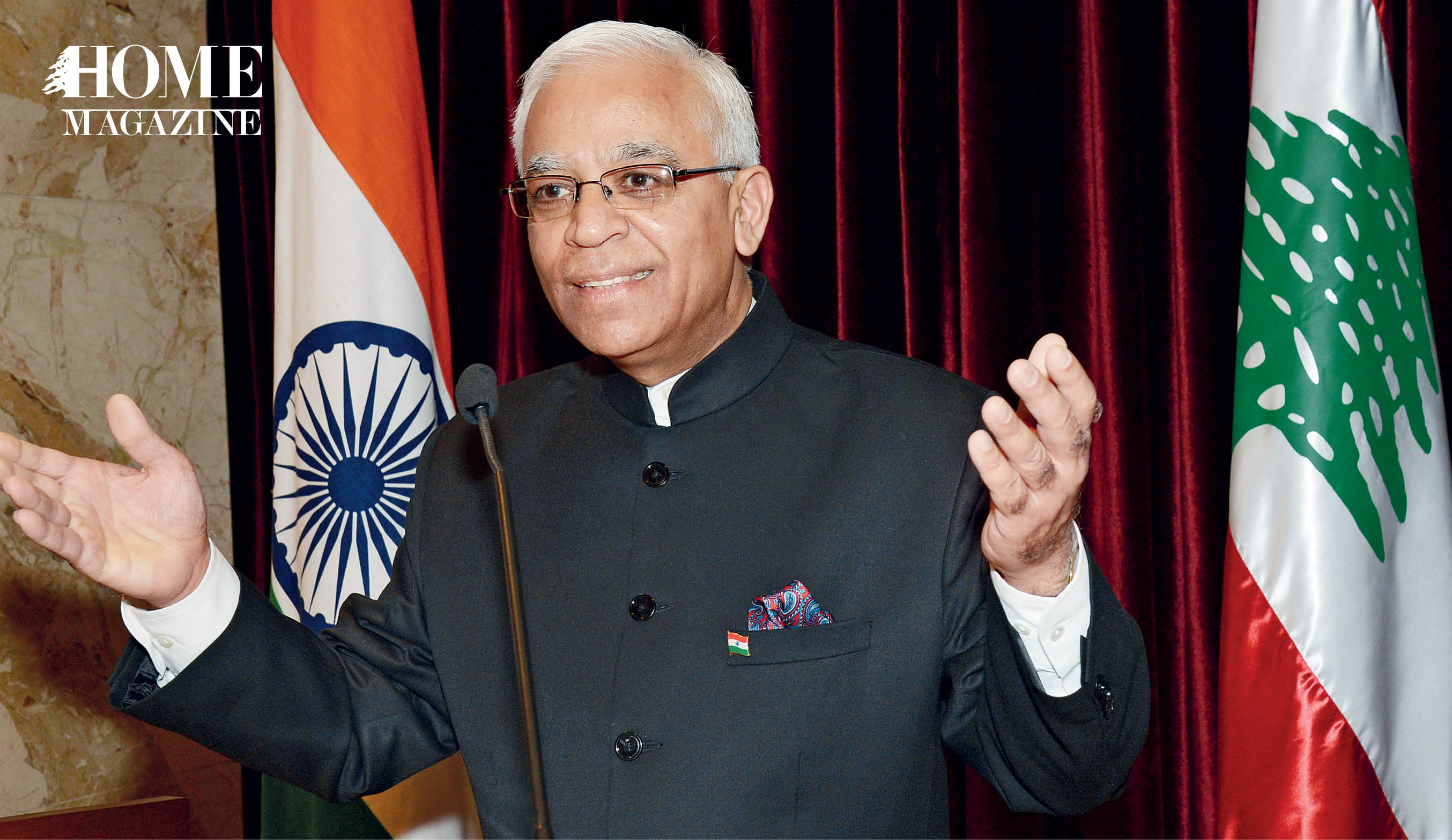
Interviewed by: Patricia Bitar Cherfan, Editor-in-Chief
Before he takes his next post in February of 2019 as India’s Secretary of Overseas
Indian Affairs, HOME Magazine sat down with H.E Sanjiv Arora who shed light on various topics, ranging from Mahatma Gandhi’s enduring legacy to his faith in the diaspora population and why bilateral trade between Lebanon and India has plenty of room for growth.
Ambassador Sanjiv Arora’s illustrious career in the Indian Foreign Service began in 1984. For his first foreign assignment, he landed in Egypt and in his three-year tenure became proficient in the Arabic language. Since then he has served numerous posts in various capacities both at headquarters in New Delhi and abroad. Arora then had diplomatic roles in Qatar, Saudi Arabia, USA (based in Texas and covering over nine states), Germany, Sri Lanka and the Czech Republic. He arrived in Beirut towards the end of 2016 to head the Indian Embassy in Lebanon. While his engaging tenure between our two countries may have come to an end, HOME is pleased for his new prestigious post in India.
On his impressions of Lebanon
“Since first coming to Lebanon, we always felt as if we were among friends. It’s been very fulfilling and enjoyable on a personal note. What we always admired about Lebanon is the pluralism and diversity and with all the challenges Lebanon faces, it has continued as a functioning democracy. These are strong commonalities between our countries.
India herself is a diverse country with so many religions and languages, much like Lebanon. Our family values are quite similar too. India’s strength is its unity, diversity and its democracy; we are the world’s largest democracy.”
On challenges in Lebanon
“I always believe problems can become opportunities with the right planning and resources. And in terms of human resources, Lebanon is very richly endowed; people are well-educated, well-traveled and speak multiple languages. Look at your diaspora. Through initiatives like the Lebanese Diaspora Energy (LDE), there are so many ways whereby the Lebanese diaspora can emerge as a strong bridge between their adopted country and Lebanon. The question is how to harness their confidence, energy and resources; it really is a win-win situation for both party’s benefit. And I am sure there will be more joint venture activities and partnerships in this regard. This is also increasingly happening in India, too. Interestingly, as we speak, the Annual Global Diaspora Convention is taking place in the holy city of Varanasi, now in its 15th year.” (The event, which is officially known as Pravasi Bharatiya Divas (PBD), is celebrated to strengthen the engagement of the overseas Indian community with the Government of India and reconnect them with their roots.)
On the history of India’s Annual Global Diaspora Convention
“This annual convention commemorates the historic return of Mahatma Gandhi to India from South Africa in 1915. In his same spirit, and with events like the annual convention, we encourage what we call ‘brain circulation’. Before we used to say ‘brain drain’ when losing people to emigration. This however, is about harnessing ideas from people no matter where they live, in order to bring new initiatives into our country.”
On encouraging business and tourism to India
“Our current government, led by Prime Minister Narendra Modi, has taken several measures to make India the preferred destination for tourists and business-people. There have been a number of new policies, incentives and simplifications of visas. We have a very swift and liberal visa policy in the embassy, including multiple entry visas which make India more attractive. From our side, we are not standing on rigid reciprocity and want to facilitate visas. We are asking for the same by the Lebanese government toward Indians who want to come and we want more and more Lebanese to visit our country.
I also ask my consul to give me daily reports of visa applications—a practice I have had for many years—so we know that the number of business people and tourists from Lebanon to India is increasing.”
“The Indians have an innate philosophy to have a way of life that is peaceful—with oneself, with others and with the environment.”
On pacifism
“In India, the majority of people are strongly attached to their roots, value systems and traditions, as illustrated in celebrations of so many festivals. I witnessed this as well, for example, when I served in Qatar, where Indians make up the largest expatriate community. Generally, they are well organized, sincere and hardworking. Speaking of teamwork, let me go back to the ancient Indian civilization ethos. There is an ancient saying in Sanskrit: “Vasudhaiva Kutumbakam“, meaning the whole world is one single family. The Indians have an innate philosophy to have a way of life that is peaceful— with oneself, with others and with the environment.”
On the global yoga movement bringing attention to India
“Yoga started in India thousands of years ago, but it belongs to the entire world really. While addressing the 69th session of United Nations General Assembly on 27 September, 2014, Honorable Prime Minister of India, Shri Narendra Modi, proposed a UN resolution to designate an International Day of Yoga, and on 11 December, 2011 UN passed a resolution establishing 21 June as International Day of Yoga (IDY), with a record of 177 co-sponsoring countries, including Lebanon. Since 2015, there is an annual celebration of IDY around.”
“The size of our middle class is at least 450 million people.”

On emerging opportunities in India and openness to more bilateral trade with Lebanon
“India is currently the world’s third largest economy on purchasing-power parity terms. India’s human resources are vast. Our big population of 1.3 billion is both a big challenge and a huge resource. Nearly 700 million Indians are below the age of 35, making it a very young population, too. The size of our middle class is at least 450 million people. So in the Indian market there is a potential for every product. India is open to anything that Lebanon is able to export.
“On another note, I must say, Lebanon has the best fresh fruits and vegetables! I have never tasted such great variety as I have in Lebanon. You also have amazing olive oil. There can be a very good joint venture possibility in the area of food processing. We have very good technologies, and your agricultural produce is excellent.
“The same can be seen in the information technology services sector. Lebanese IT engineers and entrepreneurs are increasingly visiting India for collaboration opportunities. Your fashion, hospitality and banking sectors are also great, which are potential doors for Lebanese to explore in India. Our companies have the confidence to develop world-class technological and managerial infrastructure. In fact, two years ago, an India company—OEG India Private Limited—won a tender to manage the operations and maintenance of the Zouk Mikhael power plants in Lebanon. Another notable joint venture is in shipping with the future opening of a new office by Indian Register of Shipping (IRClass). An Agency Agreement between Indian Register of Shipping (IRClass) and Exceptional Operations Classification Sal (XOClass) was signed in a joint effort to develop Lebanese market for management, surveys and classification of ships.
“In this regard, we give high importance to increasing business—between both sides. In September 2018, we had the visit of a 48-member multi-sectorial business delegation from India who had worthwhile and productive meetings in Lebanon. There are already various Lebanese companies that have invested in India, such as Dar Al-Handasah and Future Pipes Industries LLC, for example. (The total volume of trade between India and Lebanon between January and October of 2018 was $312 million. Source: Indian Embassy in Lebanon.)
“Since 1998 the Indian battalion (INDBATT) has been deployed in Lebanon with UNIFIL. Today, there are around 779 Indian personnel in the South East of Lebanon near the border.”
On expats in both countries
“The Lebanese in India are a small but vibrant community, and I have noticed recently more Lebanese are going there to explore opportunities. Lebanese cuisine is gaining increasing popularity in India with more restaurants opening. Lebanese cuisine has plenty of variety so it caters to vegetarians, too. About 8,500 Indians currently reside in Lebanon, working in a variety of sectors including construction, academia, agricultural farms, entrepreneurial and others. Some are spouses married to Lebanese. Also, since 1998 the Indian battalion (INDBATT) has been deployed in Lebanon with UNIFIL. Today, there are 779 Indian peacekeeping personnel in the south east of Lebanon near the border. It is also significant that in Kazakhstan’s first ever contribution to a UN Peacekeeping Mission, 120 Kazakh troops have been deployed under the command of the Indian Battalion since 31 October, 2018.
On Lebanese-Indian associations and programs
“There are a number of active associations and programs. There is the Association for Development of Lebanese-Indian Relations (ADLIR) headed by Mr. Ali Ghandour, and we have the Lebanese-Indian Friendship Parliamentary Committee (LIFPC), chaired by Mr. Ali Osseiran—both aimed at strengthening people-to-people contacts and cooperation in diverse sectors. The Indian Technical & Economic Cooperation (ITEC) program has been popular in Lebanon and has increased its candidates each year. It was launched in 1964 by the government of India for fellow developing countries. This year, we accepted 75 Lebanese civilians for training slots covering IT, English language, banking, audit, parliamentary procedures and other subjects, in addition to 33 defense-training slots for the Lebanese Army.”
On status of women in India
“Over the years, women have occupied positions in every sector. The issue is extremely important in India. Every government has been giving it very high priority. Luckily, in society too, there has been heightened awareness that women must be empowered and must have absolute, equal work opportunities. All that is guaranteed by our constitution, but in practice we are seeing this more and more—in sectors of higher education, research and technology, and in our defense forces.
For example, we have three female fighter pilots and many women in our space research program. In politics, the current Speaker of the Parliament the Honorable Smt. Sumitra Mahajan took over the post from a woman. The External Affairs Minister, the Honorable Smt. Sushma Swaraj and Defense Minister, the Honorable Smt. Nirmala Sitharaman are women. Prime Minister Indira Gandhi was the first and only female prime minister of India. Every government has had women ministers, and we also had a female president from 2007 to 2012, the Honorable Smt. Pratibha Devisingh Patil.”
On corporate social responsibility in India
“Corporate social responsibility (CSR) has acquired an important dimension over the years. There is growing awareness among the corporate sector in various areas, such as health, education, empowerment of women, environmental protection and looking out for the underprivileged in society. I would envision in the years to come that CSR will increase substantially. Increasing awareness is the driving force to boost this sector. For some, CSR is just a photo opportunity, but there are others who are deeply committed to doing work at the grassroots level. In fact, India is the first country in the world to make Corporate Social Responsibility (CSR) mandatory, following an amendment to the Companies Act, 2013 in April 2014. Currently, there is our government initiative called Clean India Mission. It is an ambitious $8.6 billion USD cleanup project that started in 2014 and runs until October 2, 2019, the 150th anniversary of the birth of Mahatma Gandhi.”
“Be the change that you want to see in the world.”
On Mahatma Gandhi
“Gandhi was the greatest Indian immigrant. He galvanized millions of Indians in the peaceful civil-disobedience movement against British rule which led to our freedom. In South Africa, he built a momentum in which he faced strong discrimination. There, he spent 21 years practicing law and securing significant legal concessions for the local Indian population. Your late leader Kamal Jumblatt was deeply inspired by Gandhi, and we truly cherish his love for our country and his efforts for strengthening ties between our countries many years ago. The Lebanese poet Jawdat Haydar also dedicated a poem to Gandhi. If you ask me which of Ghandi’s words left a strong imprint on me, it is this message: ‘Be the change that you want to see in the world’. It’s to lead by example as Gandhi himself did.”
Specific Features of Companies Act – 2013
• These rules came in to force from 1st April, 2014.
• The government of India made it mandatory for companies to undertake CSR activities under the Companies Act, 2013.
• The CSR activities will have to be within India, and the new rules will also apply to foreign companies registered here.
• Funds given to political parties and the money spent for the benefit of the company’s own employees (and their families) will not count as CSR.
• The concept of CSR is defined in clause 135 of the Act, and it is applicable to companies which have:
• An annual turnover of Rs 1,000 crore or more, or a
• Net worth of Rs 500 crore or more, or a
• Net profit of Rs 5 crore or more.
• An average of the previous three financial year PAT will be considered for calculating the 2% for CSR.
• CSR policy of a company should ensure that surplus arising out a CSR activity will not become part of business profits.


HOMEland
Coming Soon
HOMEland Events & Collaborations
Coming Soon
 Signature Boutique