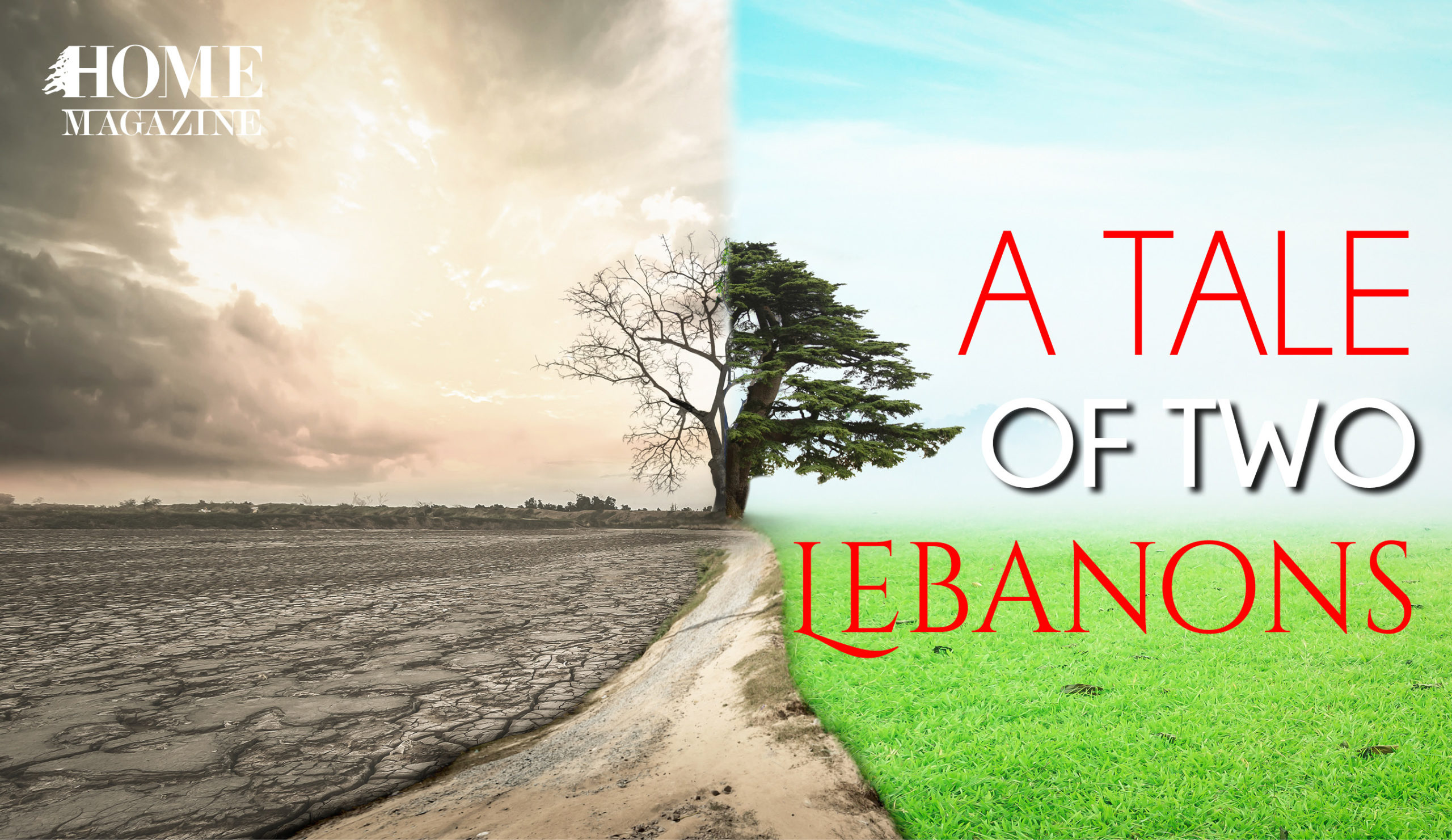
A century ago, famed Lebanese poet Gebran Khalil Gebran wrote, “You have your Lebanon and I have my Lebanon.” His words still ring true, as seemingly two Lebanons have emerged.
One is the old Lebanon—still living in its shadowy past, where the nation is split among populations, geographies, sects and classes. With senseless wars and irresponsible famines, it is the Lebanon that cannot take care of its own. It is the very same one in which a handful of leaders control its destiny, government is deaf, corruption is rampant, people have no rights, lawlessness and injustice prevail, the environment is abused and resources are scarce. It is a Lebanon without infrastructure, public school, or opportunities, which cries everyday as more of its sons and daughters leave its shores. It is one in which empty pride cloaks a lack of dignity, and meaningless materialism fills hollow souls. It is an absurd Lebanon, living on a fictitious past, borrowed time and a baseless future. It is the Lebanon with ample leaders but no leadership, with power seekers aplenty but no sense of duty or responsibility. It is a Lebanon where politics is the purview of a select few, democracy is bought and sold to the highest bidder, the state is indifferent and the citizen has been left with no sense of national identity or belonging. It is the Lebanon whose mothers have been left to lament the absence of their sons and whose fathers weep at the frustrations of their daughters. The old Lebanon lacks empathy, love, hope or imagination.

Then there is the new Lebanon. It is the one with concerned citizens involved in every nook and cranny of the country, treating one another like sister and brother. It is the Lebanon of the one flag and national anthem. It is the very one that has recognized and reconciled with the mistakes of the past, striving to move forward towards equality and justice. It is the Lebanon in which the citizen holds dear a Bill of Rights, reigning in a tampered constitution. The new Lebanon helps those in need first, offering gender equality and protecting individual freedoms, while safeguarding the environment and the country’s heritage.
Indeed, the new Lebanon is one in which the people choose their leaders and not the other way around. It is one in which the public servants are proud to serve, where projects are implemented without corruption, and where everyone appreciates the state because it offers them excellent education, health and transportation.
It is the Lebanon of regional empowerment, giving everyone in the nation an equal opportunity, while protecting them. It is the Lebanon, which seeks no ill will towards anyone, proudly welcoming every well-intentioned to its shores, while globally fostering the industry of its good people and the fruits of their labor. The new Lebanon is that of love, respect, creativity and hope.
Hence, Lebanon is now witnessing an immigration of an unusual sort—one not of the accustomed geographic nature, but a rather different dimension. You see, brave citizens are crossing the Rubicon and immigrating from the old Lebanon to the new Lebanon, projecting themselves to a future where truth, dignity, justice and common identity prevail.
Yes, at this time in its history, we find that there are two Lebanons—the old Lebanon housing the corrupt, fearful and misguided and the new Lebanon that has captured the free, the spirited and the visionary. But old Lebanon is fighting back against an inevitable tide even while it’s crumbling. Those in the new Lebanon can see it, but how to explain to their brothers and sisters to leave their sink hole and join them? How to convince them that even though they love them as their own and extend their hand, they cannot allow themselves to be pulled into the old abyss of expired ideas, false calculations and fear of change?
And so, they pray. They pray that all those stuck down in old Lebanon will see the light and join them, for deep inside they don’t want to see two Lebanons anymore. They want to see only one for all its citizens—the new Lebanon.
HOMEland Magazine
We firmly believe that the internet should be available and accessible to anyone, and are committed to providing a website that is accessible to the widest possible audience, regardless of circumstance and ability.
To fulfill this, we aim to adhere as strictly as possible to the World Wide Web Consortium’s (W3C) Web Content Accessibility Guidelines 2.1 (WCAG 2.1) at the AA level. These guidelines explain how to make web content accessible to people with a wide array of disabilities. Complying with those guidelines helps us ensure that the website is accessible to all people: blind people, people with motor impairments, visual impairment, cognitive disabilities, and more.
This website utilizes various technologies that are meant to make it as accessible as possible at all times. We utilize an accessibility interface that allows persons with specific disabilities to adjust the website’s UI (user interface) and design it to their personal needs.
Additionally, the website utilizes an AI-based application that runs in the background and optimizes its accessibility level constantly. This application remediates the website’s HTML, adapts Its functionality and behavior for screen-readers used by the blind users, and for keyboard functions used by individuals with motor impairments.
If you’ve found a malfunction or have ideas for improvement, we’ll be happy to hear from you. You can reach out to the website’s operators by using the following email
Our website implements the ARIA attributes (Accessible Rich Internet Applications) technique, alongside various different behavioral changes, to ensure blind users visiting with screen-readers are able to read, comprehend, and enjoy the website’s functions. As soon as a user with a screen-reader enters your site, they immediately receive a prompt to enter the Screen-Reader Profile so they can browse and operate your site effectively. Here’s how our website covers some of the most important screen-reader requirements, alongside console screenshots of code examples:
Screen-reader optimization: we run a background process that learns the website’s components from top to bottom, to ensure ongoing compliance even when updating the website. In this process, we provide screen-readers with meaningful data using the ARIA set of attributes. For example, we provide accurate form labels; descriptions for actionable icons (social media icons, search icons, cart icons, etc.); validation guidance for form inputs; element roles such as buttons, menus, modal dialogues (popups), and others. Additionally, the background process scans all the website’s images and provides an accurate and meaningful image-object-recognition-based description as an ALT (alternate text) tag for images that are not described. It will also extract texts that are embedded within the image, using an OCR (optical character recognition) technology. To turn on screen-reader adjustments at any time, users need only to press the Alt+1 keyboard combination. Screen-reader users also get automatic announcements to turn the Screen-reader mode on as soon as they enter the website.
These adjustments are compatible with all popular screen readers, including JAWS and NVDA.
Keyboard navigation optimization: The background process also adjusts the website’s HTML, and adds various behaviors using JavaScript code to make the website operable by the keyboard. This includes the ability to navigate the website using the Tab and Shift+Tab keys, operate dropdowns with the arrow keys, close them with Esc, trigger buttons and links using the Enter key, navigate between radio and checkbox elements using the arrow keys, and fill them in with the Spacebar or Enter key.Additionally, keyboard users will find quick-navigation and content-skip menus, available at any time by clicking Alt+1, or as the first elements of the site while navigating with the keyboard. The background process also handles triggered popups by moving the keyboard focus towards them as soon as they appear, and not allow the focus drift outside it.
Users can also use shortcuts such as “M” (menus), “H” (headings), “F” (forms), “B” (buttons), and “G” (graphics) to jump to specific elements.
We aim to support the widest array of browsers and assistive technologies as possible, so our users can choose the best fitting tools for them, with as few limitations as possible. Therefore, we have worked very hard to be able to support all major systems that comprise over 95% of the user market share including Google Chrome, Mozilla Firefox, Apple Safari, Opera and Microsoft Edge, JAWS and NVDA (screen readers).
Despite our very best efforts to allow anybody to adjust the website to their needs. There may still be pages or sections that are not fully accessible, are in the process of becoming accessible, or are lacking an adequate technological solution to make them accessible. Still, we are continually improving our accessibility, adding, updating and improving its options and features, and developing and adopting new technologies. All this is meant to reach the optimal level of accessibility, following technological advancements. For any assistance, please reach out to