Barrak Naamani became a tailor – taking over his family business in 2009 – after he left a lucrative advertising career in the Gulf. Today his workshop and showroom space in the heart of Hamra in Beirut specializes in bespoke shirts and suits, but Naamani has also become known in his neighborhood and beyond as an artist. His showroom’s window displays, which he designs himself, are always creative and festive, and he has developed a burgeoning side business of unique decorative HOME objects made with antique discarded sewing machines.

“At first my father thought I was crazy,” reveals Naamani. His father Zouheir Naamani’s renowned bespoke tailoring business dates back to 1959 and operated in the more traditional way common of his generation. But when he started to hear comments from customers about the meticulous precision of his son’s shirts and how exquisite the window displays are, he had a change of heart. “Do what you want he told me after a while.” Clearly he trusted his son and confidently passed on the mantle knowing that Naamani is doing things right, albeit in his own particular style.
His style is definitely one of flair, creativity and precision. His bespoke shirts are assembled in a slightly different way today so that seams are ingeniously hidden. Then there are the regular animated store windows, which are highly anticipated by his neighbors. “People come to take pictures,” he says coyly. Finally his most prized achievement is his decorative HOME objects, which have become collectors’ items.

“One day when I was re-decorating my dad’s workshop, I thought the entrance needed a coffee table to go with the sofa,” explains Naamani. He stared at his father’s old defunct sewing machine with the foot pedal sitting in the corner and something sparked in his head. He quickly began sketching tables to be made from the sewing machine and went onto create his first prototype. He learned how to put the metals together and create his sculptural objects by hand. He posted his first table on Facebook and within half an hour someone asked to buy it. (An architect saw it and made him an offer). “From then, people started asking me to make them one and it took off from there really,“ says Naamani.
“One piece titled “Aziza” is named after a woman that lived in his neighborhood… She was this goddess and all the kids would look at her in awe when she was walking. She even left behind a trail of strong perfume.”

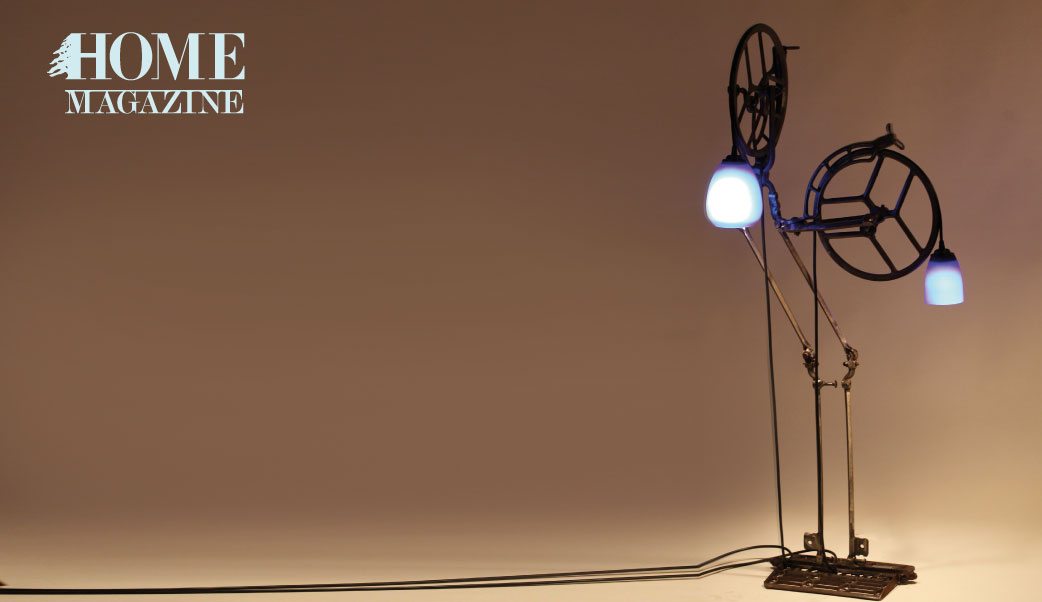
All his objects are functional while decorative, mainly as tables or lamps. Today his pieces are all made from antique sewing machines. Many of his lamps are also made using his store’s fabrics. He usually makes a collection of 15-22 pieces and each piece has a name and story behind it. One piece titled “Aziza” is named after a woman that lived in his neighborhood when Naamani was a child. “She was this goddess and all the kids would look at her in awe when she was walking. She even left behind a trail of strong perfume,” he recalls fondly. “When I finished this piece it just reminded me so much of this person.” Other pieces include “The Greatest” which was a table piece he did in memory of the late boxer and activist Mohammed Ali and a light called “Marmar” named after his daughter Maria, who inspired him to start making lamps after the tables.

To date Naamani has had a solo exhibition at the Aida Cherfan Art Gallery in Beirut and he presented his pieces at the last Beirut Art Fair in September 2016. In the same month he was also invited to display his work at ‘Maison & Objet’ in Paris where his entire collection was snatched by one buyer. Recently he has been invited to exhibit at the International Art Fair of New York in April and at the Tokyo International Art in May 2017. Currently, Naamani is working on a new collection titled ‘You & I’. He gladly shows HOME the preliminary sketches, which features abstract figures of a couple intertwined in various poses. Once they are completed, no doubt it will be nothing short of mesmerizing.
For more info: Instagram: barraknaamani

HOMEland Magazine
We firmly believe that the internet should be available and accessible to anyone, and are committed to providing a website that is accessible to the widest possible audience, regardless of circumstance and ability.
To fulfill this, we aim to adhere as strictly as possible to the World Wide Web Consortium’s (W3C) Web Content Accessibility Guidelines 2.1 (WCAG 2.1) at the AA level. These guidelines explain how to make web content accessible to people with a wide array of disabilities. Complying with those guidelines helps us ensure that the website is accessible to all people: blind people, people with motor impairments, visual impairment, cognitive disabilities, and more.
This website utilizes various technologies that are meant to make it as accessible as possible at all times. We utilize an accessibility interface that allows persons with specific disabilities to adjust the website’s UI (user interface) and design it to their personal needs.
Additionally, the website utilizes an AI-based application that runs in the background and optimizes its accessibility level constantly. This application remediates the website’s HTML, adapts Its functionality and behavior for screen-readers used by the blind users, and for keyboard functions used by individuals with motor impairments.
If you’ve found a malfunction or have ideas for improvement, we’ll be happy to hear from you. You can reach out to the website’s operators by using the following email
Our website implements the ARIA attributes (Accessible Rich Internet Applications) technique, alongside various different behavioral changes, to ensure blind users visiting with screen-readers are able to read, comprehend, and enjoy the website’s functions. As soon as a user with a screen-reader enters your site, they immediately receive a prompt to enter the Screen-Reader Profile so they can browse and operate your site effectively. Here’s how our website covers some of the most important screen-reader requirements, alongside console screenshots of code examples:
Screen-reader optimization: we run a background process that learns the website’s components from top to bottom, to ensure ongoing compliance even when updating the website. In this process, we provide screen-readers with meaningful data using the ARIA set of attributes. For example, we provide accurate form labels; descriptions for actionable icons (social media icons, search icons, cart icons, etc.); validation guidance for form inputs; element roles such as buttons, menus, modal dialogues (popups), and others. Additionally, the background process scans all the website’s images and provides an accurate and meaningful image-object-recognition-based description as an ALT (alternate text) tag for images that are not described. It will also extract texts that are embedded within the image, using an OCR (optical character recognition) technology. To turn on screen-reader adjustments at any time, users need only to press the Alt+1 keyboard combination. Screen-reader users also get automatic announcements to turn the Screen-reader mode on as soon as they enter the website.
These adjustments are compatible with all popular screen readers, including JAWS and NVDA.
Keyboard navigation optimization: The background process also adjusts the website’s HTML, and adds various behaviors using JavaScript code to make the website operable by the keyboard. This includes the ability to navigate the website using the Tab and Shift+Tab keys, operate dropdowns with the arrow keys, close them with Esc, trigger buttons and links using the Enter key, navigate between radio and checkbox elements using the arrow keys, and fill them in with the Spacebar or Enter key.Additionally, keyboard users will find quick-navigation and content-skip menus, available at any time by clicking Alt+1, or as the first elements of the site while navigating with the keyboard. The background process also handles triggered popups by moving the keyboard focus towards them as soon as they appear, and not allow the focus drift outside it.
Users can also use shortcuts such as “M” (menus), “H” (headings), “F” (forms), “B” (buttons), and “G” (graphics) to jump to specific elements.
We aim to support the widest array of browsers and assistive technologies as possible, so our users can choose the best fitting tools for them, with as few limitations as possible. Therefore, we have worked very hard to be able to support all major systems that comprise over 95% of the user market share including Google Chrome, Mozilla Firefox, Apple Safari, Opera and Microsoft Edge, JAWS and NVDA (screen readers).
Despite our very best efforts to allow anybody to adjust the website to their needs. There may still be pages or sections that are not fully accessible, are in the process of becoming accessible, or are lacking an adequate technological solution to make them accessible. Still, we are continually improving our accessibility, adding, updating and improving its options and features, and developing and adopting new technologies. All this is meant to reach the optimal level of accessibility, following technological advancements. For any assistance, please reach out to