Interviewed by Patricia Bitar Cherfan, Editor-in-Chief
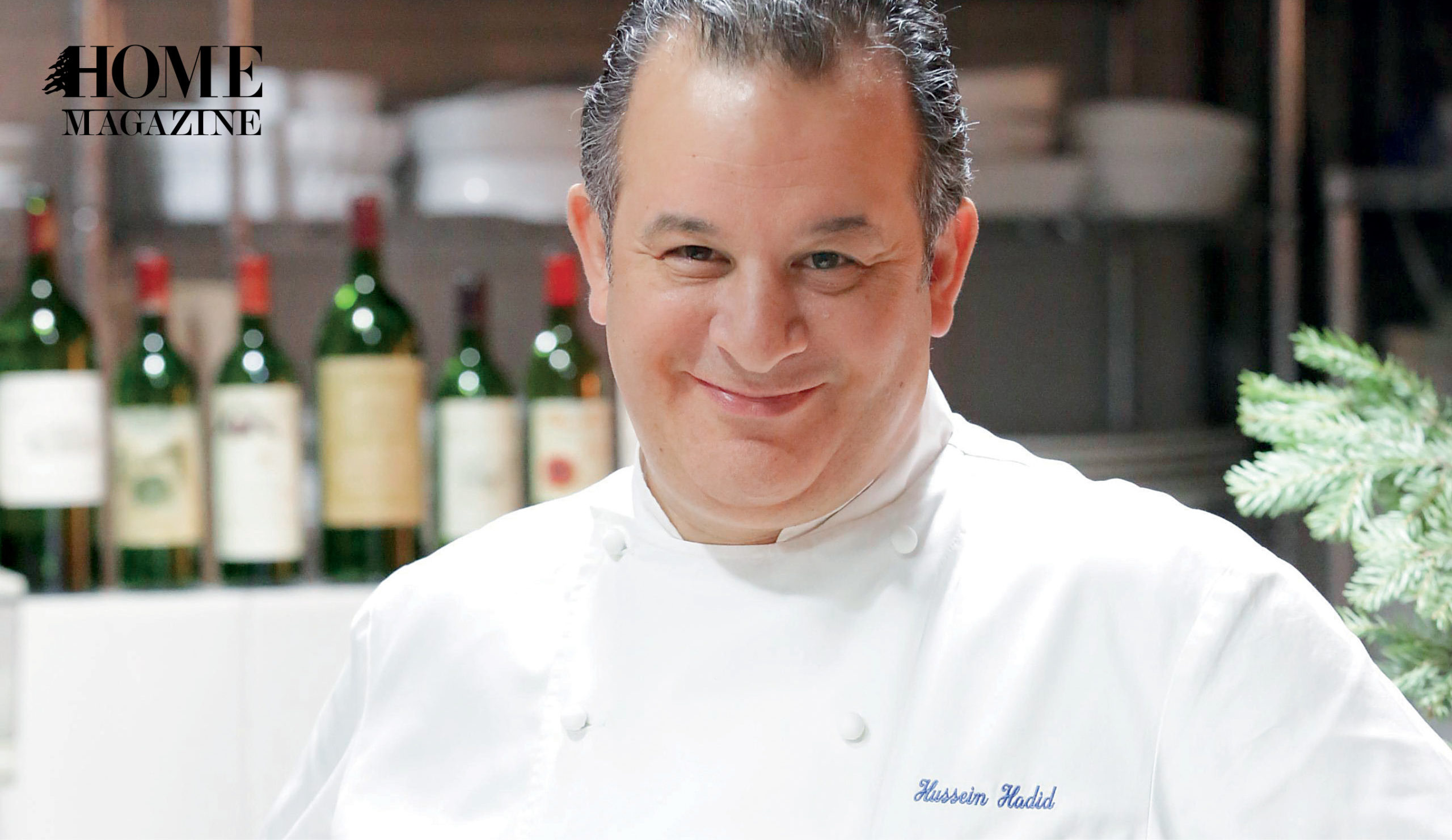
Jean-Marc Mompach has enjoyed a flourishing career. HOME had the pleasure of meeting with him at Horeca — the yearly food, beverage, and hospitality convention that attracts some of the world’s most coveted chefs to showcase their virtuosity. Mompach talks about his love for teaching, loz akhdar, and Lebanon.
A medal noticeably hangs around Mompach’s neck as a testament to his illustrative career. “The coin represents my presidency at l’Academie Nationale de Cuisine (ANC),” says Mompach of his liaison with the leading culinary academy in France. He points at a golden star proudly adorning his chest. “This one is a symbol of my membership in l’Academie Culinaire de France,” he notes.
To top it off, the trailblazer holds the title of the Legion d’Honneur 2019, which is widely recognized as the highest decoration in France. The fourtime winner of the Meilleur Ouvrier de France — his self-described greatest achievement to date — also snagged the Bocuse d’Or at the biennale world chef championship.
“Not bad, eh?” he adds with a touch of unexpected humility — the type perhaps expected from a first-time cook or newcomer to the industry. Any kind of intimidation that Mompach’s stature might inspire is quickly blunted by his gentle disposition and kind nature.

Something that rivals Mompach’s joy for cooking is teaching the next generation of chefs. At this advanced stage of his career, the pedagogue can step back to observe the next wave of chefs and serve as a mentor to them. By passing on the tricks of the trade, Mompach’s legacy can live on. “We want it to be une academie vivante . If we don’t then it will die,” says Mompach. His hands-off teaching style allows his apprentices to develop resilience and a sense of autonomy as well as other useful skills for high pressure situations. After transmitting his knowledge, the chef retreats. “I teach them what I know and then disappear. I want them to take initiative,” says Mompach.
Mompach says that he really enjoys the atmosphere of a good competition which can push participants to transcend their limits. The chef comments on the tremendous change in the past five years in Lebanon.
“Lebanese emerging chefs used to sometimes copy other chefs during competitions,” he says. “Now, I see more originality and creativity coming from them.”
“For all that the French can teach us, they have also taken a tab from Lebanese know-how, such as les farcis aux fromage .”
Culinary schools for aspiring chefs do, in fact, exist in Lebanon. Most notably, The Cordon Bleu campus in Jounieh specializes in hospitality and culinary matters. Mompach’s face lights up when he talks about his love for teaching.
“We trained Moroccan chefs eight years ago,” Mompach says. “Now they’ve won the Bocuse d’Or five times.
If we trained in Lebanon, we could take them to that level,” predicts Mompach. His philosophy rests on the idea that learning is always a two-way street. In that sense, an exchange between the French and Lebanese must and does occur. For all that the French can teach us, they have also taken a tab from Lebanese know-how, such as les farcis aux fromage .”
“I want to come back to Lebanon. I didn’t really get the chance to be a tourist this time because I’ve been busy with the food festival. I heard so much about Lebanon before visiting. Next time, I would like to spend time and absorb the culture,” says Mompach.
While locals take everyday foodstuff for granted, foreigners enjoy the novelty of being in Lebanon, and take delight in discovering new things. Alongside numerous other discoveries, this trip introduced Mompach to something he had never eaten before: green almonds (colloquially known as loz akhdar).
The future of the Lebanese culinary industry and its standing in international scene depend on today’s chefs who are becoming increasingly committed to bringing creativity and passion to the kitchen.

HOMEland Magazine
We firmly believe that the internet should be available and accessible to anyone, and are committed to providing a website that is accessible to the widest possible audience, regardless of circumstance and ability.
To fulfill this, we aim to adhere as strictly as possible to the World Wide Web Consortium’s (W3C) Web Content Accessibility Guidelines 2.1 (WCAG 2.1) at the AA level. These guidelines explain how to make web content accessible to people with a wide array of disabilities. Complying with those guidelines helps us ensure that the website is accessible to all people: blind people, people with motor impairments, visual impairment, cognitive disabilities, and more.
This website utilizes various technologies that are meant to make it as accessible as possible at all times. We utilize an accessibility interface that allows persons with specific disabilities to adjust the website’s UI (user interface) and design it to their personal needs.
Additionally, the website utilizes an AI-based application that runs in the background and optimizes its accessibility level constantly. This application remediates the website’s HTML, adapts Its functionality and behavior for screen-readers used by the blind users, and for keyboard functions used by individuals with motor impairments.
If you’ve found a malfunction or have ideas for improvement, we’ll be happy to hear from you. You can reach out to the website’s operators by using the following email
Our website implements the ARIA attributes (Accessible Rich Internet Applications) technique, alongside various different behavioral changes, to ensure blind users visiting with screen-readers are able to read, comprehend, and enjoy the website’s functions. As soon as a user with a screen-reader enters your site, they immediately receive a prompt to enter the Screen-Reader Profile so they can browse and operate your site effectively. Here’s how our website covers some of the most important screen-reader requirements, alongside console screenshots of code examples:
Screen-reader optimization: we run a background process that learns the website’s components from top to bottom, to ensure ongoing compliance even when updating the website. In this process, we provide screen-readers with meaningful data using the ARIA set of attributes. For example, we provide accurate form labels; descriptions for actionable icons (social media icons, search icons, cart icons, etc.); validation guidance for form inputs; element roles such as buttons, menus, modal dialogues (popups), and others. Additionally, the background process scans all the website’s images and provides an accurate and meaningful image-object-recognition-based description as an ALT (alternate text) tag for images that are not described. It will also extract texts that are embedded within the image, using an OCR (optical character recognition) technology. To turn on screen-reader adjustments at any time, users need only to press the Alt+1 keyboard combination. Screen-reader users also get automatic announcements to turn the Screen-reader mode on as soon as they enter the website.
These adjustments are compatible with all popular screen readers, including JAWS and NVDA.
Keyboard navigation optimization: The background process also adjusts the website’s HTML, and adds various behaviors using JavaScript code to make the website operable by the keyboard. This includes the ability to navigate the website using the Tab and Shift+Tab keys, operate dropdowns with the arrow keys, close them with Esc, trigger buttons and links using the Enter key, navigate between radio and checkbox elements using the arrow keys, and fill them in with the Spacebar or Enter key.Additionally, keyboard users will find quick-navigation and content-skip menus, available at any time by clicking Alt+1, or as the first elements of the site while navigating with the keyboard. The background process also handles triggered popups by moving the keyboard focus towards them as soon as they appear, and not allow the focus drift outside it.
Users can also use shortcuts such as “M” (menus), “H” (headings), “F” (forms), “B” (buttons), and “G” (graphics) to jump to specific elements.
We aim to support the widest array of browsers and assistive technologies as possible, so our users can choose the best fitting tools for them, with as few limitations as possible. Therefore, we have worked very hard to be able to support all major systems that comprise over 95% of the user market share including Google Chrome, Mozilla Firefox, Apple Safari, Opera and Microsoft Edge, JAWS and NVDA (screen readers).
Despite our very best efforts to allow anybody to adjust the website to their needs. There may still be pages or sections that are not fully accessible, are in the process of becoming accessible, or are lacking an adequate technological solution to make them accessible. Still, we are continually improving our accessibility, adding, updating and improving its options and features, and developing and adopting new technologies. All this is meant to reach the optimal level of accessibility, following technological advancements. For any assistance, please reach out to