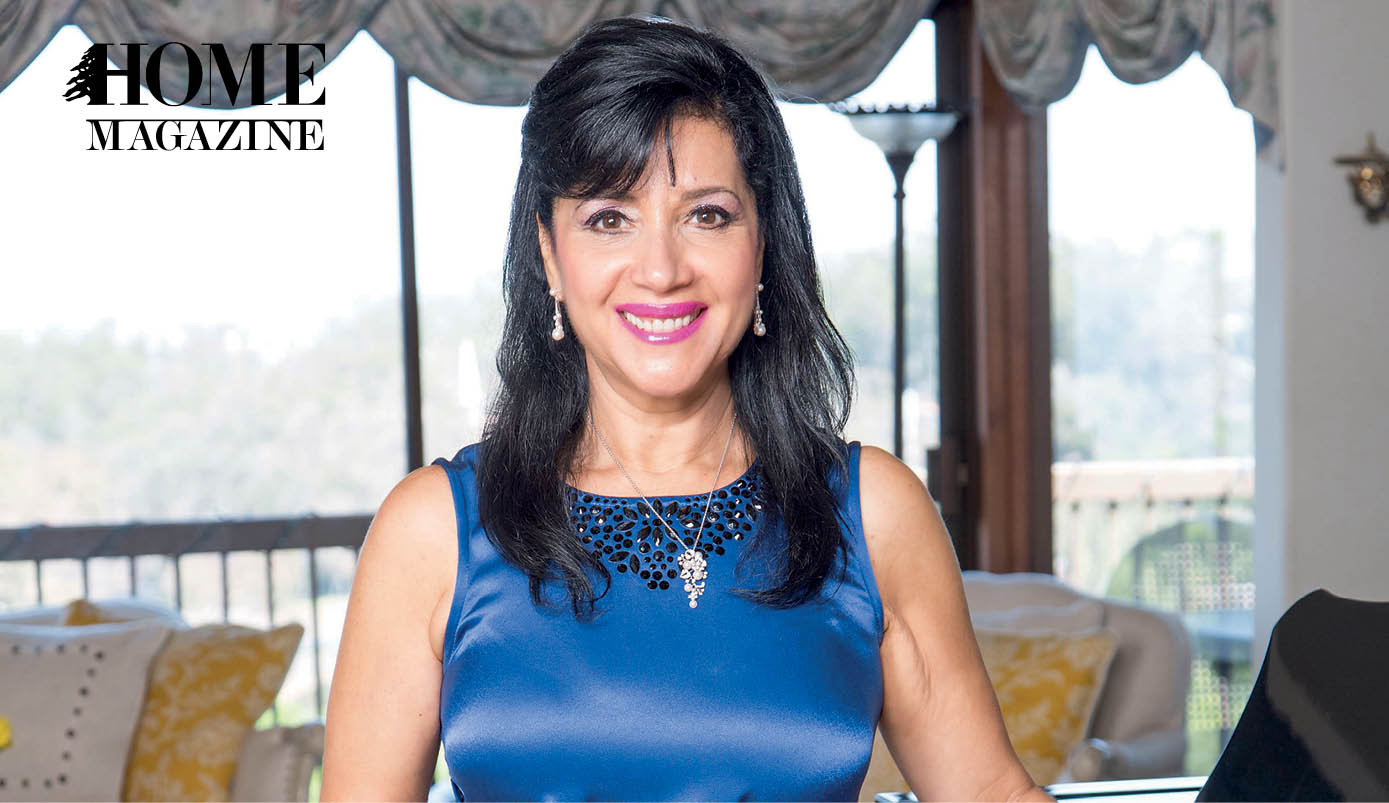
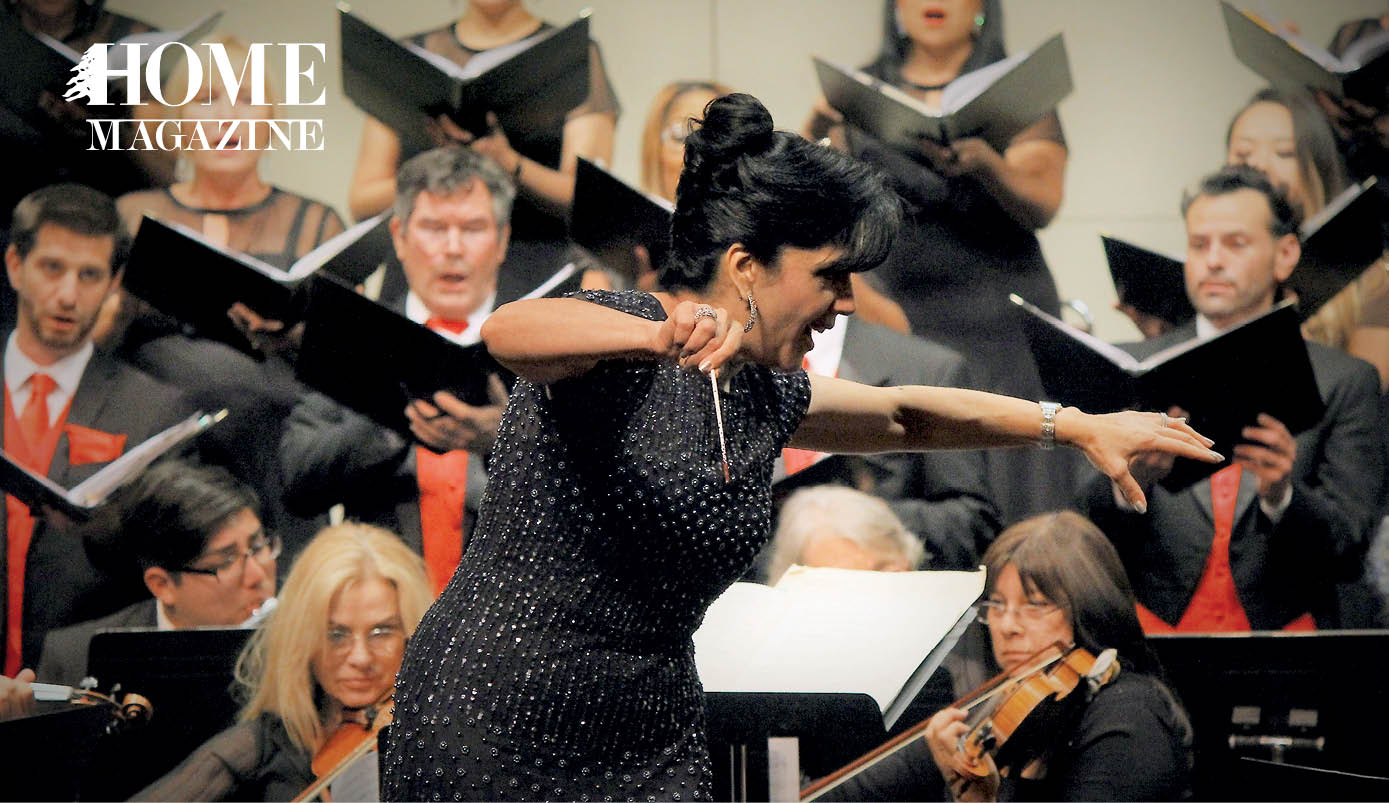
When conductor Joanna Medawar Nachef, Ph.D., takes the podium, her dress sparkles. As the first female orchestra conductor from the Middle East, she is known for her sense of style, among other things.
“I wear glittery dresses and use my feminine traits,” said the Ashrafieh-born, Los Angeles-educated, Lebanese American musician. “I don’t want to look or act like a man when conducting.”
Nachef has distinguished herself as a renowned international conductor, music teacher, academic and citizen diplomat.
HOME interviewed Nachef via Skype from her HOME in Palos Verdes Estates, California, a green oasis in the concrete of Los Angeles County, with low mountains abutting the sea. It looks like parts of her native Lebanon, which she left as a teenager with her family in 1977, during Lebanon’s civil war. She told us about her life’s path and the role music has played in it as a bridge between cultures.
A life in music
Nachef’s passion for music began at an early age, singing with her mother, who she describes as an “exceptional soprano,” she has fond memories of accompanying her on the piano and joining in, singing alto.
Nachef majored in piano performance at California State University, and earned a master’s degree in church music and a doctorate in choral and instrumental conducting from the University of Southern California.
She happily recalled the comment of her first music professor at El Camino Community College, when she conducted the national anthem in class: “Young lady, you have the natural talent to be a conductor.”
“The Lebanese can play Arabic music and then turn around to play classical music.”
“And now I’ve been teaching for 27 years in the same college where my first professor taught me; I sit at her desk, playing her role, carrying on her legacy after all these years,” Nachef marveled. “I now conduct six different choirs and professional orchestras as well.”
One highlight of her career was conducting the Lebanese Philharmonic Orchestra in December 2014. “They were so enthusiastic to work with me, with such warmth and professionalism. I’m just amazed with all they have been through. They are so versatile and flexible,” she said. “The Lebanese can play Arabic music and then turn around to play classical music.”
In December 2016, Nachef was in Beirut as a guest conductor of the Beirut Chants Festival Orchestra in a performance of Handel’s “Messiah.” A musician in the audience that night described her performance:
“She is powerful. She stood, planted, back straight. Only her arms were moving. You felt she had everything under the control of her baton.
“She knew exactly what she wanted, and delivered the beautiful musical phrases in this masterpiece with just the right energy and tempo. And she not only conducted the music; she interacted with the humans in the orchestra and the choir, connecting with the people behind the music.
“Her energy remained high throughout the long performance. The audience loved her. She was impeccable.”
“Music is the universal language, you can hum a tune together and you no longer need a common language.”
Nachef is an enthusiastic university professor as well. “I do a lot of life lessons for these millennials,” she said. “I tell them, ‘You have to find the passion that gets you out of bed. You should go out and discover what’s most interesting for you and then continually grow and challenge yourself.’”
She said she was fortunate to have been able to develop and explore her own passion through the music education she had. She warned that due to school budget cuts in the U.S., many of today’s students are missing an opportunity. “In Los Angeles, for example, my generation learned music at school since a young age. The students I’m teaching in college today didn’t have that same exposure.”
Music: the bridge between cultures
Nachef said she finds the ability of music to serve as a bridge between cultures “most interesting.” Her choral and conducting activities have led her to a role as a U.S. State Department speaker and a “citizen diplomat,” where she has built a collaboration with the Lebanese University to implement a global education program. For these initiatives she is called “the ambassador of harmony.”
“Americans especially have not been exposed to other cultures,” she said. “By sharing in the music of other countries, they can gain understanding. Music is the universal language. You can hum a tune together and you no longer need a common language.”
Behind this successful woman
Nachef credits her parents, her family and her faith for her success in music. “My parents have instilled in me the desire to follow my dreams, to pursue paths that may not have been tread before,” she said.
Her father, Michel Medawar, set a good example. He is known as the Lebanese inventor who created the talking clock, which first originated in Beirut.
Her mother is “an amazing 80-year-old who is still singing until today,” Nachef said. “She’s the best soprano in all of my choirs. She wanted to become a professional musician, so she instilled this desire in me.”
“You have to find the passion that gets you out of bed.”
“I have been blessed with her support and we do so many things together,” said Nachef. They have been singing together for the joy of it for 48 years now.
She also recognized her husband and children for the sacrifices they have made for her career. Her daughter, 24, is finishing her third year of law school and simultaneously working on her master’s degree in public policy.
” I’m very grateful they were able to tolerate my hours, my absence.”
Her 19-year-old son is in his first year of college, studying mechanical engineering. She’s “very grateful they were able to tolerate my hours, my absence.
“If it weren’t for my whole family, I wouldn’t be where I am today,” she added. “My Lebanese husband gives me all the support; he’s always beside me, wherever I reach. We were partners in raising the kids and making a loving HOME.”
“If it weren’t for my whole family, I wouldn’t be where I am today. My Lebanese husband gives me all the support; he’s always beside me, wherever I reach.”
Most important is her faith, said Nachef. “My faith is what drives me forward in everything I do, I want to bring glory to God. Every word I say, I want to reflect what He would want me to say and do. I want people to see Him in me.
“‘Soli Deo Gloria’ — to God alone is the glory. Jesus is my savior; my life won’t mean anything if I don’t have him first and foremost.”

Continuing the family tradition
Nachef expects her family’s musical tradition to continue. Her husband, Hani, who is a violinist, also comes from a musical family — his uncle, Saiid Nachef, was a composer, and his father, a professional lutist.
Her daughter is a violinist now. She also plays the piano and guitar and sings. Her son is a pianist and a vocalist and plays the saxophone. “We have been singing together ever since they were kids, especially during Christmas time. Everyone picks up an instrument and we all play together.”
For more info: http://www.jmnsingers.com/about/about-joanna-medawar-nachef/


HOMEland
Coming Soon
HOMEland Events & Collaborations
Coming Soon
 Signature Boutique