

HOMEland
Coming Soon
HOMEland Events & Collaborations
Coming Soon
 Signature Boutique


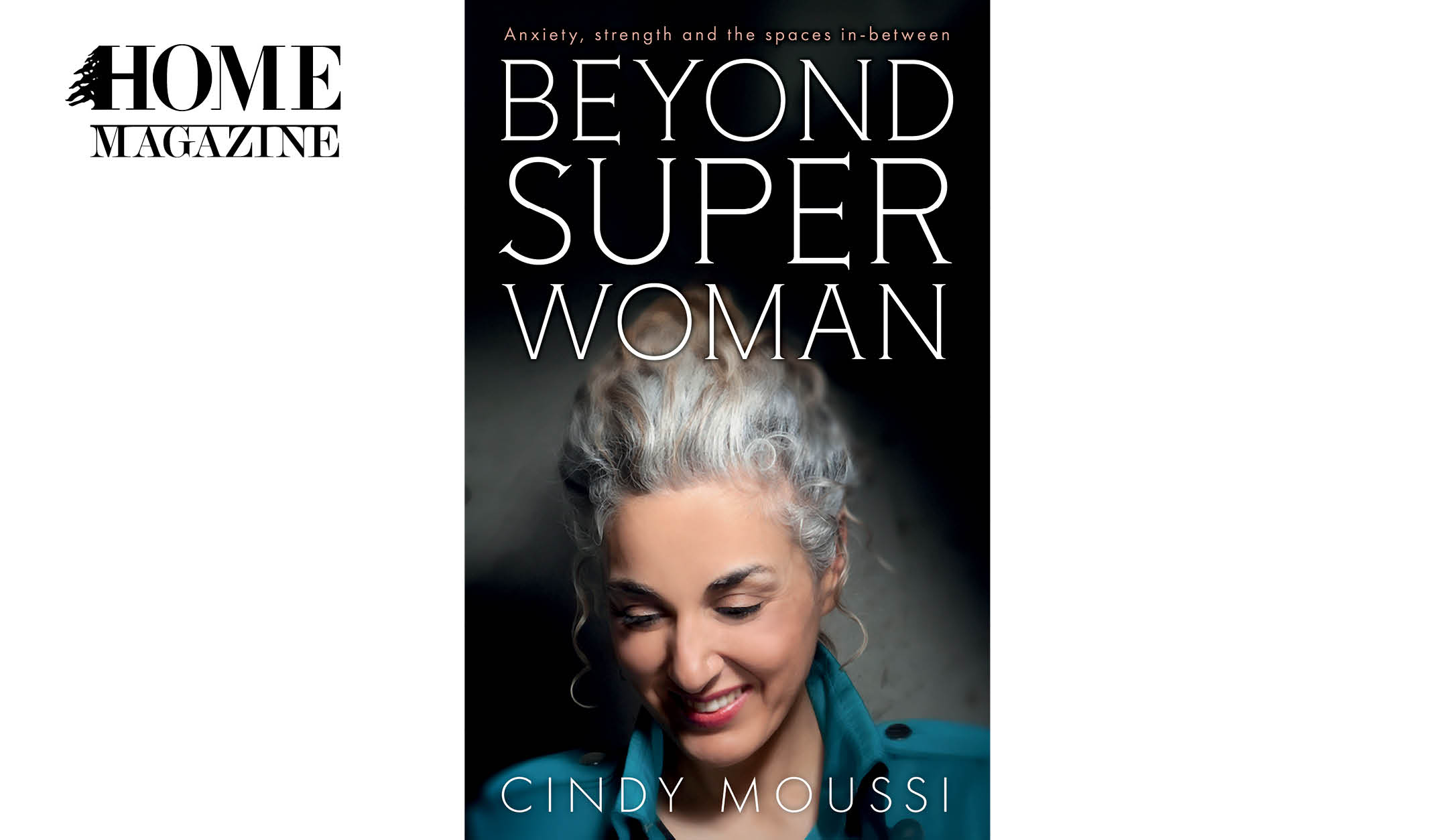
At the age of 43, Lebanese-Australian Cindy Moussi thought she had it all. Her son was grown up and independent, so it was time for a gap year – a year to step off the fast track and consider life’s deeper meanings, to figure out where to go from here.
So, she left her fast-paced life in Sydney and moved to her country HOME, a HOME she had built but never lived in. She imagined simple days of yoga and gardening, maybe even taking a trip to walk the Camino de Santiago.
There was one problem. She had not expected the feelings slowing down would release. First came the exhaustion, then the anxiety. Cindy wrote Beyond Superwoman to try to understand “how this could happen to me.”
“Don’t give a book talk if you have anxiety,” said Cindy Moussi wryly. The author of Beyond Superwoman spoke to a full house at Aliya’s Books in Gemmayzeh. Tall, with beautiful, thick, curly, silver hair, long legs and a tiny waist, at 47, she looks more like a runway model ready to talk about a glamorous career in fashion. But, in fact, this moment was the culmination of nearly two years of exploring through writing – what is going on with me?
Cindy, who was born in Lebanon and lived here from ages 7 to 12, came back HOME for an extended visit to hike the mountains of Lebanon and to finish writing her book, which she began in Australia. On that evening in February, at the book talk, she shared passages and openly answered questions.
A few days earlier, HOME met Cindy at her childhood HOME in Bouar, a quiet coastal town in the Mount Lebanon district. She spoke candidly about her remarkable journey and why writing this book was a crucial part of her self-discovery and healing.
Born in Beirut, Cindy spent her early childhood in Lebanon during the Civil War. She moved to Australia as a teenager.
An overachiever by nature, she went on to excel in the corporate world as a management consultant and an executive coach. Cindy holds an accounting degree and has a doctorate in philosophy.
However, nine months into her gap year, she was gripped by crippling anxiety. Unable to comprehend what was happening, she began researching and writing about her personal experiences. In the process, she discovered that the pain is not just about her, but went deeper than that. It had family roots, which began in Lebanon.
For Cindy, the symptoms of anxiety started with fatigue. “I was simply exhausted the first year,” she said. “I kept thinking if I just rest, it will get better; it didn’t.” Aside from the exhaustion, she had constant panic attacks that were completely debilitating. She lived in constant fear of them.
Her one year off turned into two as she felt she could not get her act together. “I felt deep shame,” she said. “I was too exhausted to consider full-time work and thought I should be able to. I thought I was going to run out of money. I feared I was going to lose everything I had built.”
Cindy sought professional help, and she was also deeply engaged in meditation and a spiritual path, which helped her repressed feelings come to the surface. She recalled how she felt like she was going crazy as the anxiety gradually escalated. The thought – How could this be happening to me? – continued to run through her mind.
“She learned anxiety was not something she could control.”
In 2014, when she was having the symptoms of fear, she watched a TED Talk on anxiety. Cindy recalled the speaker saying: “It’s fine to deal with depression, but it’s when the fear hits that I feel like I can’t go on any longer.” These words resonated deeply. The more Cindy learned from others and sought help, the more she began to comprehend her situation and come to terms with it.
She decided to enroll in a writing workshop, thinking perhaps she could write a book about coaching professionals to get her back on track. The instructor later became her writing mentor. “She encouraged me to write a book that I would love to read, not a book to try and impress anyone. She gave me confidence to just write and to not seek approval.”
This was the beginning of Beyond Superwoman, which was not only therapeutic, but allowed Cindy to look deeper into the causes of her anxiety. One of the causes is “definitely ancestral,” she said. Through research and reading, she came across the idea that there is cellular memory of anxiety, pain and trauma being passed down. “That’s why I started to look back at my parent and grandparents. We didn’t talk about mental health problems in our household. I can now see that anxiety was a constant undercurrent – my dad using humor and friends to soothe; my mom maintaining a perfect HOME,” she said.
“Later, I got myself very educated. But as successful as I could be, I was never at peace,” Cindy explained.
When Cindy was 22, she had already had a child and was filing for divorce – about to be the first divorcee in her family. “I wanted to be somebody to compensate for my shame. I think that’s at the heart of it all.”
Always needing to prove herself, Cindy constantly pushed to the limits. She was too busy to enjoy the simple things in life.
She learned anxiety was not something she could control. “Before I experienced anxiety, I thought people with anxiety and depression should just eat better, exercise more and manage their minds. I lacked compassion. My own journey humbled me, melting away any arrogance I may have had.”
Beyond Superwoman is not a book of answers, but rather one that opens up life’s painful events to understand them and move past them. “I was called to write this book,” said Cindy. “Something in me said I’ve got to write this book because listening to other people’s stories and reading about their experiences with anxiety are what made the greatest difference to me.”
 Signature Boutique
Lebanon, in your inbox

HOMEland Magazine
We firmly believe that the internet should be available and accessible to anyone, and are committed to providing a website that is accessible to the widest possible audience, regardless of circumstance and ability.
To fulfill this, we aim to adhere as strictly as possible to the World Wide Web Consortium’s (W3C) Web Content Accessibility Guidelines 2.1 (WCAG 2.1) at the AA level. These guidelines explain how to make web content accessible to people with a wide array of disabilities. Complying with those guidelines helps us ensure that the website is accessible to all people: blind people, people with motor impairments, visual impairment, cognitive disabilities, and more.
This website utilizes various technologies that are meant to make it as accessible as possible at all times. We utilize an accessibility interface that allows persons with specific disabilities to adjust the website’s UI (user interface) and design it to their personal needs.
Additionally, the website utilizes an AI-based application that runs in the background and optimizes its accessibility level constantly. This application remediates the website’s HTML, adapts Its functionality and behavior for screen-readers used by the blind users, and for keyboard functions used by individuals with motor impairments.
If you’ve found a malfunction or have ideas for improvement, we’ll be happy to hear from you. You can reach out to the website’s operators by using the following email
Our website implements the ARIA attributes (Accessible Rich Internet Applications) technique, alongside various different behavioral changes, to ensure blind users visiting with screen-readers are able to read, comprehend, and enjoy the website’s functions. As soon as a user with a screen-reader enters your site, they immediately receive a prompt to enter the Screen-Reader Profile so they can browse and operate your site effectively. Here’s how our website covers some of the most important screen-reader requirements, alongside console screenshots of code examples:
Screen-reader optimization: we run a background process that learns the website’s components from top to bottom, to ensure ongoing compliance even when updating the website. In this process, we provide screen-readers with meaningful data using the ARIA set of attributes. For example, we provide accurate form labels; descriptions for actionable icons (social media icons, search icons, cart icons, etc.); validation guidance for form inputs; element roles such as buttons, menus, modal dialogues (popups), and others. Additionally, the background process scans all the website’s images and provides an accurate and meaningful image-object-recognition-based description as an ALT (alternate text) tag for images that are not described. It will also extract texts that are embedded within the image, using an OCR (optical character recognition) technology. To turn on screen-reader adjustments at any time, users need only to press the Alt+1 keyboard combination. Screen-reader users also get automatic announcements to turn the Screen-reader mode on as soon as they enter the website.
These adjustments are compatible with all popular screen readers, including JAWS and NVDA.
Keyboard navigation optimization: The background process also adjusts the website’s HTML, and adds various behaviors using JavaScript code to make the website operable by the keyboard. This includes the ability to navigate the website using the Tab and Shift+Tab keys, operate dropdowns with the arrow keys, close them with Esc, trigger buttons and links using the Enter key, navigate between radio and checkbox elements using the arrow keys, and fill them in with the Spacebar or Enter key.Additionally, keyboard users will find quick-navigation and content-skip menus, available at any time by clicking Alt+1, or as the first elements of the site while navigating with the keyboard. The background process also handles triggered popups by moving the keyboard focus towards them as soon as they appear, and not allow the focus drift outside it.
Users can also use shortcuts such as “M” (menus), “H” (headings), “F” (forms), “B” (buttons), and “G” (graphics) to jump to specific elements.
We aim to support the widest array of browsers and assistive technologies as possible, so our users can choose the best fitting tools for them, with as few limitations as possible. Therefore, we have worked very hard to be able to support all major systems that comprise over 95% of the user market share including Google Chrome, Mozilla Firefox, Apple Safari, Opera and Microsoft Edge, JAWS and NVDA (screen readers).
Despite our very best efforts to allow anybody to adjust the website to their needs. There may still be pages or sections that are not fully accessible, are in the process of becoming accessible, or are lacking an adequate technological solution to make them accessible. Still, we are continually improving our accessibility, adding, updating and improving its options and features, and developing and adopting new technologies. All this is meant to reach the optimal level of accessibility, following technological advancements. For any assistance, please reach out to
