Roadie Tuner: When Music Meets Technology
Two AUB graduates built Roadie Tuner, the world's first automated string tuner, starting with the oud before conquering the guitar market.


When Bassam Jalgha started designing the world’s first automated string instrument tuner, he didn’t have guitars in mind.
The Roadie range of products has received glowing reviews from luminaries of the rock scene, garnering praise from guitarists such as Spike Edney from Queen, Vinney Moore (UFO), Chet Roberts from Three Doors Down, and Mark Farner from Grand Funk Railroad. “We had to wait backstage for artists to come off stage,” says Roadie Tuner co-founder, Bassam Jalgha. “We would do a demo, they would ask to try it and then they would give their testimonial.”
Jalgha initially set out to conquer the unstandardized, notoriously frustrating tuning pegs of the oud — a lute-type instrument common across the Middle East. “I am a musician, and have been studying the oud ever since I was 12. Tuning the oud is very difficult, very frustrating,” he says.
The oud’s wooden pegs work based on friction with the pegbox — the equivalent of a guitar’s head. The material and design of the pegs mean that they are susceptible to minor changes in temperature and humidity.
This posed Jalgha, at the time a student of mechanical engineering at the American University of Beirut, with a scientific quandary: how to create an automated tuner that can take both humidity and temperature into account. “ make it very hard from a technological point of view to create a system that’s reliable because the friction-based pegs depend on a lot of variables that we don’t have control over,” says Jalgha.
As he considered the design, Jalgha quickly realized that the technology could be developed much more easily for the guitar. “The guitar is pretty much standardized. You have the standard gear … so it’s much easier in terms of technology,” says Jalgha. A further positive was that guitar players represent a much bigger market than oud players. “We decided to say ‘let’s focus on the guitar market’ and other stringed instruments that are equipped with guitar-like pegs such as the ukulele, the banjo, and the mandolin,” says Jalgha.
In 2011, Jalgha joined forces with computer engineer and fellow AUB graduate Hassane Slaibi who had recently returned from Australia where he had been doing research in audio processing. “He had the right know-how and knowledge,” says Jalgha. “Hassane came back to Lebanon and was working in a software company. He decided he wanted to do something on the side. He talked to me and we started doing electronic consultancy and building projects for marketing purposes.”
Jalgha and Slaibi had known each other since childhood: the pair would play music together. After some time working together, they decided to focus on developing Roadie for the guitar, with Slaibi taking care of the product’s software. “We both loved music, so we said ‘let’s make it happen.’ He joined me officially in 2012 and we spent one year developing the technology,” says Jalgha.
In 2014, Jalgha and Slaibi launched Roadie 1, the first member of the Roadie family. But Jalgha admits that they had by no means perfected the product.
“You had to use a mobile application, which transmits the frequency to your device by bluetooth.” This meant that tuning became difficult in noisy environments, a turn off for band members in the middle of a jamming session. “We knew it was not ideal but wanted to launch it quickly so we could figure out our markets,” says Jalgha.
Meanwhile, the pair were already working on Roadie 2 — a device they hoped would be considerably more advanced than the first model.
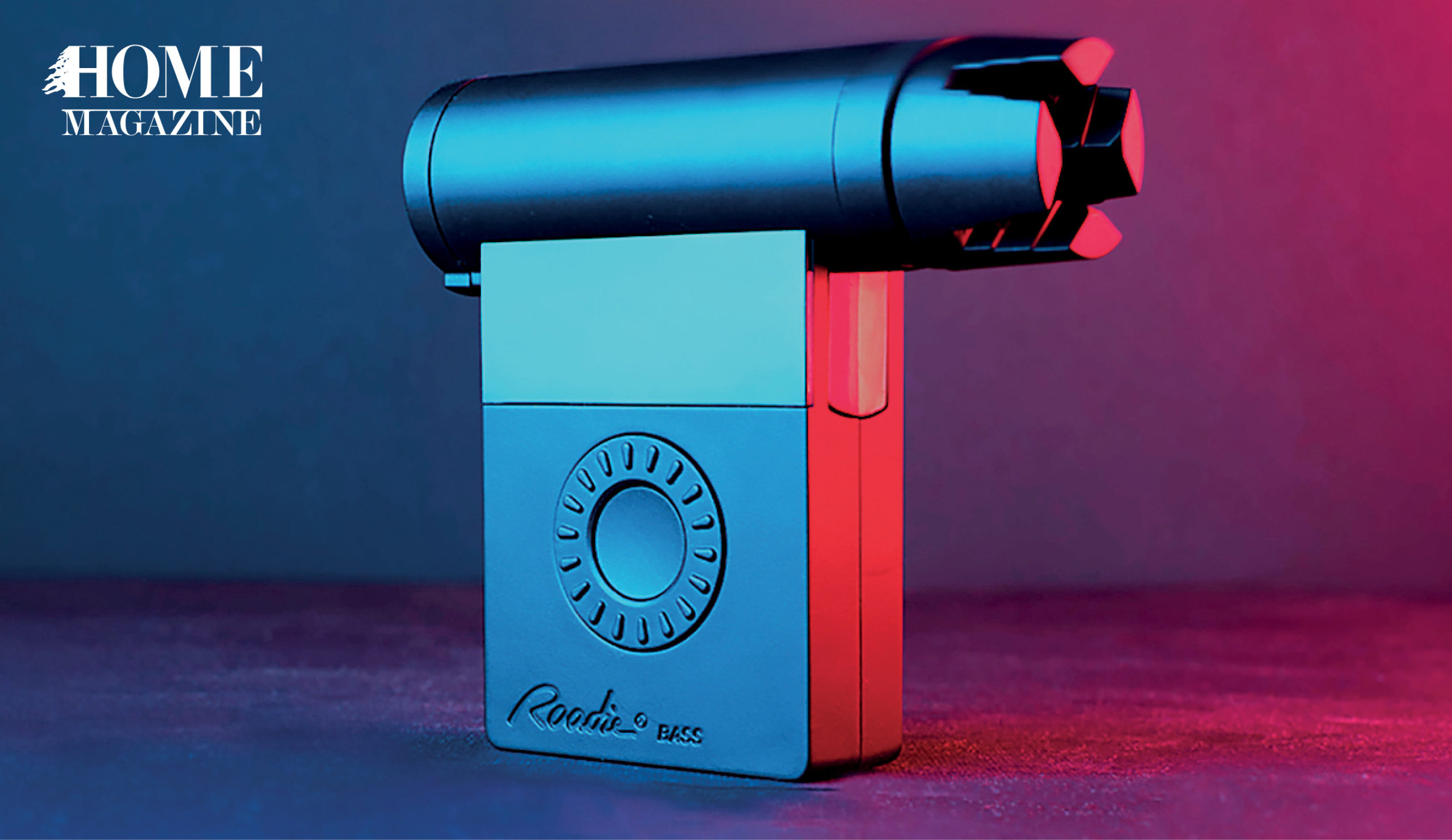
Manufacturing processes were changing rapidly at the time, making high processing power increasingly accessible, according to Jalgha. Their patience was rewarded. In 2018 the pair released two new products: Roadie 2 and Roadie Bass. The new additions to the Roadie family began shipping to over 80 countries.
Both models use a vibration sensor to transmit frequencies directly from the instrument’s head to the device, meaning that ambient noise does not affect the device’s performance.
In addition, both devices have screens, allowing the user to experiment with more than 40 alternative tunings, or make their own custom presets.
Jalgha is thankful that he had the opportunity to continue developing his products during his time working as a research assistant in robotics after he had completed a master’s degree in the subject. “It is a great thing working as a research assistant — you are still involved in robotics,” says Jalgha.
Now, Jalgha wants to take Roadie in a new direction.
“The Roadie family is moving forward,” says Jalgha. “We are improving on software and hardware. Now, the program has moved toward music education.” Jalgha explains that he and Slaibi have been developing firmware and software that could be used in music classrooms to “help students learn and teachers teach.” He is unwilling to give any more details on the secret project which he hopes will launch next year.
“We haven’t announced this yet. It is a new technology,” he adds, describing it as “basically using artificial intelligence to teach students music.” The new technology may or may not be released under the Roadie trademark.
Despite Roadie’s commercial success in the world of standardized stringed instruments, Jalgha is still looking for challenges and may bring Roadie full circle. “Designing a tuner for the oud is still a pet project. It is a very interesting engineering problem, but very hard.”
For more info:
https://www.instagram.com/bassamjalgha/
https://www.facebook.com/bassam.jalgha
Twitter @bassamjalgha



 Signature Boutique