


HOMEland
Coming Soon
HOMEland Events & Collaborations
Coming Soon
 Signature Boutique


It all started in a small Armenian-Lebanese community in Antelias. The initial idea of Ganatch -the Armenian word for ‘green’-came from former yoga instructor Varant Kurkjian, who wanted to revive the spirit not only in the physical sense, but also emotionally; to liberate the mind and soul through the simple act of recycling. In essence, giving birth to a greener environment, and a greener person.
The initiative
The main motto of Ganatch is “Recycle with a Purpose.” Kurkjian, along with two other key activists Garo Keurkeunian and Lara Chahbazian, are the people behind this initiative.
Not only does this initiative recycle plastic bottles, cardboard, and paper, but also several out of the ordinary materials. Old electronics, home appliances, metals, glassware, old books, and cans are all treasures in their eyes.
Kurkjian’s younger sister, Dikki Vrejkurkjiann, a student at the American University of Beirut, helped to create the process and explained what sets Ganatch apart from other recycling initiatives that have cropped up in recent years.
“We’re different because we don’t just give people recycling bins and tell them to put their trash in them, we actually go inside families’ HOMEs and cooperate with them to sort the garbage on a more personal level. Ganatch creates the change within a person. It’s literally like planting a seed and watching the lifestyle changes, and the ways they think about nature and the environment,” says Vrejkurkjiann.
“We actually go inside families’ HOMEs and cooperate with them to sort the garbage on a more personal level”
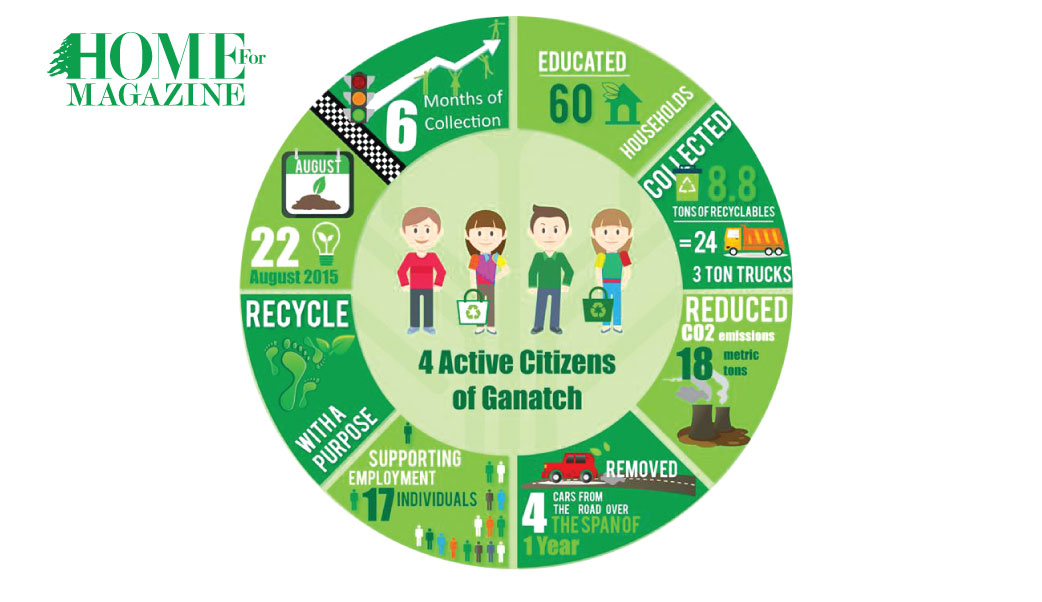
Recycling with a purpose involves reducing waste, reusing and giving back to the environment as much as we take from it. Ganatch teamed up with L’Ecoute, an NGO which gathers and sorts the materials. L’Ecoute employs disadvantaged and disabled people, and the amount of garbage that they recycle determines their wage. By working with this particular organization, Ganatch increases the amount of recyclables that they collect, and by extension, creates more job opportunities for the employees. Over the past nine months, Ganatch has been spreading the word and expanding slowly across Lebanon, most recently in the Mar Mikhael-Gemmayze area of Beirut.
There is a fundamental belief system inherent in any recycling initiative: Go back to the basics of active citizenship.
“We witnessed firsthand disabled people diligently working and trying to help sort out the materials, even though they have special needs; some are visually impaired, auditory impaired or non-verbal,” Vrejkurkjiann revealed how Ganatch envisions that principle.
The objective
“The reason we collect right now is simply to take that first step in encouraging people in the long run to adopt the habit of recycling. Word of mouth has worked in our favor. Friends tell their neighbors,” continued Vrejkurkjiann.
Ganatch has managed to collect an overwhelming 8.8 tons of recyclables and reduced about 18 metric tons of CO2 emissions in just six months, and the numbers are still climbing. Their guidelines of what can and cannot be recycled, in which bin it goes into and whether the item should be rinsed has also played a major role in training the young.
Ganatch was recently awarded $5,000 by LG Lebanon for its ‘Wish Upon a Star’ competition. This prize will help in the coming year, covering the expenses of the truck that Kurkjian , Keurkeunian and Chahbazian have rented to collect the recyclables.
Signature Boutique
Lebanon, in your inbox


HOMEland Magazine
We firmly believe that the internet should be available and accessible to anyone, and are committed to providing a website that is accessible to the widest possible audience, regardless of circumstance and ability.
To fulfill this, we aim to adhere as strictly as possible to the World Wide Web Consortium’s (W3C) Web Content Accessibility Guidelines 2.1 (WCAG 2.1) at the AA level. These guidelines explain how to make web content accessible to people with a wide array of disabilities. Complying with those guidelines helps us ensure that the website is accessible to all people: blind people, people with motor impairments, visual impairment, cognitive disabilities, and more.
This website utilizes various technologies that are meant to make it as accessible as possible at all times. We utilize an accessibility interface that allows persons with specific disabilities to adjust the website’s UI (user interface) and design it to their personal needs.
Additionally, the website utilizes an AI-based application that runs in the background and optimizes its accessibility level constantly. This application remediates the website’s HTML, adapts Its functionality and behavior for screen-readers used by the blind users, and for keyboard functions used by individuals with motor impairments.
If you’ve found a malfunction or have ideas for improvement, we’ll be happy to hear from you. You can reach out to the website’s operators by using the following email
Our website implements the ARIA attributes (Accessible Rich Internet Applications) technique, alongside various different behavioral changes, to ensure blind users visiting with screen-readers are able to read, comprehend, and enjoy the website’s functions. As soon as a user with a screen-reader enters your site, they immediately receive a prompt to enter the Screen-Reader Profile so they can browse and operate your site effectively. Here’s how our website covers some of the most important screen-reader requirements, alongside console screenshots of code examples:
Screen-reader optimization: we run a background process that learns the website’s components from top to bottom, to ensure ongoing compliance even when updating the website. In this process, we provide screen-readers with meaningful data using the ARIA set of attributes. For example, we provide accurate form labels; descriptions for actionable icons (social media icons, search icons, cart icons, etc.); validation guidance for form inputs; element roles such as buttons, menus, modal dialogues (popups), and others. Additionally, the background process scans all the website’s images and provides an accurate and meaningful image-object-recognition-based description as an ALT (alternate text) tag for images that are not described. It will also extract texts that are embedded within the image, using an OCR (optical character recognition) technology. To turn on screen-reader adjustments at any time, users need only to press the Alt+1 keyboard combination. Screen-reader users also get automatic announcements to turn the Screen-reader mode on as soon as they enter the website.
These adjustments are compatible with all popular screen readers, including JAWS and NVDA.
Keyboard navigation optimization: The background process also adjusts the website’s HTML, and adds various behaviors using JavaScript code to make the website operable by the keyboard. This includes the ability to navigate the website using the Tab and Shift+Tab keys, operate dropdowns with the arrow keys, close them with Esc, trigger buttons and links using the Enter key, navigate between radio and checkbox elements using the arrow keys, and fill them in with the Spacebar or Enter key.Additionally, keyboard users will find quick-navigation and content-skip menus, available at any time by clicking Alt+1, or as the first elements of the site while navigating with the keyboard. The background process also handles triggered popups by moving the keyboard focus towards them as soon as they appear, and not allow the focus drift outside it.
Users can also use shortcuts such as “M” (menus), “H” (headings), “F” (forms), “B” (buttons), and “G” (graphics) to jump to specific elements.
We aim to support the widest array of browsers and assistive technologies as possible, so our users can choose the best fitting tools for them, with as few limitations as possible. Therefore, we have worked very hard to be able to support all major systems that comprise over 95% of the user market share including Google Chrome, Mozilla Firefox, Apple Safari, Opera and Microsoft Edge, JAWS and NVDA (screen readers).
Despite our very best efforts to allow anybody to adjust the website to their needs. There may still be pages or sections that are not fully accessible, are in the process of becoming accessible, or are lacking an adequate technological solution to make them accessible. Still, we are continually improving our accessibility, adding, updating and improving its options and features, and developing and adopting new technologies. All this is meant to reach the optimal level of accessibility, following technological advancements. For any assistance, please reach out to