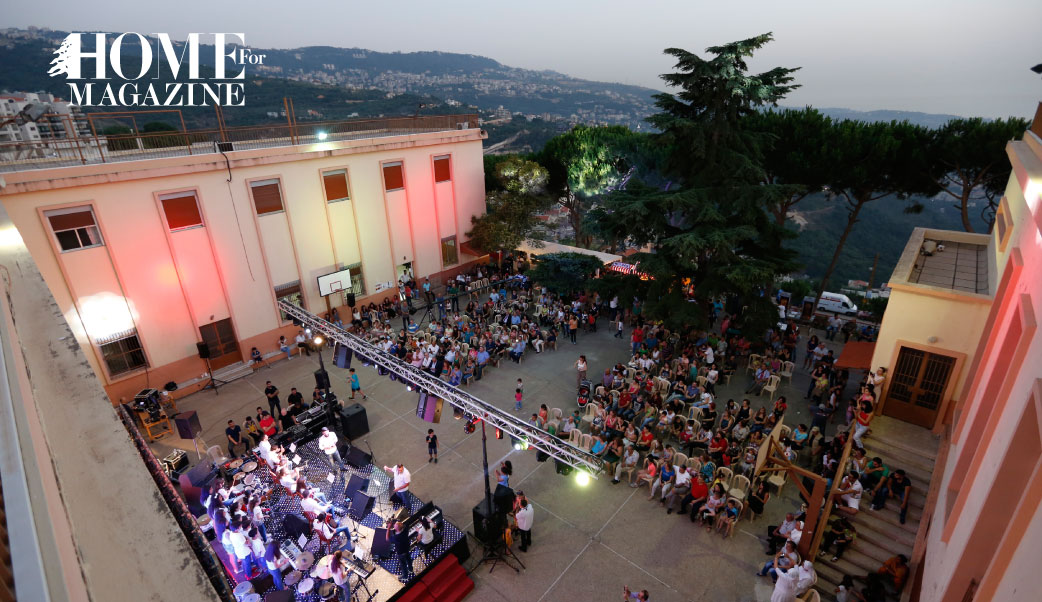
True simplicity combines goodness to beauty” are words pronounced by the great Greek philosopher Plato. They perfectly describe the evening of June 21, when Kahale and Araya, mountain villages in Aley’s district, celebrated “La fête de la musique” also known as “Make Music Day” for the first time. Families from Kahale and the surrounding villages joined on a peaceful night to enjoy live musical performances in Don Bosco’s monastery.
The terrace was overlooking majestic green scenery, lit by house lanterns and moon rays shining from a dark blue sky. A feel of intimacy and camaraderie filled the place, as everyone appeared to know everyone. The festival did not seem to be just a gathering to honour music, but to salute the people too. Suddenly, we were flashed back to the old village days, when neighbors gathered over oud melodies and sweet light saj smells. This year marks the 35th celebration of La fête de la musique in France, and the 16th in Beirut. According to Minister Audrey Azoulay, current French Culture Minister, this year’s theme is “Music is stronger than…” Remembering last year’s terrorist attacks in Paris that took the lives of 147 individuals, he adds that music is crucial when it comes to “overcoming our fears, fighting division, because it is stronger than those who want to shut it off.” The first Make Music Day was, in fact, created in 1982 by Jack Lang, former French Minister of Culture. He thought that there should be a day, when all people go on the streets to play instruments and sing. Now the festival is being celebrated in 700 cities, in 120 countries.

However, Kahale was not only glorifying music, as the people were celebrating one of its most important achievements, The Don Bosco Cultural Center. Don John Bosco, named the Father of the Oratories, or “El padre de los oratorios” in Italian, is the Roman Catholic priest who founded the Salesians of Don Bosco Institute in the nineteenth century. It all started when he picked up a delinquent boy from the street, left with neither education nor religion and spent Sundays entertaining him and other needy young ones with recreational and fun activities, to end the day with a small notion on catechism.
The Don Bosco Cultural Center opts to work towards the same mission where students of Kahale are welcome to come to “expand skills and capacities”. It offers courses in the English language, computer use, sports and many other subjects, including of course religion. It also helps students apply to jobs by improving their resumes and cover letters according to the position’s requirements. Yasmine Bejjani, a 17 year old volunteer in the center explains: “I’ve been volunteering every weekend with the kids of the oratorio. We are the salesians of Don Bosco, the congregation and the oratorio is literally our home. We can do whatever we want and the nuns are our mothers and sisters”. She also added that music is a great way to distract anyone from the problems surrounding them, allowing them to focus on the positives in life: “after all, music unites us all”.
The engine behind this initiative is Abboud Bejjani, chairman of the founding board of Don Bosco’s Cultural Center. He told HOME that it is both surprising and interesting that approximately 10% of the village’s population can play at least one instrument. They’re all amateurs and are not being paid to perform. They’re just sharing their talents for the sake of joy and obtaining revenues to fund the center’s summer camp.
For more information: www.donboscowest.org
Lebanon, in your inbox
HOMEland Magazine
We firmly believe that the internet should be available and accessible to anyone, and are committed to providing a website that is accessible to the widest possible audience, regardless of circumstance and ability.
To fulfill this, we aim to adhere as strictly as possible to the World Wide Web Consortium’s (W3C) Web Content Accessibility Guidelines 2.1 (WCAG 2.1) at the AA level. These guidelines explain how to make web content accessible to people with a wide array of disabilities. Complying with those guidelines helps us ensure that the website is accessible to all people: blind people, people with motor impairments, visual impairment, cognitive disabilities, and more.
This website utilizes various technologies that are meant to make it as accessible as possible at all times. We utilize an accessibility interface that allows persons with specific disabilities to adjust the website’s UI (user interface) and design it to their personal needs.
Additionally, the website utilizes an AI-based application that runs in the background and optimizes its accessibility level constantly. This application remediates the website’s HTML, adapts Its functionality and behavior for screen-readers used by the blind users, and for keyboard functions used by individuals with motor impairments.
If you’ve found a malfunction or have ideas for improvement, we’ll be happy to hear from you. You can reach out to the website’s operators by using the following email
Our website implements the ARIA attributes (Accessible Rich Internet Applications) technique, alongside various different behavioral changes, to ensure blind users visiting with screen-readers are able to read, comprehend, and enjoy the website’s functions. As soon as a user with a screen-reader enters your site, they immediately receive a prompt to enter the Screen-Reader Profile so they can browse and operate your site effectively. Here’s how our website covers some of the most important screen-reader requirements, alongside console screenshots of code examples:
Screen-reader optimization: we run a background process that learns the website’s components from top to bottom, to ensure ongoing compliance even when updating the website. In this process, we provide screen-readers with meaningful data using the ARIA set of attributes. For example, we provide accurate form labels; descriptions for actionable icons (social media icons, search icons, cart icons, etc.); validation guidance for form inputs; element roles such as buttons, menus, modal dialogues (popups), and others. Additionally, the background process scans all the website’s images and provides an accurate and meaningful image-object-recognition-based description as an ALT (alternate text) tag for images that are not described. It will also extract texts that are embedded within the image, using an OCR (optical character recognition) technology. To turn on screen-reader adjustments at any time, users need only to press the Alt+1 keyboard combination. Screen-reader users also get automatic announcements to turn the Screen-reader mode on as soon as they enter the website.
These adjustments are compatible with all popular screen readers, including JAWS and NVDA.
Keyboard navigation optimization: The background process also adjusts the website’s HTML, and adds various behaviors using JavaScript code to make the website operable by the keyboard. This includes the ability to navigate the website using the Tab and Shift+Tab keys, operate dropdowns with the arrow keys, close them with Esc, trigger buttons and links using the Enter key, navigate between radio and checkbox elements using the arrow keys, and fill them in with the Spacebar or Enter key.Additionally, keyboard users will find quick-navigation and content-skip menus, available at any time by clicking Alt+1, or as the first elements of the site while navigating with the keyboard. The background process also handles triggered popups by moving the keyboard focus towards them as soon as they appear, and not allow the focus drift outside it.
Users can also use shortcuts such as “M” (menus), “H” (headings), “F” (forms), “B” (buttons), and “G” (graphics) to jump to specific elements.
We aim to support the widest array of browsers and assistive technologies as possible, so our users can choose the best fitting tools for them, with as few limitations as possible. Therefore, we have worked very hard to be able to support all major systems that comprise over 95% of the user market share including Google Chrome, Mozilla Firefox, Apple Safari, Opera and Microsoft Edge, JAWS and NVDA (screen readers).
Despite our very best efforts to allow anybody to adjust the website to their needs. There may still be pages or sections that are not fully accessible, are in the process of becoming accessible, or are lacking an adequate technological solution to make them accessible. Still, we are continually improving our accessibility, adding, updating and improving its options and features, and developing and adopting new technologies. All this is meant to reach the optimal level of accessibility, following technological advancements. For any assistance, please reach out to
Speaking Truth to Power: Pierre Sadek Foundation