LeBAM, Transforming Lives Through Music Education
An 80-member youth band in a mountain courtyard sparked a decade-long mission: free music education for Lebanon's next generation.

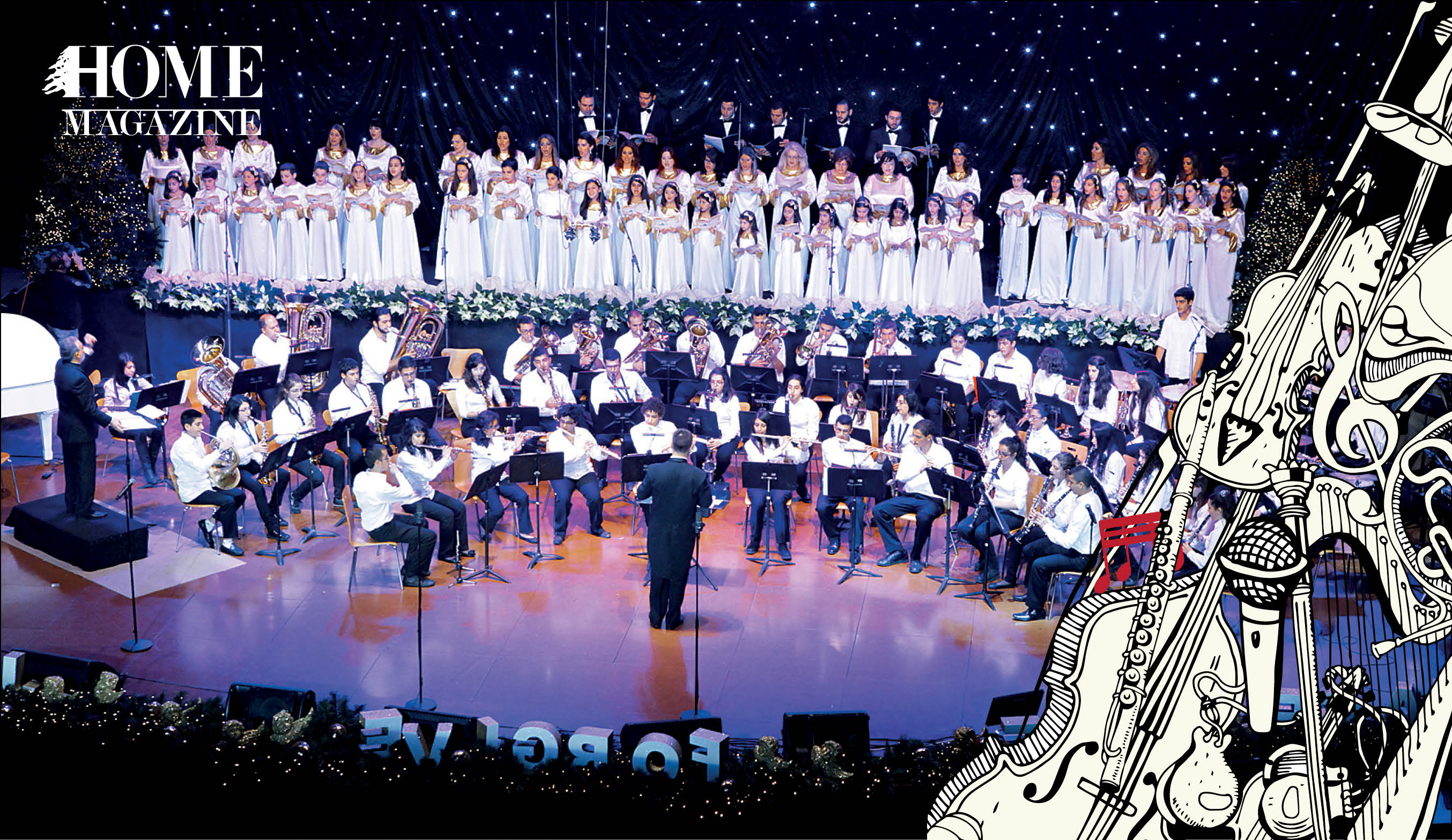
We first came into contact with The Lebanese Band Association for the Promotion of Music (LeBAM) when HOME Magazine was invited to hear its band perform in the village of Baskinta, in the district of Metn, many years ago. Not knowing what to expect from a young orchestra, we sat among the crowd expecting an ordinary, haphazard performance of familiar tunes at best. But once the music started, we were blown away and utterly surprised.
The 80-member band performed on a courtyard of a local school. Collectively, they were powerful and mesmerizing to watch. Each musician was sitting upright, transfixed on performing, while looking up methodically to receive cues from the poised and skillful conductor. The performance was pure harmony— from the rich and magnificent compositions to the meticulous organization of the entire concert.
That evening, the audience was made up of mostly parents of the young musicians. The chaos from the crowd juxtaposed with order and discipline suddenly sparked something in us. It became apparent how music transforms people—no matter where they come from—by instilling the discipline needed to perform together harmoniously. This concert further confirmed our belief that music has the power to elevate societies and to evoke positive change.
LeBAM encompasses many programs and objectives revolved around the dissemination of music to encourage positive personal and social transformation. LeBAM is truly a unique nonprofit in Lebanon, first and foremost committed to creating a nationwide network of youth orchestras and bands.

Lawyer, university lecturer and former Lebanese Member of Parliament Ghassan Moukheiber founded LeBAM in 2008 after recognizing a need in Lebanon to promote more wind and percussion players. “LeBAM was initially launched for a very simple reason,” he explains. When I was a young student back in 1977, I wanted to learn the flute, but I could not find a teacher. So instead I took up the oboe.” Lebanese music students did not favor wind instruments, such as the clarinet, trumpet and the French horn. These instruments were considered rare and more expensive, and most students gravitated toward learning piano or guitar.
To illustrate this point, Moukheiber takes out a base clarinet and an oboe from his personal collection. The oboe, which is crafted from metal and wood, can cost an average of $5,000.
Moukheiber explains that affordable instruments tend to be more popular. “For example, you can pay $100 for a guitar and around $150 for a keyboard. You can play the guitar or the piano solo and they sound great, while wind instruments and percussions are meaningful only in an orchestra.”
Harvard-educated Moukheiber truly stands apart from your typical politician in the country. His philanthropy and dedication to improve society through music is inspiring. “I once realized that music promotes peace and cooperation, while terrorists fear music, which is why they try to abolish it. Music is really transformative,” muses Moukheiber, a music lover himself who is clearly very devoted to LeBAM as its president. “The piece that made me fall in love with music was listening for the first time to the 1812 Overture by Tchaikovsky.”
The third year at LeBAM was his most rewarding he tells HOME. “We performed in Nabay, a small village in Metn, on the public square. Our young musicians performed this piece to the locals and they loved it. They heard Tchaikovsky for the first time!”
Initially, Moukhaiber partnered with the late Ghassan Tueini, veteran Lebanese journalist and member of parliament, and the late Walid Gholmieh, former composer and president of the National Higher Music Conservatoire. LeBAM began with eight teachers and 40 students. Many of the instructors and conductors were Conservatoire teachers from Eastern Europe because of the region’s wealth of skilled classical musicians and its proximity to Lebanon. Serghei Bolun, LeBAM’s National Wind Symphony’s music director and conductor, who is from Romania, joined them from the very start and continues to serve at the helm of the organization’s best group of musicians.
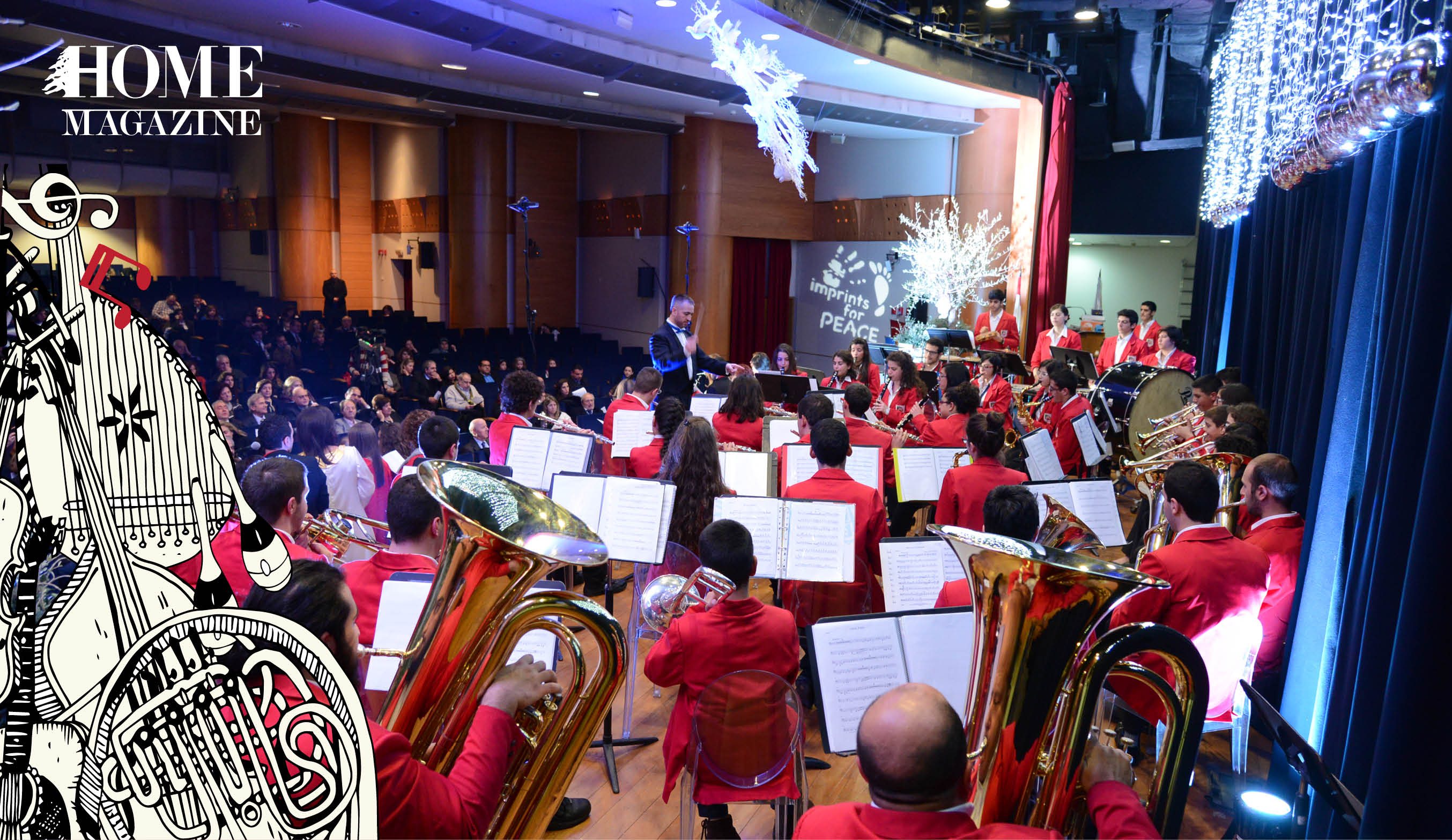
LeBAM targets 10- to 18-year-old students, primarily recruited from public schools and needy communities in the country. The organization offers free music lessons on wind and percussion instruments three hours weekly, provided to the students at no cost, and transportation is also arranged if needed, all for a very nominal and symbolic fee.
“We start our initiation to music with the recorder, a woodwind musical instrument, for three months to teach rhythm and basics of music,” explains Marina Wakim, who is Moukheiber’s wife. “Then, we divide the new students into four groups to teach them the clarinet, trombone, flute and trumpet. Later, students can move onto all other instruments, such as tuba or French horn, which are harder to master. Others move to percussions, such as drums and the xylophone.”
These instruments are essential to form an orchestra. Today, LeBAM has its own National Youth Wind Symphony including about 52 musicians of excellent standing, which has performed in prestigious venues such as the Victoria Hall in Geneva and the Beiteddine Festival. LeBAM also has eight other regional bands, ranging from beginners to advanced levels.
LeBAM teaches music for free to approximately 400 students across four centers: Beit Mery, Baskinta, Tripoli and Baakline. This year, they plan to open a center in Beirut and will be taking on plenty of new students. After Beirut, it hopes to target Saida, Zahle, Baalbeck and Tyre. “We hope to create a network of musicians with Lebanese of all social and religious backgrounds,” says Moukheiber. Unlike most music schools, LeBAM is unique in that it is a band program. The students learn with the intent of being part of an orchestra and to perform in front of an audience regularly.
“Music teaches collaboration … music teaches precision … music is an audible illustration of diversity.”
Moukheiber tells HOME that the ultimate goal of LeBAM is to make the teaching of music mandatory in schools in Lebanon. This will require the development of an adapted pedagogy, method books and the training of teachers. This project is currently still in the planning phase, in collaboration with the Ministry of Education. He strongly believes that music teaches important values to people that are inextricably linked to citizenship. He gives three examples to illustrate this: “Music teaches collaboration, whether being in a choir or an orchestra. Unlike sports, which can be competitive, music is pure collaboration. Secondly, music teaches precision. You have to play on the dot and practice a lot of discipline. You can’t get away in an orchestra with sloppy play. Thirdly, music is an audible illustration of diversity, by learning different styles of music and playing alongside different instruments and different music lines.”
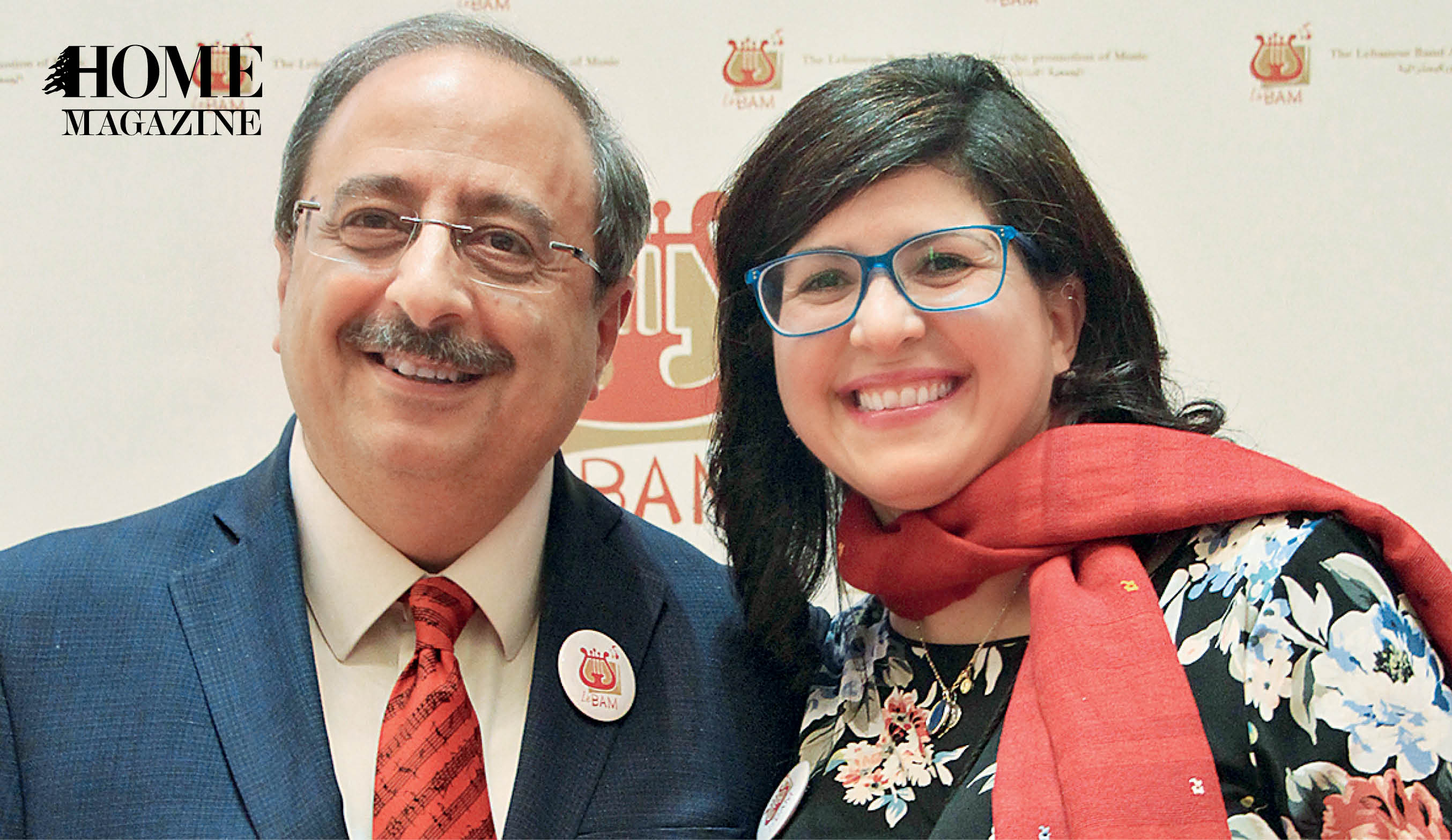
Moukheiber shows some of his instruments to HOME Magazine at his Beit Mery HOME, which he shares with his wife, a former French horn student at LeBAM, who also plays piano and sings. Since joining in 2012, Marina is very much engaged in running the organization and being its spokesperson. In fact, during the interview with HOME, Moukheiber quips with pride: “I met my wife in LeBAM!” Hearing them speak, it is clear that they both share a deep love for music and are equally and unequivocally committed to the mission of LeBAM.
At LeBAM, many genres of music are taught ranging from Arabic to jazz, classical and more. For its students, music can also become a profession instead of simply an extracurricular activity. Many LeBAM students have continued on to become full-time musicians or music teachers. “Some of our students have become members of the Lebanese Philharmonic Orchestra too,” Moukheiber says proudly. “We hope to, one day, also have a full youth symphonic orchestra. That is our long-term goal.”
LeBAM has developed pedagogies of its own that are modeled after the highest caliber methods used in the United States to provide training for its teachers. It also has the only public music library in Lebanon with more than 4,000 books and teaching materials at the Notre Dame University. Each summer, LeBAM puts together its yearly International Summer Band Camp, an eight-day workshop open to about 250 students, both LeBAM and non-LeBAM (some come from Jordan, Iraq and Palestine). The Lebanese get free transportation while the visiting students receive free room and board. The International Summer Band Camp invites some of the best teachers and conductors from around the world.
The organization has many projects in conjunction with a number of local and international partners, including the National Higher Music Conservatoire of Lebanon. LeBAM also offers programs for special needs students during their regular summer camp programs. Special needs youth are taught to play the same instruments and later integrated with LeBAM bands to perform together.
Another initiative is the LeBAM Joyful Team, which sends musicians to various nursing HOMEs and hospitals to perform to the ill and elderly all year long. “We also have a partnership with SANAD, a palliative care NGO, where we perform for terminally ill patients,” adds Wakim. “It’s a form of therapy for them. We are planning to do more music collaborations with special needs students through the Arc en Ciel NGO.”
“Band music democratizes music”
“Band music democratizes music. It makes it accessible,” says Moukheiber, who gives an example by referring to a movement in early 19th century Europe in which music kiosks were set up in public squares. “Music should be accessible to everyone. Not something aloof, expensive or only for the rich,” he adds.
2018 was a milestone for this organization as it celebrated its 10th anniversary. LeBAM released a CD celebrating Lebanese composers with musical pieces especially arranged for the occasion. It features music by Zaki Nassif, Elias Rahbani, Walid Gholmieh, Marcel Khalife and others, all performed by LeBAM’s orchestra. The CD also featured retired General Georges Herro for the arrangements of most of the music, among other key collaborators.
To sustain offering its programs at no cost, LeBAM relies on sponsors and beneficiaries for financial and in-kind contributions, such as donating new or used instruments.
Support is always welcome and can be as small as offering an instrument to a student, or as substantial as funding the cost of a yearly teacher training workshop. For more information about LeBAM and how to donate, you can visit their website at www.lebam.org.
[instalink id=”16″]
For more info: www.lebam.org.


 Signature Boutique



Speaking Truth to Power: Pierre Sadek Foundation