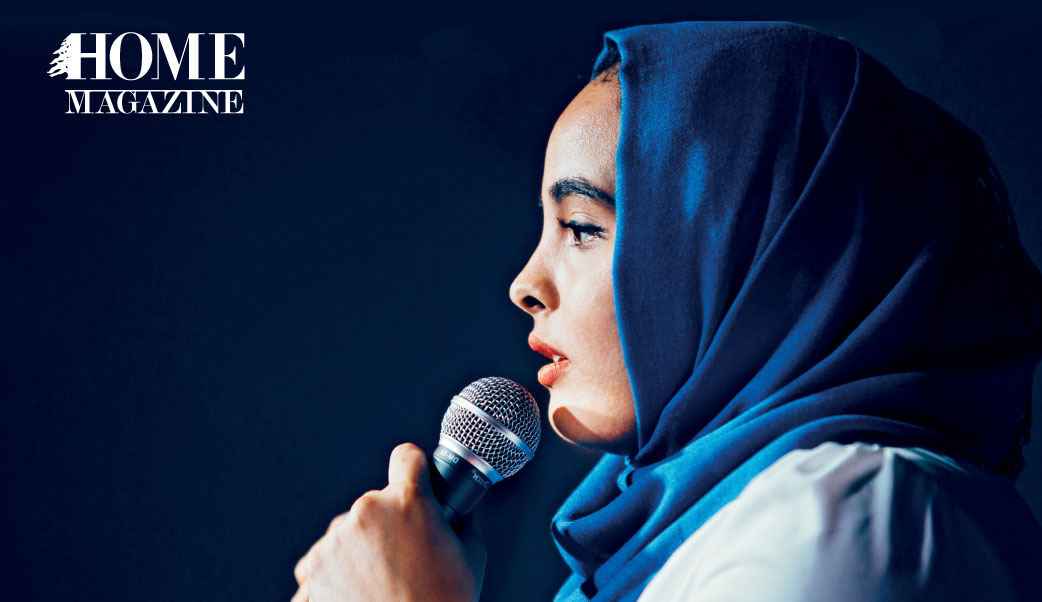
Spoken word poetry has taken a foothold in Lebanon, where a growing number of young people are embracing its soul-baring, truth-telling qualities.
Photo by: Nadim Kamel
Under the stars, on Rafik Hariri University’s green, in front of friends and strangers, Dana Seif stepped onto the stage. She felt a tightness in her throat and fluttering in her stomach as she revealed deeply personal thoughts in a poem about her struggle with depression.
Four months later, Seif competed in the first Beirut Poetry Slam at the Art Lounge in Beirut. The top two winners of the slam would represent Lebanon at an international competition in London. In the rarified air of the intimate venue, Seif felt the synergy of the supportive atmosphere. The audience snapped their fingers, as a sign of encouragement, as she bared her soul. Her poem, Tinder Talk, tackled tough questions about God and doubts about her faith.
The Beirut Poetry Slam in October 2016 marked a milestone in the growth of Lebanon’s thriving spoken word poetry scene. Several poetry collectives have developed in Beirut over the past six years and have taken hold. The art form is flourishing, with monthly spoken word events in various venues. At the slam, the collectives came together to compete and to send local poets out into the world – first stop, London.
The Slam was organized by Raw Voices, a Beirut-based spoken word collective, in collaboration with Haven for Artists, an art collective, and El Yafta, a literary circle and a collective of cultural activists, both also in Beirut. It was sponsored and supported by the Roundhouse, a leading arts center in London.
Spoken word’s distinctive style
Spoken word poetry is performance poetry – designed for the stage, not the page. Poets use rhythm, expression and intonation, as well as wordplay and rhyme. Above all, they value open and honest expression.
Spoken word poetry is particularly popular among high school and university students, who use it both for personal expression and political activism.
Ghada Seifeddine, founder of the 101 Poetry Nights collective, said she enjoys spoken word poetry because it gives her space for self-reflection. “Sometimes we go about our lives never fully able to express how we feel and what we experience, and these platforms provide the opportunity to have that.
“The community is brought together for one sole purpose: to listen to one another without judgment and bias. It is an escape from bitter realities.”

Spoken word thrives in Lebanon
“The spoken word scene in Lebanon is growing in breadth and depth,” said Sara Sibai, co-founder of Raw Voices, a collective of spoken word poets, lyricists, musicians, and performing artists. “More events are being hosted by different groups and in different spaces around Beirut. There’s a poetry event at least once a month.”
Some say that spoken word particularly resonates in the Middle East, where poetry has long been highly respected. Others say its freedom of expression is attractive in a part of the world where such freedom is lacking.
“Composing and presenting spoken word poetry challenges us,” said Sibai, “but it’s where I tap into values that I would like to engage more with in my life: courage, honesty, sharing and openness. It makes me feel very alive, present and more deeply connected to humanity.”
Dayna Ash, founder of Haven for Artists in Mar Mikhael, said that spoken word has grown quickly “because a lot of people have a lot to say.
“Poetry is an accessible form of expression. You just need to figure out how to say what you want to say.”
Facebook: Raw Voices, Haven for Artists
el Yafta
HOMEland Magazine
We firmly believe that the internet should be available and accessible to anyone, and are committed to providing a website that is accessible to the widest possible audience, regardless of circumstance and ability.
To fulfill this, we aim to adhere as strictly as possible to the World Wide Web Consortium’s (W3C) Web Content Accessibility Guidelines 2.1 (WCAG 2.1) at the AA level. These guidelines explain how to make web content accessible to people with a wide array of disabilities. Complying with those guidelines helps us ensure that the website is accessible to all people: blind people, people with motor impairments, visual impairment, cognitive disabilities, and more.
This website utilizes various technologies that are meant to make it as accessible as possible at all times. We utilize an accessibility interface that allows persons with specific disabilities to adjust the website’s UI (user interface) and design it to their personal needs.
Additionally, the website utilizes an AI-based application that runs in the background and optimizes its accessibility level constantly. This application remediates the website’s HTML, adapts Its functionality and behavior for screen-readers used by the blind users, and for keyboard functions used by individuals with motor impairments.
If you’ve found a malfunction or have ideas for improvement, we’ll be happy to hear from you. You can reach out to the website’s operators by using the following email
Our website implements the ARIA attributes (Accessible Rich Internet Applications) technique, alongside various different behavioral changes, to ensure blind users visiting with screen-readers are able to read, comprehend, and enjoy the website’s functions. As soon as a user with a screen-reader enters your site, they immediately receive a prompt to enter the Screen-Reader Profile so they can browse and operate your site effectively. Here’s how our website covers some of the most important screen-reader requirements, alongside console screenshots of code examples:
Screen-reader optimization: we run a background process that learns the website’s components from top to bottom, to ensure ongoing compliance even when updating the website. In this process, we provide screen-readers with meaningful data using the ARIA set of attributes. For example, we provide accurate form labels; descriptions for actionable icons (social media icons, search icons, cart icons, etc.); validation guidance for form inputs; element roles such as buttons, menus, modal dialogues (popups), and others. Additionally, the background process scans all the website’s images and provides an accurate and meaningful image-object-recognition-based description as an ALT (alternate text) tag for images that are not described. It will also extract texts that are embedded within the image, using an OCR (optical character recognition) technology. To turn on screen-reader adjustments at any time, users need only to press the Alt+1 keyboard combination. Screen-reader users also get automatic announcements to turn the Screen-reader mode on as soon as they enter the website.
These adjustments are compatible with all popular screen readers, including JAWS and NVDA.
Keyboard navigation optimization: The background process also adjusts the website’s HTML, and adds various behaviors using JavaScript code to make the website operable by the keyboard. This includes the ability to navigate the website using the Tab and Shift+Tab keys, operate dropdowns with the arrow keys, close them with Esc, trigger buttons and links using the Enter key, navigate between radio and checkbox elements using the arrow keys, and fill them in with the Spacebar or Enter key.Additionally, keyboard users will find quick-navigation and content-skip menus, available at any time by clicking Alt+1, or as the first elements of the site while navigating with the keyboard. The background process also handles triggered popups by moving the keyboard focus towards them as soon as they appear, and not allow the focus drift outside it.
Users can also use shortcuts such as “M” (menus), “H” (headings), “F” (forms), “B” (buttons), and “G” (graphics) to jump to specific elements.
We aim to support the widest array of browsers and assistive technologies as possible, so our users can choose the best fitting tools for them, with as few limitations as possible. Therefore, we have worked very hard to be able to support all major systems that comprise over 95% of the user market share including Google Chrome, Mozilla Firefox, Apple Safari, Opera and Microsoft Edge, JAWS and NVDA (screen readers).
Despite our very best efforts to allow anybody to adjust the website to their needs. There may still be pages or sections that are not fully accessible, are in the process of becoming accessible, or are lacking an adequate technological solution to make them accessible. Still, we are continually improving our accessibility, adding, updating and improving its options and features, and developing and adopting new technologies. All this is meant to reach the optimal level of accessibility, following technological advancements. For any assistance, please reach out to