



HOMEland THEMES
Coming Soon
HOMEland Events & Collaborations
Coming Soon
 Signature Boutique

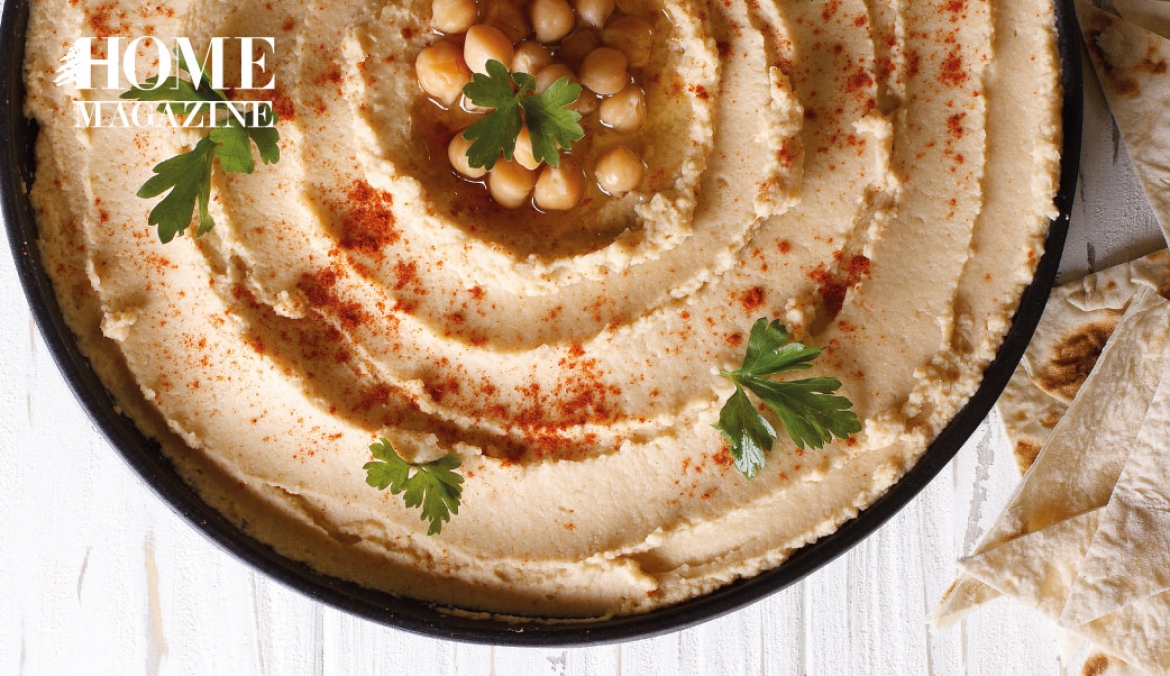
Some might describe it as a creamy, savory, decadent appetizer with numerous nutritional values. Others may think of it as mesmerizing and purely satisfying to their pallet. Still others would cross heaven and hell to claim it as their own, whether you’re a native Lebanese resident or a member of the vast diaspora, one thing is certain: Hummus tastes like HOME.
HISTORY & FOLKLORE
For centuries, there has been much debate as to the roots of this essential part of the Lebanese culinary heritage. As everyone in this quaint Mediterranean country knows hummus, or hummus bi tahini, is a staple of any cold mezze or feast. Few know, however, the exact origins of the chickpea and tahini based paste or how it came to be so popular.
Hummus, literally translated as chickpea in Arabic, comprises four main ingredients chickpeas, tahini (sesame seed paste),garlic, and lemon. This flavor combination holds significant importance to Turkish, Egyptian, Syrian, and most prominently,Lebanese backgrounds. Early medieval cookbooks from 13th century Cairo and Damascus depict recipes that bear uncanny resemblances to modern-day hummus, but lack in either lemon or tahini. Extra herbs and walnuts were added to those variations, while vinegar was sometimes substituted for lemon.
Lebanon expands on ancient customs, making the creamy spread even tastier by incorporating various additions, such as olive oil, paprika, spiced ground meat, pine nuts, pomegranate seeds, and/or radish blossoms.In 2010, a group of 300 Lebanese student chefs at Al- Kafaat University in Beirut achieved the Guinness World Record for the largest serving of hummus, in an effort to put to rest any claims that hummus originated elsewhere. It weighed 10,452 kilograms and was served on a giant ceramic plate 7.17 meters in diameter.
“Whether you’re a native Lebanese resident or a member of the vast diaspora, one thing is certain: Hummus tastes like HOME.”
The truth is, there are incomplete records of hummus’ birthplace, but what is known is that the components have been used in the Eastern Mediterranean and the Middle East for thousands of years. Chickpeas and tahini have been around for roughly 10,000 years, possibly since the beginning of civilization, predating both pottery and the written word. Lemons, on the other hand, are said to have first arrived in the region in the 8th century, while garlic goes all the way back to ancient Egypt and the construction of the Pyramids of Giza.
Some explain it as one of the oldest prepared foods known to man, while it is often claimed that hummus was a common street vendor product in old Palestine and that chickpeas were one of the earliest crops in Mesopotamia. Food variations previously relied on affordability and availability. Given the arid, desert climate of one half of the region and the humid, rainy weather of the other, it’s evident that hummus was a healthy, flavorful food that traveled exceptionally well. High in fiber, iron, potassium, and Vitamin C, it is often described as a nutritionists’ miracle dish.
The historical enigma surrounding hummus laid the groundwork for what has come to be an international gastronomic phenomenon, with many expert chefs and HOMEcooks revolutionizing the procedure with ingredients that complement the original formula nicely. They substitute edamame beans, white kidney beans, avocados, and so much more for chickpeas, while they add various flavor options like roasted red pepper, zucchini, spinach, and feta.
Nowadays, Lebanese cooks have the convenience of utilizing canned chickpeas, which is a contentious issue: canned versus fresh. Most people also have a food processor somewhere in their kitchen cabinet. Traditionally, however, there was a very specific and elaborate process to preparing hummus bi tahini, one that involved a mortar and pestle.
For more info
Signature Boutique 

HOMEland Magazine
We firmly believe that the internet should be available and accessible to anyone, and are committed to providing a website that is accessible to the widest possible audience, regardless of circumstance and ability.
To fulfill this, we aim to adhere as strictly as possible to the World Wide Web Consortium’s (W3C) Web Content Accessibility Guidelines 2.1 (WCAG 2.1) at the AA level. These guidelines explain how to make web content accessible to people with a wide array of disabilities. Complying with those guidelines helps us ensure that the website is accessible to all people: blind people, people with motor impairments, visual impairment, cognitive disabilities, and more.
This website utilizes various technologies that are meant to make it as accessible as possible at all times. We utilize an accessibility interface that allows persons with specific disabilities to adjust the website’s UI (user interface) and design it to their personal needs.
Additionally, the website utilizes an AI-based application that runs in the background and optimizes its accessibility level constantly. This application remediates the website’s HTML, adapts Its functionality and behavior for screen-readers used by the blind users, and for keyboard functions used by individuals with motor impairments.
If you’ve found a malfunction or have ideas for improvement, we’ll be happy to hear from you. You can reach out to the website’s operators by using the following email
Our website implements the ARIA attributes (Accessible Rich Internet Applications) technique, alongside various different behavioral changes, to ensure blind users visiting with screen-readers are able to read, comprehend, and enjoy the website’s functions. As soon as a user with a screen-reader enters your site, they immediately receive a prompt to enter the Screen-Reader Profile so they can browse and operate your site effectively. Here’s how our website covers some of the most important screen-reader requirements, alongside console screenshots of code examples:
Screen-reader optimization: we run a background process that learns the website’s components from top to bottom, to ensure ongoing compliance even when updating the website. In this process, we provide screen-readers with meaningful data using the ARIA set of attributes. For example, we provide accurate form labels; descriptions for actionable icons (social media icons, search icons, cart icons, etc.); validation guidance for form inputs; element roles such as buttons, menus, modal dialogues (popups), and others. Additionally, the background process scans all the website’s images and provides an accurate and meaningful image-object-recognition-based description as an ALT (alternate text) tag for images that are not described. It will also extract texts that are embedded within the image, using an OCR (optical character recognition) technology. To turn on screen-reader adjustments at any time, users need only to press the Alt+1 keyboard combination. Screen-reader users also get automatic announcements to turn the Screen-reader mode on as soon as they enter the website.
These adjustments are compatible with all popular screen readers, including JAWS and NVDA.
Keyboard navigation optimization: The background process also adjusts the website’s HTML, and adds various behaviors using JavaScript code to make the website operable by the keyboard. This includes the ability to navigate the website using the Tab and Shift+Tab keys, operate dropdowns with the arrow keys, close them with Esc, trigger buttons and links using the Enter key, navigate between radio and checkbox elements using the arrow keys, and fill them in with the Spacebar or Enter key.Additionally, keyboard users will find quick-navigation and content-skip menus, available at any time by clicking Alt+1, or as the first elements of the site while navigating with the keyboard. The background process also handles triggered popups by moving the keyboard focus towards them as soon as they appear, and not allow the focus drift outside it.
Users can also use shortcuts such as “M” (menus), “H” (headings), “F” (forms), “B” (buttons), and “G” (graphics) to jump to specific elements.
We aim to support the widest array of browsers and assistive technologies as possible, so our users can choose the best fitting tools for them, with as few limitations as possible. Therefore, we have worked very hard to be able to support all major systems that comprise over 95% of the user market share including Google Chrome, Mozilla Firefox, Apple Safari, Opera and Microsoft Edge, JAWS and NVDA (screen readers).
Despite our very best efforts to allow anybody to adjust the website to their needs. There may still be pages or sections that are not fully accessible, are in the process of becoming accessible, or are lacking an adequate technological solution to make them accessible. Still, we are continually improving our accessibility, adding, updating and improving its options and features, and developing and adopting new technologies. All this is meant to reach the optimal level of accessibility, following technological advancements. For any assistance, please reach out to