He dared to dream big and to realize his dream. Micky Chebli decided for his 50th birthday to cycle for life. The Lebanese father, humanitarian and athlete succeeded in cycling from Paris to Beirut in May 2016 completing 4000 km in 35 days. His ultimate goal was to overcome the challenge while raising money to help three Lebanese local NGOs.
Wearing a smile and a bicycle bracelet, Micky talked about his journey to HOME Magazine.
“Cycling for life was my way of giving back to a life that has been so generous towards me and to understand the world differently,” states Micky. For him, pain is temporary but saving a child is forever. The experience allowed him to raise $198,000 to help three NGOs: Oum el Nour, that is specialized in drug prevention and rehabilitation, Les Petits Soleils that offers free health care for children in need, and Myschoolpulse that brings schools to hospitals and offers education to children undergoing treatment for life – threatening diseases. It all begun in 2008 when financial markets around the world crashed.
“From Paris to Beirut to raise $198,000 to help three NGOs”
Micky who was working in the banking sector, used to travel a lot. He was living abroad for a period of time, for him, it was a very unhealthy way of life and he started to feel the pressure. The crash was a wake- up call for him to change some aspects of his being.
In February 2009, he came back to Lebanon and decided to change things for good. He took up running. In November 2009, he ran his first marathon in Beirut and raised some money for Oum el Nour. From this point on a new passion was born, 2009 was the year of changes for Micky and his priorities shifted from banking to sports.
In 2015, Micky came up with a plan. “I was about to turn 50 and I really wanted to chase a new dream and to challenge myself. I decided to do something that no cyclist had done before and to bike from to Beirut while helping people in need. I felt it is a privilege to make his journey. That was my dream, my challenge.”
The journey was not easy. Micky took a one – way ticket from Beirut to Paris and started the adventure from the Arc de Triomphe in Paris with the support of the Lebanese Embassy in France.
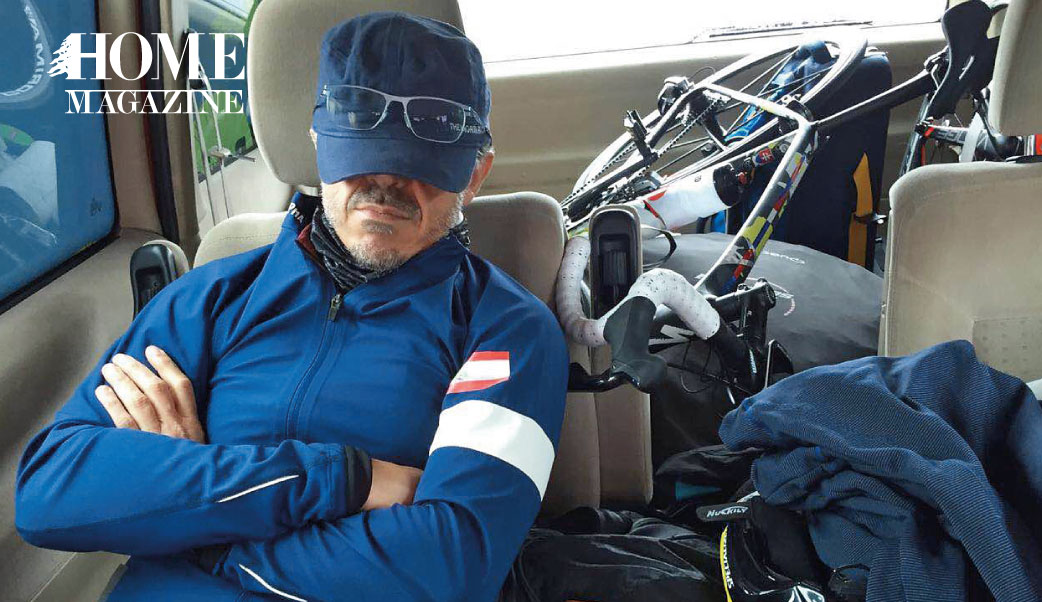
He had to complete 130 km every day. He biked all the way down through France and continued to the southern Italy coastal city of Brindisi where he took a boat to Italy. He crossed Greece and then took the plane from Greece to Izmir in Turkey.
“It was so hot in Greece and Turkey; the weather was a nightmare. The temperature was close to 52 degrees. I had to change the whole strategy of the trip and to start biking very early every day to avoid the hot weather as much as possible. I had a van following me with an extra bike. The van broke down, the bike didn’t!”

Turkey was the last destination before taking the plane to Beirut and then back on the bike for the final leg from Beirut to Byblos. Despite all the challenges, obstacles, pain and loneliness, Micky says “that ride was the best bike ride ever. It was a detoxification of my body and soul. Spending six hours alone every day is a way to go through everything in your life. My dreams and my priorities have changed because of this challenge. This experience brought me balance and inner peace and helped me to better understand myself”. Many people, family members, friends, organizations and sponsors supported Micky during his journey. This support helped Micky to achieve his dream. He was reading their encouraging messages all the way. He says: “I didn’t want to disappoint my wife and kids and everyone who believed in me. The pictures of kids from the three NGOs I was helping kept me going forward and the prospect of raising a life changing amount of money for them made my hard journey bearable, and my dad who accompanied me helped complete my quest.”
“Spending six hours alone every day is a way to go through everything in your life”
This was his 50th birthday gift and he shared it with Lebanese children. He wanted to be an inspiration to his family and to other people. His message to them is “dare to dream, dream big and go all the way to achieve your dream. And if you do so, try to make the less fortunate people feel happier”.
Micky’s next challenge is to cycle from New York to San Francisco (a 4000 km journey) and he intends to complete it in 40 days. Meanwhile, he is still running almost every day.
Micky Chebli is a cyclist for life; his dream is that in the future thousands of people will be cycling for life. Today he is more than ready for the next cycle of his life.
HOMEland Magazine
We firmly believe that the internet should be available and accessible to anyone, and are committed to providing a website that is accessible to the widest possible audience, regardless of circumstance and ability.
To fulfill this, we aim to adhere as strictly as possible to the World Wide Web Consortium’s (W3C) Web Content Accessibility Guidelines 2.1 (WCAG 2.1) at the AA level. These guidelines explain how to make web content accessible to people with a wide array of disabilities. Complying with those guidelines helps us ensure that the website is accessible to all people: blind people, people with motor impairments, visual impairment, cognitive disabilities, and more.
This website utilizes various technologies that are meant to make it as accessible as possible at all times. We utilize an accessibility interface that allows persons with specific disabilities to adjust the website’s UI (user interface) and design it to their personal needs.
Additionally, the website utilizes an AI-based application that runs in the background and optimizes its accessibility level constantly. This application remediates the website’s HTML, adapts Its functionality and behavior for screen-readers used by the blind users, and for keyboard functions used by individuals with motor impairments.
If you’ve found a malfunction or have ideas for improvement, we’ll be happy to hear from you. You can reach out to the website’s operators by using the following email
Our website implements the ARIA attributes (Accessible Rich Internet Applications) technique, alongside various different behavioral changes, to ensure blind users visiting with screen-readers are able to read, comprehend, and enjoy the website’s functions. As soon as a user with a screen-reader enters your site, they immediately receive a prompt to enter the Screen-Reader Profile so they can browse and operate your site effectively. Here’s how our website covers some of the most important screen-reader requirements, alongside console screenshots of code examples:
Screen-reader optimization: we run a background process that learns the website’s components from top to bottom, to ensure ongoing compliance even when updating the website. In this process, we provide screen-readers with meaningful data using the ARIA set of attributes. For example, we provide accurate form labels; descriptions for actionable icons (social media icons, search icons, cart icons, etc.); validation guidance for form inputs; element roles such as buttons, menus, modal dialogues (popups), and others. Additionally, the background process scans all the website’s images and provides an accurate and meaningful image-object-recognition-based description as an ALT (alternate text) tag for images that are not described. It will also extract texts that are embedded within the image, using an OCR (optical character recognition) technology. To turn on screen-reader adjustments at any time, users need only to press the Alt+1 keyboard combination. Screen-reader users also get automatic announcements to turn the Screen-reader mode on as soon as they enter the website.
These adjustments are compatible with all popular screen readers, including JAWS and NVDA.
Keyboard navigation optimization: The background process also adjusts the website’s HTML, and adds various behaviors using JavaScript code to make the website operable by the keyboard. This includes the ability to navigate the website using the Tab and Shift+Tab keys, operate dropdowns with the arrow keys, close them with Esc, trigger buttons and links using the Enter key, navigate between radio and checkbox elements using the arrow keys, and fill them in with the Spacebar or Enter key.Additionally, keyboard users will find quick-navigation and content-skip menus, available at any time by clicking Alt+1, or as the first elements of the site while navigating with the keyboard. The background process also handles triggered popups by moving the keyboard focus towards them as soon as they appear, and not allow the focus drift outside it.
Users can also use shortcuts such as “M” (menus), “H” (headings), “F” (forms), “B” (buttons), and “G” (graphics) to jump to specific elements.
We aim to support the widest array of browsers and assistive technologies as possible, so our users can choose the best fitting tools for them, with as few limitations as possible. Therefore, we have worked very hard to be able to support all major systems that comprise over 95% of the user market share including Google Chrome, Mozilla Firefox, Apple Safari, Opera and Microsoft Edge, JAWS and NVDA (screen readers).
Despite our very best efforts to allow anybody to adjust the website to their needs. There may still be pages or sections that are not fully accessible, are in the process of becoming accessible, or are lacking an adequate technological solution to make them accessible. Still, we are continually improving our accessibility, adding, updating and improving its options and features, and developing and adopting new technologies. All this is meant to reach the optimal level of accessibility, following technological advancements. For any assistance, please reach out to