


HOMEland THEMES
Coming Soon
HOMEland Events & Collaborations
Coming Soon
 Signature Boutique

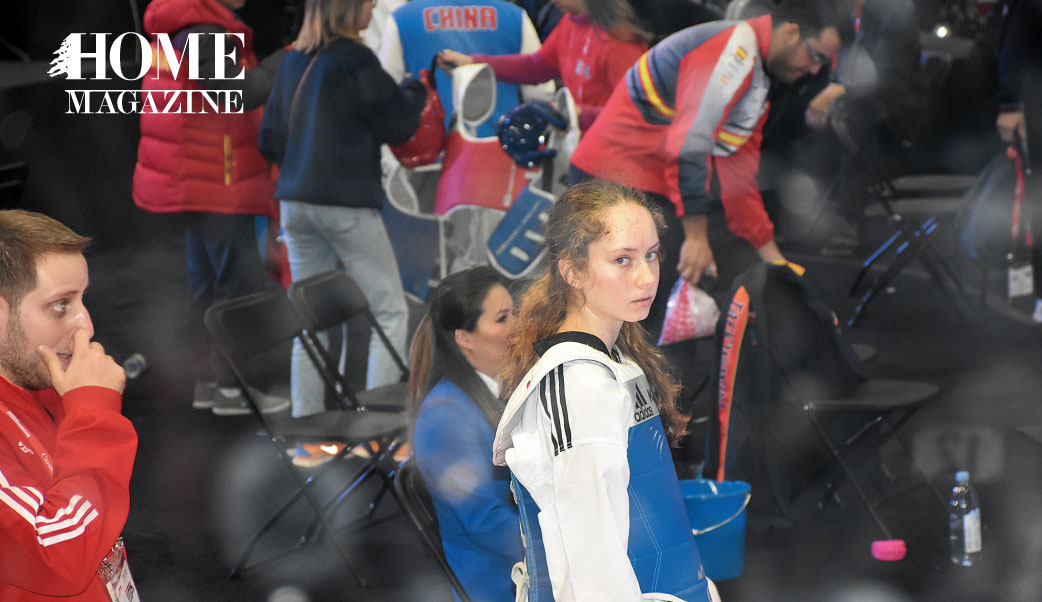
A talented Lebanese teenager is making a name for herself and her country internationally in Taekwondo, the popular Korean martial art of self-defense.
Fifteen-year old Laetitia Aoun has won a string of championships and currently ranks fourth place worldwide in the young female (52kg) category.
It takes a lot of agility and strength to master the fast, high and spinning kicks typically performed in Taekwondo. To make sure she can achieve her best, Aoun practices daily for two hours. “The only days I don’t practice are days of exams,” Aoun tells HOME. Her regular training takes place at the Mont La Salle Sports Center in Ain Saade, the pine-forested suburb northeast of Beirut. “I enjoy my Taekwondo training,“ she explains. “I feel stronger, more responsible and more confident in myself. I am always learning new techniques that help me in winning.”
It’s not surprising to know that Aoun’s mother once practiced Taekwondo as a teenager and encouraged her daughter to take it up. However, it was Judo that Aoun first began practicing only to shift to Taekwondo at the age of eight. Since then she has developed her skills quickly and now holds a black belt 3 Dan. Aoun even has seven medals under her belt: three silver were won between 2014 at the Turkish Open in Antalya (Turkey), 2015 at the Asian Cadet Championship in Taipei City (Taiwan) and this year in Turkish Open in Antalya. Three Gold ones were earned in 2015 in the Qatar Open in Doha and in the Croatia Open in Zagreb and this year in the Jordan Open in Amman. Finally a bronze medal was won at the World Junior Championship in Burnaby (Canada).
In person, Aoun’s pretty feminine look, characterized by large blue doe eyes and long blond curls, belies the sheer toughness and performance she exhibits when she is practicing Taekwondo. Like any teenager, she loves hanging out with her friends, watching movies and listening to music, but it is clear when speaking to her that Taekwondo is her priority before everything else. Her dedication has allowed her to climb up the ranks faster than any other teenager in Lebanon and out of nine international competitions she has won seven of them.
Aouns tells HOME that her dream like most athletes is to partake in the Olympics one day, while she also plans to attend university. She is a big fan of the 23-year old British double Olympic Champion Jade Jones. “I particularly like how she plays, especially the speed and the strength of her movements.” With talent and discipline, the sky is the limit and this youngster may be one to watch to hold Lebanon’s flag at the world’s biggest sporting event one day…
Signature Boutique 

HOMEland Magazine
We firmly believe that the internet should be available and accessible to anyone, and are committed to providing a website that is accessible to the widest possible audience, regardless of circumstance and ability.
To fulfill this, we aim to adhere as strictly as possible to the World Wide Web Consortium’s (W3C) Web Content Accessibility Guidelines 2.1 (WCAG 2.1) at the AA level. These guidelines explain how to make web content accessible to people with a wide array of disabilities. Complying with those guidelines helps us ensure that the website is accessible to all people: blind people, people with motor impairments, visual impairment, cognitive disabilities, and more.
This website utilizes various technologies that are meant to make it as accessible as possible at all times. We utilize an accessibility interface that allows persons with specific disabilities to adjust the website’s UI (user interface) and design it to their personal needs.
Additionally, the website utilizes an AI-based application that runs in the background and optimizes its accessibility level constantly. This application remediates the website’s HTML, adapts Its functionality and behavior for screen-readers used by the blind users, and for keyboard functions used by individuals with motor impairments.
If you’ve found a malfunction or have ideas for improvement, we’ll be happy to hear from you. You can reach out to the website’s operators by using the following email
Our website implements the ARIA attributes (Accessible Rich Internet Applications) technique, alongside various different behavioral changes, to ensure blind users visiting with screen-readers are able to read, comprehend, and enjoy the website’s functions. As soon as a user with a screen-reader enters your site, they immediately receive a prompt to enter the Screen-Reader Profile so they can browse and operate your site effectively. Here’s how our website covers some of the most important screen-reader requirements, alongside console screenshots of code examples:
Screen-reader optimization: we run a background process that learns the website’s components from top to bottom, to ensure ongoing compliance even when updating the website. In this process, we provide screen-readers with meaningful data using the ARIA set of attributes. For example, we provide accurate form labels; descriptions for actionable icons (social media icons, search icons, cart icons, etc.); validation guidance for form inputs; element roles such as buttons, menus, modal dialogues (popups), and others. Additionally, the background process scans all the website’s images and provides an accurate and meaningful image-object-recognition-based description as an ALT (alternate text) tag for images that are not described. It will also extract texts that are embedded within the image, using an OCR (optical character recognition) technology. To turn on screen-reader adjustments at any time, users need only to press the Alt+1 keyboard combination. Screen-reader users also get automatic announcements to turn the Screen-reader mode on as soon as they enter the website.
These adjustments are compatible with all popular screen readers, including JAWS and NVDA.
Keyboard navigation optimization: The background process also adjusts the website’s HTML, and adds various behaviors using JavaScript code to make the website operable by the keyboard. This includes the ability to navigate the website using the Tab and Shift+Tab keys, operate dropdowns with the arrow keys, close them with Esc, trigger buttons and links using the Enter key, navigate between radio and checkbox elements using the arrow keys, and fill them in with the Spacebar or Enter key.Additionally, keyboard users will find quick-navigation and content-skip menus, available at any time by clicking Alt+1, or as the first elements of the site while navigating with the keyboard. The background process also handles triggered popups by moving the keyboard focus towards them as soon as they appear, and not allow the focus drift outside it.
Users can also use shortcuts such as “M” (menus), “H” (headings), “F” (forms), “B” (buttons), and “G” (graphics) to jump to specific elements.
We aim to support the widest array of browsers and assistive technologies as possible, so our users can choose the best fitting tools for them, with as few limitations as possible. Therefore, we have worked very hard to be able to support all major systems that comprise over 95% of the user market share including Google Chrome, Mozilla Firefox, Apple Safari, Opera and Microsoft Edge, JAWS and NVDA (screen readers).
Despite our very best efforts to allow anybody to adjust the website to their needs. There may still be pages or sections that are not fully accessible, are in the process of becoming accessible, or are lacking an adequate technological solution to make them accessible. Still, we are continually improving our accessibility, adding, updating and improving its options and features, and developing and adopting new technologies. All this is meant to reach the optimal level of accessibility, following technological advancements. For any assistance, please reach out to