
HOMEland THEMES
Coming Soon
HOMEland Events & Collaborations
Coming Soon
 Signature Boutique

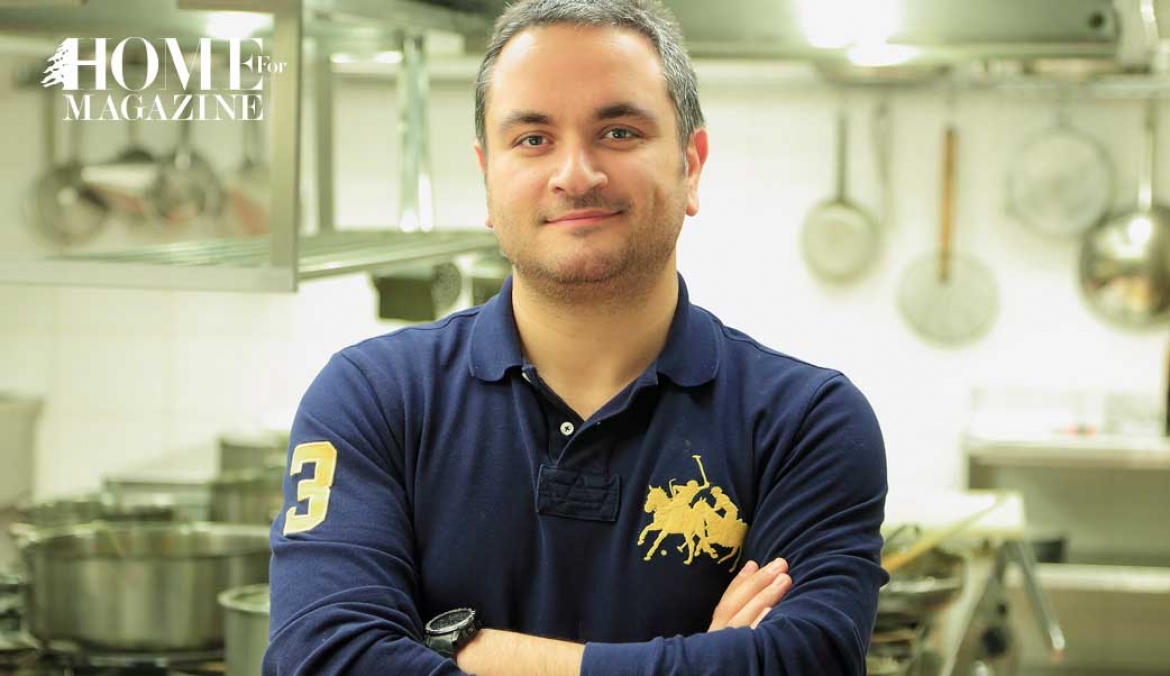
Anthony Rahayel is a fulltime dentist, husband, father of three and the man behind famous food blog No Garlic No Onions. HOME For Summer sat down to share a meal with the legendary blogger to catch up on his latest food adventures.
We met Rahayel at a trendy, Lebanese fusion diner somewhere in Lebanon. After ordering a slew of dishes, we got down to business. Since the inauguration of No Garlic No Onions (NGNO) in March 2012, it has grown exponentially larger than Rahayel had ever imagined it would. One picture and four lines of text.
That’s how it all started. After a while the press was hounding him: TV and radio stations, columnists, everyone wanted to know whose was the face behind the blog. For two years his identity remained a mystery. He valued his privacy and had no desire to become well known or famous. He just wanted to make a difference, to highlight the positive in Lebanon, and remain the mysterious benefactor. But that was about to change.
After discovering that only 20 percent of the Lebanese population could read his blog, he started thinking about how to make it accessible to the masses. Not everyone has access to the Internet but surely most have access to a television.
He approached MTV with an idea for a TV show that would be promoting Lebanon, and soon enough, he was live on the air, his identity revealed, and there was no going back.
The show was a hit from its first episode. You too can watch him live on MTV on a show called “Mechwar,” Sundays at 10:30 a.m.
He constantly receives invitations to review the newest locations but declines every single one. “If I want to review I have to pay for it myself. It’s a golden rule,” he said.
One day he wrote a review about a bag of kaak he was given at HORECA, the annual food and hospitality exhibition. The next day he got a phone call from the woman who made them, saying that since his review in 24 hours, she had sold 150 bags of the kaak. He accepted nothing in return. “This is my way of promoting my country, and giving back.”
At this point in the meal, we were through with our appetizers and one of the waitresses came over to our table, she clearly recognized who he was and had been itching to say something. “Kil shi 3a zawkon?” (Was everything to your liking?) “Habeyto el ekel?” (Did you enjoy the food?) He replied that everything was delicious and she smiled, at which point, we asked him how he handles being recognized.
“Sometimes I just want to be cool and have a quiet meal.”
As is the case with being successful, other sacrifices must be made. He spends 60 percent of his time working on NGNO and the rest of the time is divided between his dentistry practice, which pay the bills and spending time with his family.
NGNO is a non-profit activity and has not made a penny of profit since the beginning. “It’s a passion that costs a lot,” he says, as he admits he had to stop photography and various other activities just to give NGNO the attention it needed.
Did you know that approximately 80 percent of the population in Lebanon cannot afford to go out to eat? Because of this, the blog has branched out into 12 sections, each packed with something everyone can enjoy: the best places for mano2she, falafel, street food, kitchen appliances and travel reviews, to name a few.
The Box
One of his latest projects is called “The Box.”
For the first time in Lebanon, a surprise box containing food items chosen by Rahayel himself from all over the country – closed, sealed and delivered to all of Lebanon, on the same day, same hour, when everyone can open and discover it together.
“This project is a way of traveling with me while in the comfort of your own HOME, and a way of promoting artisans around the country.”
The Box is delivered, on the first Wednesday of every month, to those who have registered online and you can even send one as a gift to wHOMEver you choose. You can subscribe for one time, a month, a year – it’s your choice.
“I love the idea of offering someone a gift and watching them open and enjoy its contents.”
Inside the box contains items with a label describing the source that it came from and market price of each one.
Eventually, he wants to take his idea internationally.
Top 10
Another first for Rahayel was starting an annual list of top 10 restaurants in 23 categories, coming out every January.
“There’s no such thing as ‘the best restaurant,’” he said, but when you have categories like “best burger,” “best Italian,” “best street food” or “best Armenian food,” then you can rate them properly within their own categories.
Through his food adventures, he has visited over 26 Lebanese villages and learned invaluable information about life, and success. “I’ve matured a lot with this blog. I learned to understand and listen to people more, to accept people. I’ve learned to eat and critique. It’s an endless journey.
‘Leave this world better than you came into it.’ It’s not about becoming a public figure or being famous, it’s about adding something to the world. My dream was to bring to Lebanon a new concept that would work and that would promote the country and its positives, and my dream came true.”
Reviewing five places a week can take a toll on anyone’s stomach. When asked how he stays fit, he revealed that he usually just tastes the dishes and tries not to eat much, but added, “I believe whatever you do positively is good for your health. Enjoy while eating.”
For the future of NGNO, he is dreaming up a mobile application unlike Lebanon has ever seen.
Signature Boutique 

HOMEland Magazine
We firmly believe that the internet should be available and accessible to anyone, and are committed to providing a website that is accessible to the widest possible audience, regardless of circumstance and ability.
To fulfill this, we aim to adhere as strictly as possible to the World Wide Web Consortium’s (W3C) Web Content Accessibility Guidelines 2.1 (WCAG 2.1) at the AA level. These guidelines explain how to make web content accessible to people with a wide array of disabilities. Complying with those guidelines helps us ensure that the website is accessible to all people: blind people, people with motor impairments, visual impairment, cognitive disabilities, and more.
This website utilizes various technologies that are meant to make it as accessible as possible at all times. We utilize an accessibility interface that allows persons with specific disabilities to adjust the website’s UI (user interface) and design it to their personal needs.
Additionally, the website utilizes an AI-based application that runs in the background and optimizes its accessibility level constantly. This application remediates the website’s HTML, adapts Its functionality and behavior for screen-readers used by the blind users, and for keyboard functions used by individuals with motor impairments.
If you’ve found a malfunction or have ideas for improvement, we’ll be happy to hear from you. You can reach out to the website’s operators by using the following email
Our website implements the ARIA attributes (Accessible Rich Internet Applications) technique, alongside various different behavioral changes, to ensure blind users visiting with screen-readers are able to read, comprehend, and enjoy the website’s functions. As soon as a user with a screen-reader enters your site, they immediately receive a prompt to enter the Screen-Reader Profile so they can browse and operate your site effectively. Here’s how our website covers some of the most important screen-reader requirements, alongside console screenshots of code examples:
Screen-reader optimization: we run a background process that learns the website’s components from top to bottom, to ensure ongoing compliance even when updating the website. In this process, we provide screen-readers with meaningful data using the ARIA set of attributes. For example, we provide accurate form labels; descriptions for actionable icons (social media icons, search icons, cart icons, etc.); validation guidance for form inputs; element roles such as buttons, menus, modal dialogues (popups), and others. Additionally, the background process scans all the website’s images and provides an accurate and meaningful image-object-recognition-based description as an ALT (alternate text) tag for images that are not described. It will also extract texts that are embedded within the image, using an OCR (optical character recognition) technology. To turn on screen-reader adjustments at any time, users need only to press the Alt+1 keyboard combination. Screen-reader users also get automatic announcements to turn the Screen-reader mode on as soon as they enter the website.
These adjustments are compatible with all popular screen readers, including JAWS and NVDA.
Keyboard navigation optimization: The background process also adjusts the website’s HTML, and adds various behaviors using JavaScript code to make the website operable by the keyboard. This includes the ability to navigate the website using the Tab and Shift+Tab keys, operate dropdowns with the arrow keys, close them with Esc, trigger buttons and links using the Enter key, navigate between radio and checkbox elements using the arrow keys, and fill them in with the Spacebar or Enter key.Additionally, keyboard users will find quick-navigation and content-skip menus, available at any time by clicking Alt+1, or as the first elements of the site while navigating with the keyboard. The background process also handles triggered popups by moving the keyboard focus towards them as soon as they appear, and not allow the focus drift outside it.
Users can also use shortcuts such as “M” (menus), “H” (headings), “F” (forms), “B” (buttons), and “G” (graphics) to jump to specific elements.
We aim to support the widest array of browsers and assistive technologies as possible, so our users can choose the best fitting tools for them, with as few limitations as possible. Therefore, we have worked very hard to be able to support all major systems that comprise over 95% of the user market share including Google Chrome, Mozilla Firefox, Apple Safari, Opera and Microsoft Edge, JAWS and NVDA (screen readers).
Despite our very best efforts to allow anybody to adjust the website to their needs. There may still be pages or sections that are not fully accessible, are in the process of becoming accessible, or are lacking an adequate technological solution to make them accessible. Still, we are continually improving our accessibility, adding, updating and improving its options and features, and developing and adopting new technologies. All this is meant to reach the optimal level of accessibility, following technological advancements. For any assistance, please reach out to