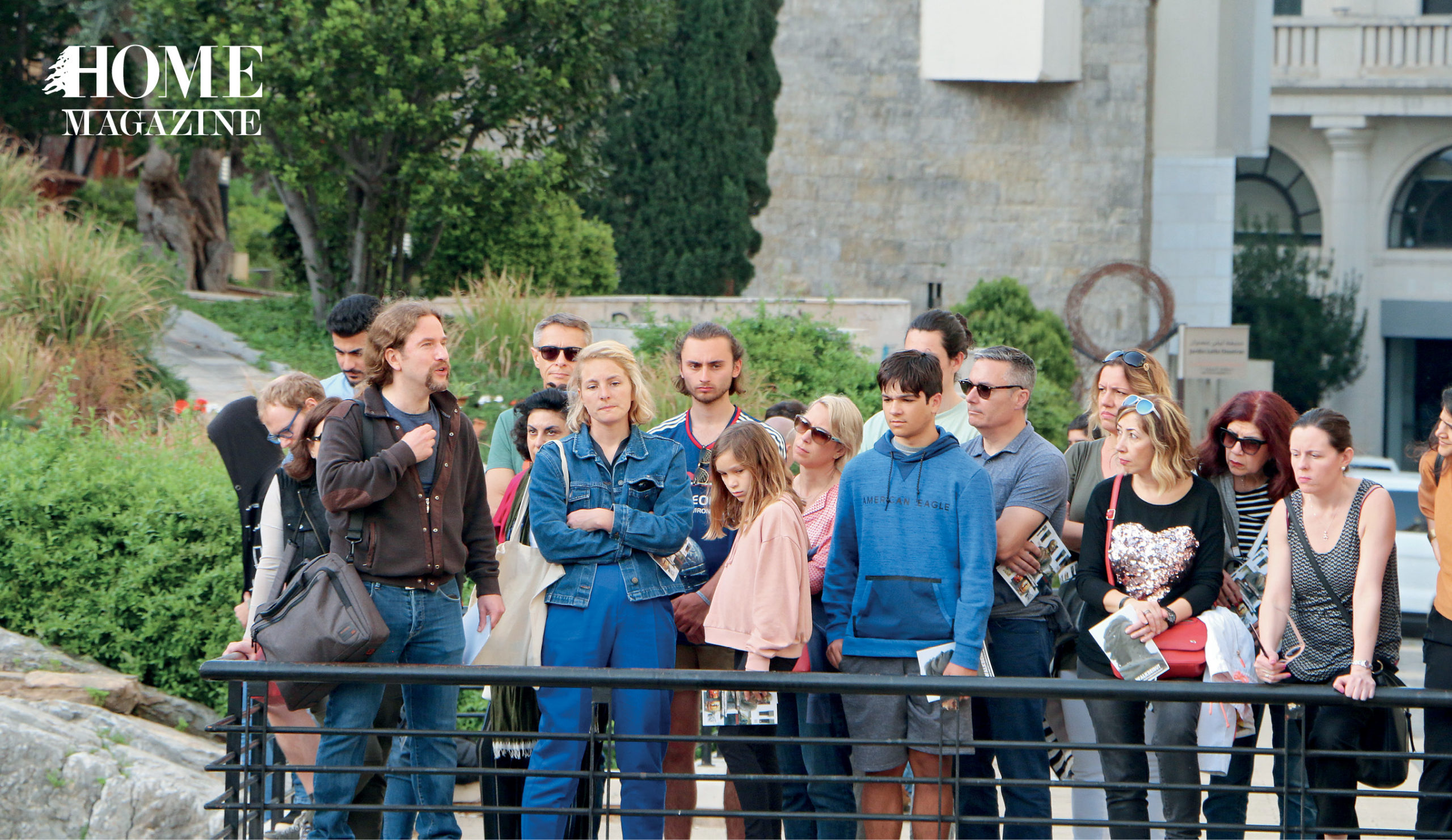
Ronnie Chatah, founder of WalkBeirut, paints a nuanced portrait of the city he calls HOME.
Ronnie Chatah’s relationship with Lebanon is, well, complicated.
“It’s not a love-hate relationship,” Beirut’s most famous walking tour leader insisted over late-afternoon coffee at Kissproof Café in Badaro. Chatah, 38, with wavy chestnut-brown hair pulled back in a ponytail, has been described as “a modern romantic poet” or “a storybook Jesus.” Of fair complexion with light blue eyes and a classic goatee, Chatah was sometimes mistaken for a native of Scotland when he was a graduate student at the University of Edinburgh.
His WalkBeirut tours have been featured in leading news outlets around the world — The New York Times, The Guardian, Wall Street Journal, BBC and National Geographic Traveler – to name a few. A skilled storyteller, Chatah weaves complicated episodes from Beirut’s history with insights on Lebanon’s unique monetary policies to its odd property laws, creating an engaging tale.
In addition to his tours, Chatah launched an audio podcast this summer named The Beirut Banyan. He also plans to publish a memoir with the working title Buried in Beirut.
Hatred, on his part, would be easy to understand. His father, statesman Mohamad Chatah, was assassinated on December 27, 2013 — the last of a dozen high-profile assassinations that began in 2005 with late Prime Minister Rafik Hariri, and included journalists Samir Kassir and Gebran Tueni.
The elder Chatah worked at the International Monetary Fund (IMF) in the 1980s. He served as vice-governor to the Central Bank of Lebanon in the mid-1990s. From 1997 to 2000, Chatah was Lebanon’s ambassador to the United States. He returned to the IMF until 2005, but ultimately came back to Lebanon shortly after Rafik Hariri was killed.
An economist, Mohamad Chatah became senior adviser to former Prime Minister Fouad Siniora in 2005. In 2008, he was appointed Minister of Finance, then became the foreign policy adviser to Prime Minister Saad Hariri in 2009, where he served until his death in 2013.
Chatah was in his apartment near the national museum when he heard the explosion. He could never have imagined it was his father being targeted. “My father was not in a traditional position of power at the time. He was an adviser to a former prime minister — a soft-spoken man of ideas,” says Chatah. “He rarely used a security detail, moving around Beirut with just a driver.”
He recalled the many walks they took together on the Corniche and around the American University of Beirut. “I lost not only my father but my best friend,” says Chatah. His father liked discussing wide-ranging topics with him like quantum mechanics and philosophies of free will.
“To fight for a better future, you face severe risks.”
“His life was — what he was doing — was dangerous,” says Chatah, referring to his father’s calls for Lebanese neutrality and independence from regional politics. “To fight for a better future, you face severe risks.”
“And your love for Lebanon, how do you explain it?” HOME asks. “I have a healthy skepticism,” says Chatah. “When away, it’s easy to see Lebanon through rose-tinted glasses. I don’t want that type of relationship. From my own experience, I’ve learned to embrace the pain of my personal and public loss without letting it impact what I still love about this country.
“And I also have an obligation. I don’t want my father’s legacy to disappear,” says Chatah. “The book I’m writing is a memoir of my father — his story intertwined with Beirut’s recent history.”
“I’ve learned to embrace the pain of my personal and public loss without letting it impact what I still love about this country.”
Walking Beirut with a passionate, irreverent, astute narrator
I met Chatah on his comeback tour following a four-year hiatus in January 2018. I had tried signing up several years earlier only to discover that Chatah was away. Then I received an email inviting me to join in a free tour and raising donations for an internship set up at the Grand Serail under his father’s name.
“I used to provide donations to the Samir Kassir Foundation and contributed to their annual journalist awards ceremony,” says the storyteller. “I now provide the stipend award for the Mohamad Chatah Internship Program, which gives student interns an opportunity to work at the prime minister’s office, where my father spent his final years. They get experience in public policy, international relations, and diplomacy firsthand.”
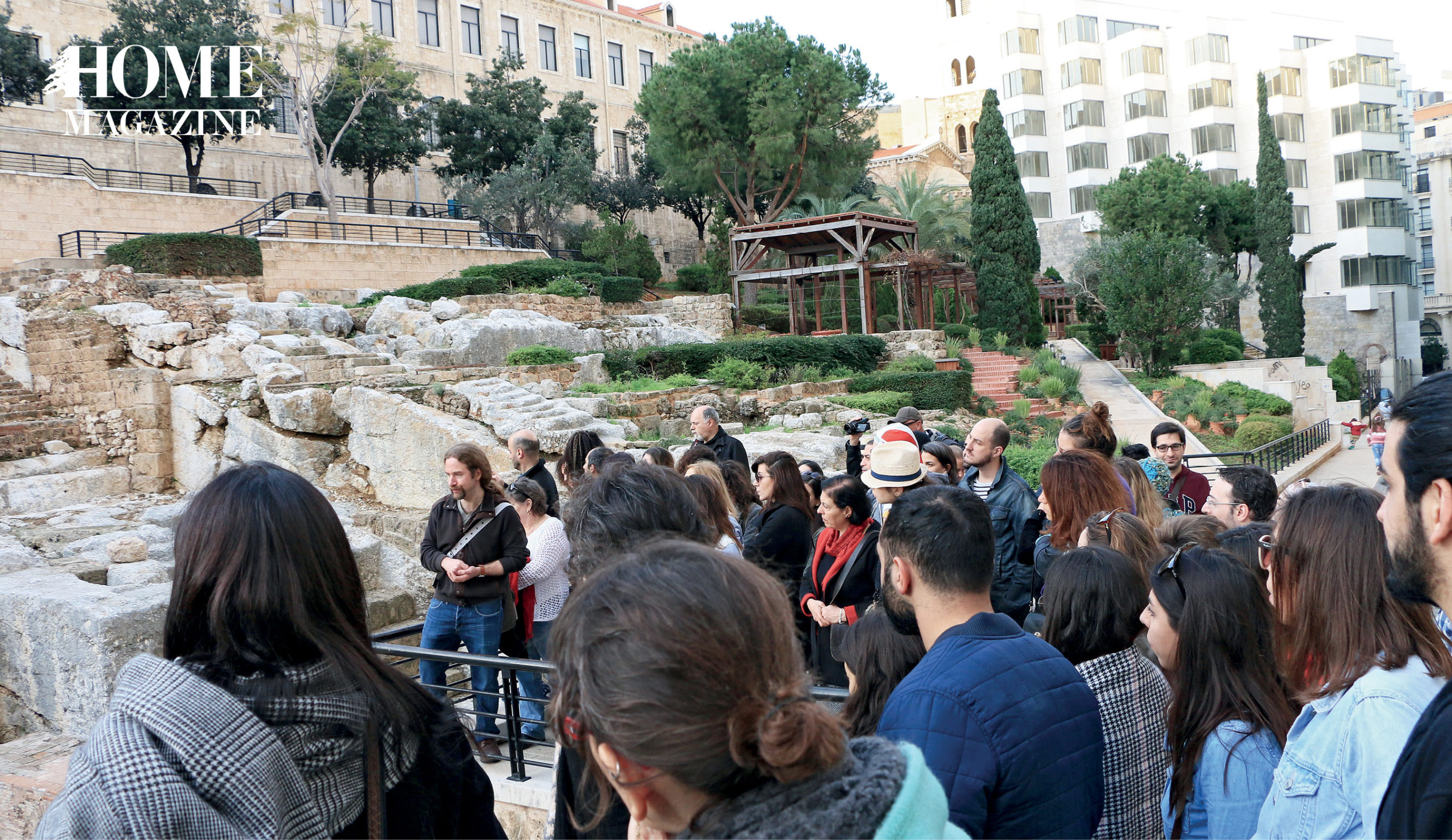
A large crowd gathered on that Sunday afternoon, including locals, tourists, and Lebanese from the diaspora. Chatah said he was especially pleased by the Lebanese turn out. “Getting fellow Lebanese to walk in the city for four hours and fall in love with Beirut’s story is something I really enjoy,” he says.
“A comeback tour requires clarity,” Chatah admits. “The one concern I had was that I would deliver a poor version of the story, that I would forget, that I would not know how to talk about my father.” On the days before his first tour, Chatah rehearsed beside his father’s tomb in Martyr’s Square. The tomb lies beside Rafik Hariri’s, adjacent to the Mohammad Al-Amin Mosque.
“My life became part of this story,” he says. “I was afraid if it was too raw, it would be an unpleasant experience. I didn’t want to open these wounds to people in the immediate aftermath of my father’s killing. I needed my own time to reflect, which is why I stopped. I also needed to detach in order to mourn properly and begin accepting what had happened.”
Indeed, Chatah tells a comprehensive story that careens through Beirut’s history from the Phoenicians to the present. He pauses to explain some of the city’s more curious eccentricities, like why Lebanon has not conducted a census since 1932 (it would upset the government structure, which is based on religious demographics) or why one older HOME is immaculately maintained while the house next door is dilapidated (new rent law applies to leases established after the Lebanese Civil War and those are renewed every three years, so landlords may raise rents and profit from the property. Old rents, before and during the Civil War, which can be passed down through families, are adjusted to the old lira rates).
“Most countries have eminent domain and expiration laws. Lebanon has abandoned property problems also linked to family inheritance. Siblings, children, and grandchildren often inherit property without necessarily residing in Lebanon, and multiple owners in one family cannot always agree on whether to retain or sell.”
Along the way he quizzed us and handed out prizes to the first participant with the right answer. “Who knows how many official religions there are in Lebanon? Eighteen, who said, ‘18?’ Who can name them? An empire imploded in World War I. Which one? Who said, ‘Ottoman?’ What European mandate ruled Lebanon? Who said, ‘French?’”
We stopped in front of the bullet-ridden Holiday Inn. “You are looking at a hotel that opened for less than two years, from 1973 to 1975. Imagine a crystal chandelier at the entrance, fully furnished, the largest Holiday Inn in the Middle East. It was looted at the beginning of the war,” relays Chatah. After that, everyone set up headquarters there—from pro and anti-Palestinian fighters to most Lebanese militias, to the Israelis to the Syrians. After the Syrian army left in 2005, the Lebanese army eventually moved in, he explained.
Chatah jokingly traces his own beginnings to the Holiday Inn’s rotating bar. “I found out my parents had one of their first dates up there, up in the sky. I’d like to think I’m a product of that great view,” he muses.
We moved to downtown, across Wadi Abu Jmeel — the city’s former Jewish Quarter and HOME to the renovated Magen Avraham synagogue — to the Roman baths, a large, outdoor archeological site renovated in the 1990s with lighting and benches throughout. “More often than not this part of the city turns into Beirut’s lovers’ lane,” quips Chatah. It is also a reminder of Beirut’s ancient history he adds. “If you keep digging, you’ll hit Roman, Byzantine, Hellenistic ruins. Then keep digging and if you are lucky, you’ll find Phoenician dwellings. Sometimes you don’t have to dig that deep — an earthquake and flooding in 551 A.D. toppled and reburied it.”
Perhaps Chatah’s favorite part of the tour is ending at the Samir Kassir Public Garden, near the An Nahar building where Kassir had worked.
“Kassir was of the café culture: humble, a journalist, a historian, an intellectual. He was Syrian, Palestinian, and French- Lebanese — I liked that complexity,” says Chatah. “I end the tour with him because this is how the whole thing started. A dedication to Lebanon’s historians and storytellers.”
How it all started
“I was first inspired to start the tour in early 2005. I met renowned historian and writer Kamal Salibi. He was very reflective and a great person to learn from,” says Chatah. “In June 2005, with Kassir’s assassination, I immersed myself in Beirut’s history. I deeply admired Kassir’s love and obsession with our own past, challenging us to reflect and learn from our mistakes.”
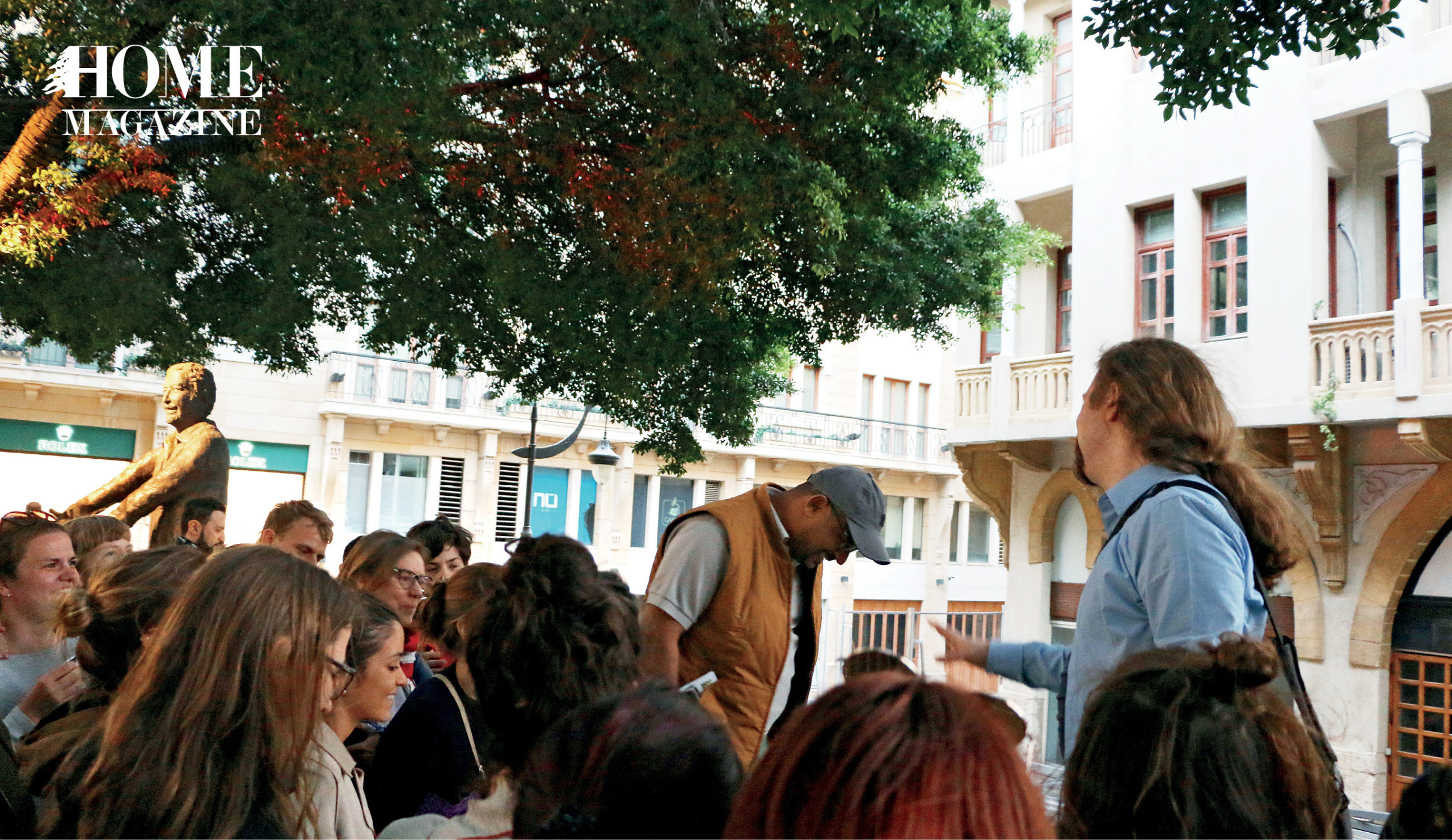
Up to that point, Chatah had spent his life back and forth between Lebanon and the United States. The dual U.S.- Lebanese citizen was born in Texas when his father was completing a doctorate at the University of Texas. He remembers regular visits to Lebanon with family during the war. They would fly into Damascus and take the long taxi journey to their HOME in Tripoli. They moved to Beirut in the early 1990s and he “walked into war-torn Downtown regularly” once the landmines were removed. The family moved back to the United States and lived in Virginia, near Washington, D.C., when his father was Lebanon’s ambassador to the United States.
Chatah spent his undergraduate career in the United States at George Mason University, where he double majored in political science and psychology. He came back to Lebanon when his father moved back in 2005.
“I decided to stay in Lebanon and complete a master’s degree in Middle East studies at the American University of Beirut (AUB). My father was fully committed to Lebanon at that time, and I couldn’t imagine leaving,” says Chatah. While an AUB student, as a hobby, he took students and anyone else who was interested on walks around Beirut. He drew from writings of Salibi and Kassir, and provided his own way of navigating complex issues into an afternoon stroll.
In April 2009, during a period of relative calm, Chatah decided to launch WalkBeirut in earnest. On his first tour, only one woman came — a woman working at the United Nations. She recommended it to a few friends. By the third tour, he had 15 people and by the fourth, the tour reached 40 participants.
A highlight of his touring career was when his father came along early on. “No one knew who he was. He was wearing a beret, a blazer and sun glasses. I teased him quite a bit,” says Chatah.
“I loved giving the tours back then and would have never stopped,” he says. “It is the only job I have enjoyed doing immensely. If I’m ever fully in my element, it’s when I’m conducting the tour.”
When his father was killed in December 2013, Chatah went to Scotland to enroll in a master’s level creative writing program and to work on a book.
Then one day in 2016, he opened his WalkBeirut email account. “I found thousands of emails unread. I never truly appreciated the feedback until that moment. I finally took the time to pay attention,” says Chatah. He sat in front of the screen and soaked them all in.
He currently goes back and forth. Half of the year abroad, half at HOME. He married in October 2018, and his wife lives and works in New York. But he is determined to stay as close to Lebanon as possible and keep his tours going. “I’ll find my way,” he says. “I cannot detach from Beirut.”
[instalink id=”27″]
For more info:
WalkBeirut:
https://www.instagram.com/walkbeirut/
https://www.facebook.com/walkingtourbeirut/
The Beirut Banyan:
https://www.instagram.com/thebeirutbanyan/
https://www.facebook.com/thebeirutbanyan/
Twitter @beirut_banyan
www.bebeirut.org


HOMEland
Coming Soon
HOMEland Events & Collaborations
Coming Soon
 Signature Boutique
 Signature Boutique