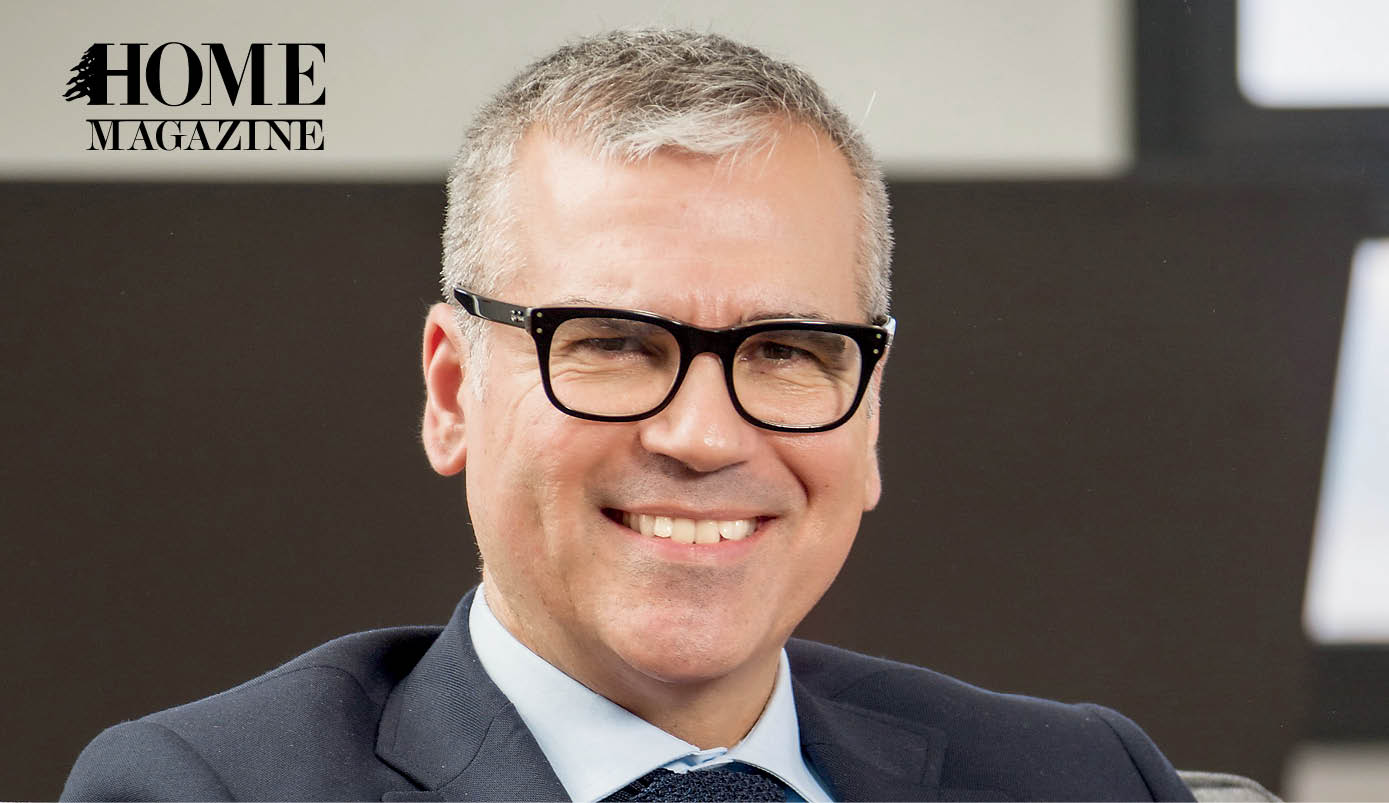
Alexis Nasard is chief executive officer of the world’s largest footwear and accessory brand based on volume of sales — with 30,000 employees worldwide, 23 manufacturing facilities, 5,300 retail stories and operating in more than 70 countries.
While nurturing his brilliant career, Nasard has kept Lebanon in his heart.
Alexis Nasard will soon celebrate his second year at the helm of Bata, the top-selling footwear and accessory manufacturer and retailer in the world. In his illustrious business career, he also played leading roles in two other worldclass organizations — Heineken and Procter & Gamble. Before he was tapped as Bata’s CEO on April 4, 2016, Nasard was Heineken’s global chief marketing officer and its president of Europe. He landed a position early in his career at Procter & Gamble, where he held various senior management roles over 17 years with the company.
Back in Lebanon in the ’80s, Nasard was a middle- and high-school student at Collège des Frères Maristes Champville in Metn. A childhood friend described him as a “a status-quo-hating, out-ofthe- box-thinking contrarian, a voracious reader, classical music lover and most of all a loyal Lebanese patriot.”
To learn more about the life and career of this successful Lebanese businessman, HOME magazine recently interviewed Nasard from his office in Bata global headquarters in Lausanne, Switzerland.
Tell us about your personal journey to the prominent positions you have had in business.
After graduating as a civil engineer from the University of Saint Joseph’s École supérieure d’ingénieurs de Beyrouth (Beirut Graduate School of Engineering), I was clear about the career paths I wanted for myself, and engineering was not one of them. I’m more gregarious. Even though my family had a successful steel trading business that was passed on from generation to generation till the end of the war, it was simply not for me. I’m more into visibility and communication. I’ve always had a flair for business, and I realized I’m quite sensitive to end products that involve stories and legends.
Why is it important for products to have stories?
Because, in the end, what is the difference between a product and a brand? A brand is the product of a story with a capital of trust. You buy every brand based on a promise.
“A brand is the product of a story with a capital of trust. You buy every brand based on a promise.”
How did you get your first job and build your career?
When I finished my MBA at the University of California Berkeley, I started with Bechtel Engineering. They were recruiting young MBAs to help with business projects that went beyond construction. I loved California, but shortly, it was pretty clear to me that it was fundamentally, at its core, a construction company. All the work revolved around construction, and this was not what I was looking for.
So I contacted Procter & Gamble, after having had an initial contact on campus. I joined them in 1992 and stayed to 2009. I prize dearly the 17 years I spent there. What’s interesting at P&G is that you meet many people of diverse backgrounds.
P&G is renowned for being an amazing management school. It is one of the best; you cannot gain the same experience elsewhere. The rigor, the professionalism, the thoughtfulness and the analytics you learn at P&G make any other company look like a startup.
“P&G makes any company look like a startup.”
The culture at P&G is rigorous, consumer oriented and has integrity. Everything you do at P&G is linked to the consumer. You will almost never find memos with inaccuracies, typos,inconsistent dates, etc. The first memo I wrote was reviewed 18 times before it was approved!
I was P&G ‘s GM for personal care for the Middle East and Africa, and Central Europe. To continue my career progress, and become the division president, I had to relocate to the main P&G headquarters in Cincinnati, Ohio, in the U.S., and this was not of interest to me and my family. It was then that I took the Heineken opportunity.
The Heineken culture is fun, creative and entrepreneurial. The combination of a beer industry and the Dutch spirit makes it fun. Its marketing is daring. Its advertising campaigns are immense, with themes from James Bond movies to Champions League — you name it, the sky is the limit. It feels entrepreneurial because decisions can be made quickly.
“In family businesses, whenever there’s a vague role description … this can undercut the authority of management, rendering it ineffective.”
Bata was founded in 1894. Very few family-owned businesses have the longevity Bata has. How was it achieved?
To create a company that is built to last, one must focus on merit, performance and fairness. Recognizing performance in a very objective way is the key to success in my opinion, and not easy to execute.
There must be clear rules of engagement, a well-defined hierarchy for decision-making, and clear lines of communication that can help prevent many possible problems from arising. In family businesses, whenever there’s a vague role description or lack of clear rules of engagement, this can undercut the authority of management, rendering it ineffective. This can also have a negative impact on retaining high caliber executives. This is not the case with Bata, which is based on concrete roles and boundaries.
Another essential is commitment and dedication to values. Thousands of companies set mission statements; one must be ready to uphold them and be accountable to carry them out. When crises hit, it is more challenging to be principle based.
What is your leadership style?
I believe in transforming business objectives into a crusade that goes beyond numbers, encapsulating them into meaningful results that touch people’s lives. That’s why when establishing a strategy, I want it to be meaningful. For example, at Heineken we created a strategy called “Not an inch back” — driving growth in all circumstances. At Bata, our strategy is “Sweeping Angela off her feet.” We want the consumer to have fun, interact and be inspired while shopping.
“When crises hit, it is more challenging to be principle-based.”
I call another part of my leadership style “tight-loose-tight.” I’m very tight on objective strategy and results, but I’m not tight on how you apply it, as long as you respect the company’s values. I also believe leadership is circumstantial. Organizations have different cultures; if you imply the same leadership to all, you will not be as effective.
Even within the same company, a leader needs to maintain some flexibility when approaching each department. They are each in different stages of development and unique circumstances.
What are your thoughts about sustainability?
I have strong beliefs about corporate social responsibility. The most sustainable activities are those well married to the commercial model.
Whenever your CSR agenda and projects are built on and related to good business practices, they can be maintained. CSR activity can be extremely beneficial to society, the environment and stakeholders and, at the same time, be good for business.
My preferred types of related activities are those that create some business communities that sustain philanthropy. These opportunities are self-generating. This is how you benefit society as a whole.
“I’m more gregarious.”
How do you see the role of women in business and society?
Well, you will never hear a man saying the role of women is not important (he said with a smile).
Personally, I have been a minority in all walks of my life, coming from a small country and sect. However you slice me, I have always been a minority. So, I’ve learned to value diversity of thinking.
I’m not talking about minorities as they are portrayed in the U.S., limited to race or gender. The diversity I’m affirming is people with different perspectives bringing different ways of thinking together. It is more effective, creative and daring. I’m very curious by nature, and I will always continue to learn from others with different points of view. They make my life richer and more interesting.
This brings us back to the role of women in society. As they move up the echelons, whether it is in academia, business or politics, they add a lot to diversity of thinking.
Who are your role models?
Pope John Paul II and Pope Francis — they represent the principles of leadership. Recognizing reality and giving people hope is the role of a true leader. You can be a credible and effective leader only if you take your organization and your people from where they are today to a better place. I am not talking about religious matters; on the contrary, I’m speaking purely on secular leadership. When you see someone galvanizing millions of people and creating hope, you know you are looking at a leader.
“… clannishness makes us smaller people. It goes in direct violation to my notions of justice and equality.”
In the business world, I have a lot of admiration for Jack Ma. He is a global business icon who is inspiring, and he doesn’t come from a NATO country. He has changed the world’s perception about Asian markets and their potential with the creation of his e-commerce website Taobao and the success of his Alibaba conglomerate.
Ma has created growth sectors in China that did not exist, like transforming Single’s Day (a de facto Chinese holiday to celebrate singles on Nov. 11) into a huge shopping day, and made billions in the process.
Ma also introduced the notion of “LQ.” In addition to IQ and EQ, he said we need LQ, “the love quotient, which machines will never have.” Love is what he says motivates humans to solve problems and make the world better.
How do you feel about Lebanon?
Like every Lebanese, I have ambiguous feelings about my country; I have a combination of endearment,attachment, nostalgia, irritation and disappointment.
“Like every Lebanese, I have ambiguous feelings about my country; I have a combination of endearment, attachment, nostalgia, irritation and disappointment.”
Yet, I have rarely found a mediocre Lebanese individual. Lebanese are always successful, brave and resourceful; they stand on their own two feet. The Lebanese don’t have a state governing them or supporting them; they are self-made.
I’ve always had nostalgia for Lebanon — my childhood, my grandparents, the food, music and my friends. I admire Lebanese individuals who stand up and improve our society against all odds. The incredible faith that keeps the Lebanese moving forward, I find extraordinary. I admire the intellectual and cultural standards of our country, our educational system — it all creates a well-equipped person. Take me. I never felt I was at any disadvantage. With the very limited resources we have in Lebanon, it’s astounding.
Visiting Lebanon with my family is a great experience. In our small country, every city has its own cultural festival. It is rich and inspiring.
The main thorny issue in Lebanon is clannishness. I consider it a violation of everything I believe in and hold dear. It goes in direct violation to my notions of justice and equality. I think clannishness makes us smaller people. It favors a narrow community to the detriment of the wellbeing of the whole. I find that appalling.
Unfortunately, we’ve seen clannishness in our history time and time again. You can trace it back to the 17th century. As people we have always been strong, but as a nation we are weak, and we only have ourselves to blame.
“I have rarely found a mediocre Lebanese individual. Lebanese are always successful, brave and resourceful; they stand on their own two feet.”
Can you credit some of your success to your DNA?
I definitely credit my grit to my DNA.
For more info:
https://www.bata.com/corpo/shoemaker-bata-selects-new-ceo/
https://thebatacompany.com/


HOMEland
Coming Soon
HOMEland Events & Collaborations
Coming Soon
 Signature Boutique
 Signature Boutique