
HOMEland THEMES
Coming Soon
HOMEland Events & Collaborations
Coming Soon
 Signature Boutique

Sitting with Roger, better known as Rodge, I was listening to him describing how he used to play music under the bombs of Lebanon’s War (p.38). I was reminded of my own experience playing piano under the very same bombs, refusing to go down to the shelter! I looked back at the time we used to surf empty streets after a cease-fire, taking a risk just to go out, when a bomb would suddenly fall somewhere so close that the sand and smoke it made would come in our eyes.
I am from Aley. I am Lebanese. I lived the war.
There are terrible stories from this war. I can never forget the one of a family friend telling us about his mother who was killed in a green field during her attempt to escape. Ugly men threw her body in the air in an evil game of trap shooting (tiro), tossing her weakened body like a clay plate until she died.
I later learned that my own mother, this elegant, delicate lady, carried weapons! If you knew her, you would be as shocked as me! She took turns with my father to stand guard at night to protect their HOME.
I have a vivid memory of myself as a curious child being pulled in from a balcony, where we were visiting. The grownups did not want me to see the atrocity of a man being dragged by a tank, to his death.
As the First Lady of Afghanistan Rula Ghani said: “With war, people lose their moral compass” (p.168).
And stories go on … Men I know, forced to sit inside car tires, crushed and curled, with their knees pressed to their faces, and left in this position for hours or perhaps days to torture them; I still don’t understand how this is physically possible.
Rita Rhayem, General Director of Caritas, mentions that “behind every screaming man is not just an angry man, but a man in pain, a lot of pain” (p.24). What we Lebanese lived through has transformed us, no matter how deeply the wounds are buried in our sub-conscience.
My family went to great lengths to keep me and my siblings from the war. We were fortunate that they repeatedly took us to Cyprus, Italy and France for short periods of schooling or when the fighting was intense. Still, we lived with fear for our loved ones left behind. Although as a family we relocated 13 times, displaced within Lebanon and taken refuge in other countries, with all the emotional instability this could bring to a teenager; we were blessed that we did not witness the barbarity firsthand and we did not lose immediate family members; we were protected and kept apart from the horror.
This does not mean that we were not affected. Nobody from this land was spared from the effects of our war’s cruelty.
This scene was different, to say the least, from the world of Barney and Disney my own children grew up in!
I was once sitting with a French sustainability expert who told me that there is one thing we Lebanese have, that if we could package and sell, would make us the richest nation in the world.
“What’s that?” I asked.
“Resilience,” he answered.
Resilience – an incredible virtue we have developed from moments that required unimaginable strength, the stamina to stay till the end, to go for the last mile.
It is so easy to give up just before the finish line.
In my fight to promote Lebanon’s best image, I am always careful not to put other nations down, to make us look better by comparison. This principle is clearly stated in our editorial guidelines. In my sleepless nights spent reading articles before publication, I erase any sentences of this sort. That said, I can’t help but compare our unique attitude to others. I remember once being in another country where I, the person who hates driving, had a very minor accident, bumping the mirror of another car. The other driver collapsed almost in tears, worried about the paint of his (possibly) new car. I smiled and thought to myself: “I don’t think I would ever see a man from my country have the same reaction; ours are tough!”
I still remember being in Limassol as a child with my family as if it was today. One night, we were getting ready to go out for dinner when my father was watching the news and saw his factory in Lebanon was burning. He watched quietly as everything he built over a lifetime was going up in flames. Without any display of emotion, he simply told us: “Let’s go. Dinner is waiting for us. I cannot do anything; I am too far away (the airport was closed). So, let us go to dinner.”
We didn’t realize back then that we were witnessing a heroic moment. It was only when we grew older that we learned that such calm in the face of great tragedy is exceptional.
Yes, we need to bottle Lebanese endurance.
We recently stayed for eight months without a government and two years and five months without a president, going through all the economic implications. Remember the chaos during our country’s deadlock frozen situation? And we are still hanging on with dignity: this is who we are.
We are who we are because we finish the last mile. When everything seems impossible and the world is collapsing around us, we gain incredible, almost divine strength to push through the last mile. In this issue, you will read about Maxime Chaya who exemplifies this Lebanese quality by challenging himself and nature, physically and mentally (p.101). Yes, we Lebanese challenge life.
In HOME Magazine, we “bottle” this spirit of bravery in the stories of exceptional Lebanon Lovers from HOME and around the globe.
People of ordinary strength transform into fierce lions when advocating for causes, especially when they are faced with adversities. In my country, I see this every day. We find our “Roads for Life” (p.134).
If only for the courage to go on for the last mile, we are a great nation.
Maybe our destiny is to get to the finish line because our endpoint is someone else’s starting line, and this is how humanity evolves.
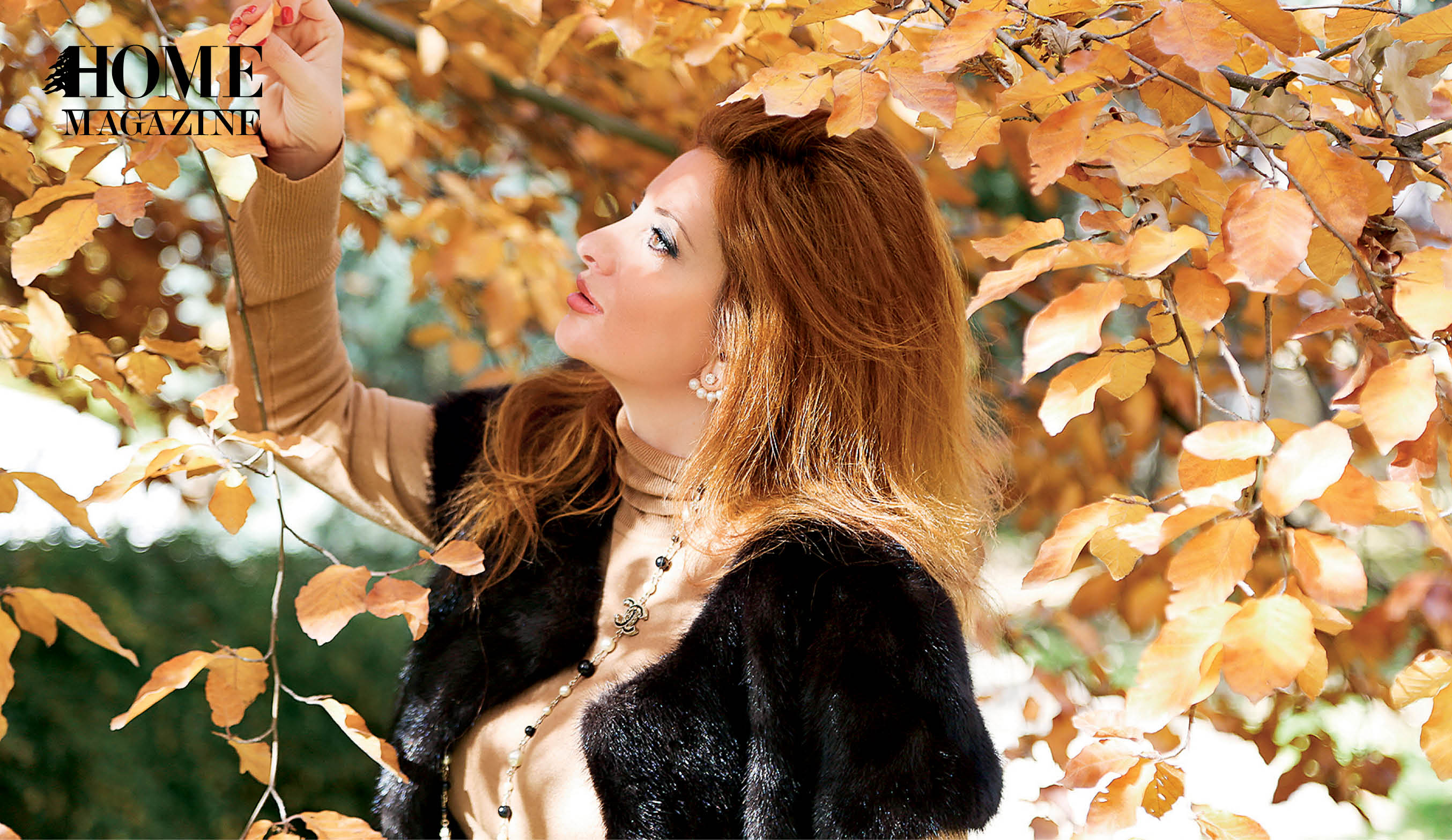
For Dad’s 75th birthday, I recently took him back to Aley. He never went back to live there, not even for the summer. For the occasion, I planted an olive tree on this beautiful Lebanese mountainside. Olive trees can live in extreme conditions and in poor, stony soils; they are incredibly resilient, just like us. This olive tree stands as a symbol for the Lebanese: those who only heard about the war, and those who lived it. This solid tree could remind us all of our endurance, taking its place perfectly alongside the trees that have already been planted before, and the trees that will be planted in the future, all watered by the same water. This symbol of peace could remind us all that reconciliation is our only solution.
Some people don’t believe in miracles. They think that nothing is a miracle. I believe that just like this tree, everything is.
Patricia Bitar Cherfan
Founder and Editor-in-Chief
Signature Boutique 

HOMEland Magazine
We firmly believe that the internet should be available and accessible to anyone, and are committed to providing a website that is accessible to the widest possible audience, regardless of circumstance and ability.
To fulfill this, we aim to adhere as strictly as possible to the World Wide Web Consortium’s (W3C) Web Content Accessibility Guidelines 2.1 (WCAG 2.1) at the AA level. These guidelines explain how to make web content accessible to people with a wide array of disabilities. Complying with those guidelines helps us ensure that the website is accessible to all people: blind people, people with motor impairments, visual impairment, cognitive disabilities, and more.
This website utilizes various technologies that are meant to make it as accessible as possible at all times. We utilize an accessibility interface that allows persons with specific disabilities to adjust the website’s UI (user interface) and design it to their personal needs.
Additionally, the website utilizes an AI-based application that runs in the background and optimizes its accessibility level constantly. This application remediates the website’s HTML, adapts Its functionality and behavior for screen-readers used by the blind users, and for keyboard functions used by individuals with motor impairments.
If you’ve found a malfunction or have ideas for improvement, we’ll be happy to hear from you. You can reach out to the website’s operators by using the following email
Our website implements the ARIA attributes (Accessible Rich Internet Applications) technique, alongside various different behavioral changes, to ensure blind users visiting with screen-readers are able to read, comprehend, and enjoy the website’s functions. As soon as a user with a screen-reader enters your site, they immediately receive a prompt to enter the Screen-Reader Profile so they can browse and operate your site effectively. Here’s how our website covers some of the most important screen-reader requirements, alongside console screenshots of code examples:
Screen-reader optimization: we run a background process that learns the website’s components from top to bottom, to ensure ongoing compliance even when updating the website. In this process, we provide screen-readers with meaningful data using the ARIA set of attributes. For example, we provide accurate form labels; descriptions for actionable icons (social media icons, search icons, cart icons, etc.); validation guidance for form inputs; element roles such as buttons, menus, modal dialogues (popups), and others. Additionally, the background process scans all the website’s images and provides an accurate and meaningful image-object-recognition-based description as an ALT (alternate text) tag for images that are not described. It will also extract texts that are embedded within the image, using an OCR (optical character recognition) technology. To turn on screen-reader adjustments at any time, users need only to press the Alt+1 keyboard combination. Screen-reader users also get automatic announcements to turn the Screen-reader mode on as soon as they enter the website.
These adjustments are compatible with all popular screen readers, including JAWS and NVDA.
Keyboard navigation optimization: The background process also adjusts the website’s HTML, and adds various behaviors using JavaScript code to make the website operable by the keyboard. This includes the ability to navigate the website using the Tab and Shift+Tab keys, operate dropdowns with the arrow keys, close them with Esc, trigger buttons and links using the Enter key, navigate between radio and checkbox elements using the arrow keys, and fill them in with the Spacebar or Enter key.Additionally, keyboard users will find quick-navigation and content-skip menus, available at any time by clicking Alt+1, or as the first elements of the site while navigating with the keyboard. The background process also handles triggered popups by moving the keyboard focus towards them as soon as they appear, and not allow the focus drift outside it.
Users can also use shortcuts such as “M” (menus), “H” (headings), “F” (forms), “B” (buttons), and “G” (graphics) to jump to specific elements.
We aim to support the widest array of browsers and assistive technologies as possible, so our users can choose the best fitting tools for them, with as few limitations as possible. Therefore, we have worked very hard to be able to support all major systems that comprise over 95% of the user market share including Google Chrome, Mozilla Firefox, Apple Safari, Opera and Microsoft Edge, JAWS and NVDA (screen readers).
Despite our very best efforts to allow anybody to adjust the website to their needs. There may still be pages or sections that are not fully accessible, are in the process of becoming accessible, or are lacking an adequate technological solution to make them accessible. Still, we are continually improving our accessibility, adding, updating and improving its options and features, and developing and adopting new technologies. All this is meant to reach the optimal level of accessibility, following technological advancements. For any assistance, please reach out to