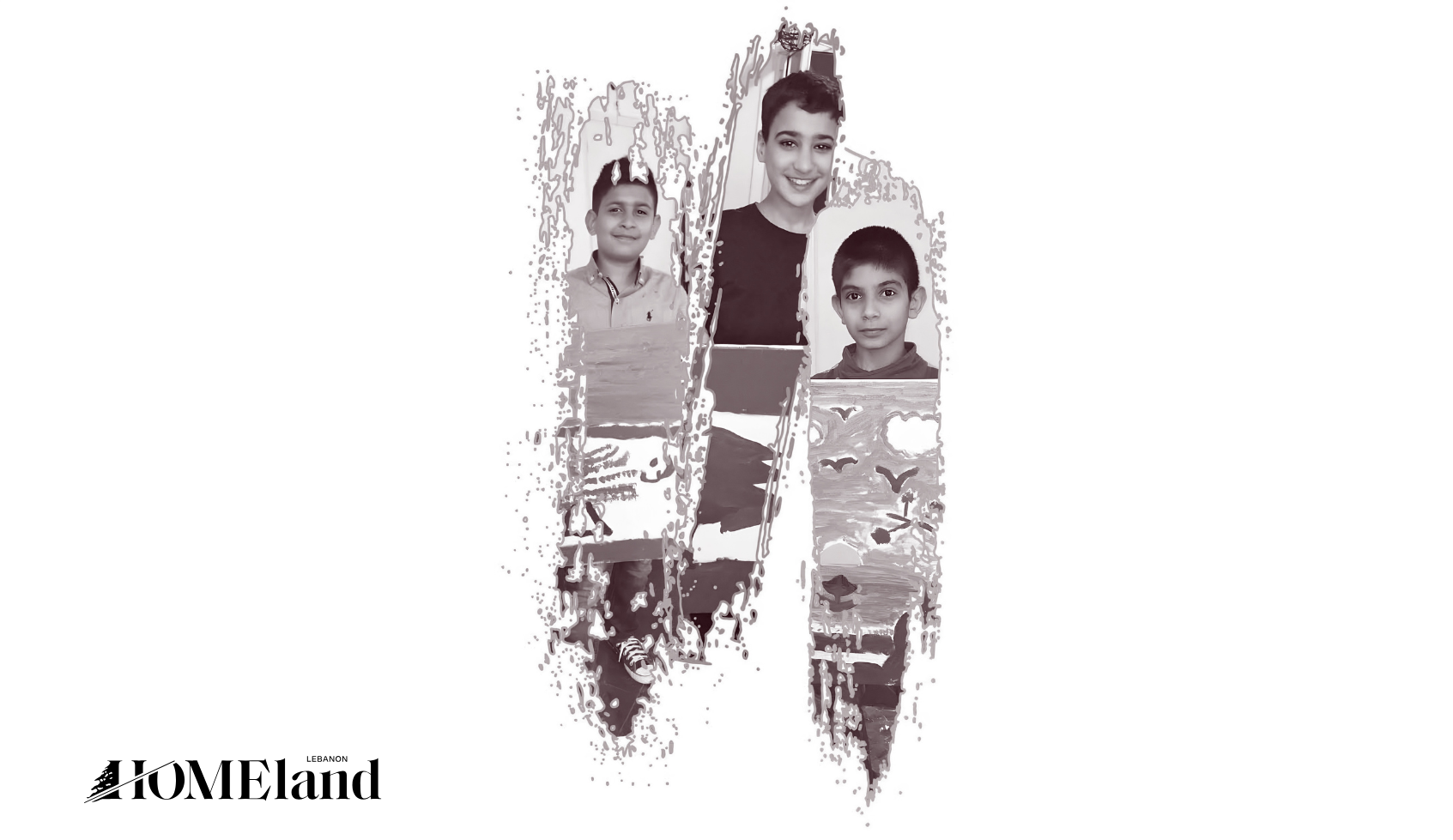
Sadika Kebbi founded the nonprofit Kun Ensen (Being Human), teaching youth to express themselves through art and public speaking, but the bigger agenda is peacebuilding.
Driving up to Tripoli, I’m thinking about the unique Sadika Kebbi and what she’s up to today – her Little Picasso Project. On this gray afternoon in early spring, the activist, professional storyteller, educator, international speaker and founder of Kun Ensen, is running two of three art workshops for children and teenagers in spaces provided by collaborating NGOs: Ishraqa in Zehryeh, Shift in Qubba and Ruwad Al Tanmya in Tebeneh. The first workshop was held yesterday.
The workshops are part of a larger peacebuilding project. The 100 participants total will learn to express themselves on canvas and through public speaking, then present their work in an art exhibition, Oct. 1-7 in Beit Beirut, Sodeco. Boys and girls from Tripoli in their late childhood or early teens are invited to join.
These workshops bring together children who are Alawite and Sunni from the Jabal Muhsen and Tebeneh areas, where there have been clashes between the groups. By creating art and speech presentations together, the children also get to know each other outside the tensions of the communities.
The Little Picasso Workshops are the latest of Kun Ensen’s peacebuilding work. Its Story Buddies Workshops, a series of weekly storytelling workshops held at the Tripoli Chamber of Commerce for 10-15 year olds, bring together children from all religious sects and ethic groups in Tripoli: Orthodox Christians, Maronites, Sunni, Alawites and Armenians. “They include not only different religious groups but also children from families of all political, economic and social backgrounds. It is full of activities that help participants share their personal narratives with each other. And it does wonders!” Sadika said enthusiastically.
I arrive in Zehryeh, looking for Ishraqa. Boys in public schools in Tripoli can go to Ishraqa after 2 p.m. for homework assistance and academic support free of charge. Today they came to paint.
I find the block, a variety of shops along the busy sidewalk with offices above. From a balcony on the first floor, one, then two boys, probably around 10 or 12, step on the balcony holding paintings. That must be it.
Up the stairs into a room with white walls – bright, multi-color canvases lie across tables and are propped against easels around the room. Thirty boys (yes, all boys) between 10 and 15, paint in silence, completely engaged. You could hear a pin drop. Guest art activist Zaahirah Muthy mixes paint in the center of the room.
“What should I paint?” one boy calls out.
“Just close your eyes, think of something that makes you happy,” answers Zaahirah.
Bringing it all together
Sadika met Zaahirah in Dubai at a Toastmasters event; they both participate in the international public speaking organization. Zaahirah is the founder of Zeearts, an arts consultancy firm launched in 2012 in Dubai. She was the curator of World Art Dubai 2017 and the 2018 Tatinis Art Fair in Singapore. She has exhibited her work in Africa, Europe and the Middle East. She says part of her mission is “to connect artists from around the world to give back.”
Zaahirah says she strongly believes “art can change lives.” Sadika presented her with an idea to do just that – facilitate workshops that introduce children and teens in a destitute part of Lebanon to painting. Sadika, an international public speaker and coach herself, would provide the same participants with public speaking workshops so they can talk about their art.
The project fits Sadika’s mission for Kun Ensen: to empower vulnerable children in the destitute areas of Lebanon. Sadika uses words, Zaahirah art – both to help young people find their “voices” and express themselves. “Children are very talented, but sometimes life or their current situations block their creativity,” says Sadika.
With support from the Municipality of Tripoli, who provided the canvases and lunches, to Zeearts, who contributed brushes and paint, and collaborating NGOs who provided the space, the Little Picasso Project was born.
“Art can change lives.”
The power of self-expression
Sadika introduces me and asks who would like to show me their work. The once silent room is suddenly abuzz. “Me! Me!” Boys pick up their paintings and walk my way. “Be careful,” says Zaahirah. “It is not dry. The paint will run.”
Mahmoud Dunawi, 15, is learning to create texture by “dry brushing” – using very little paint on the brush. It is his first time participating in an art workshop. “I love it,” he says. “It’s helou ktir (very beautiful)!” Dunawi mentions that he wants to work in the police department one day.
Abdulhadi Ismein, also 15, “did art before” with his friends, he says. “I like it.” So does Faisal Beytieh, 15. Beytieh wants to be an electrical engineer.
Sadika believes in the power of self-expression. “Whether we are dealing with one person or 1,000, the ability to transmit ideas in a coherent and compelling fashion is one of the most important skills we can ever develop,” she says. “It is a basic survival skill and always has been. To get what we want in life, we have to be able to present ourselves forcefully, credibly and convincingly.”
Zaahirah adds: “Like in art therapy, these boys are using art to express themselves. They can say whatever they like on canvas without someone saying, ‘no.’”
“It’s amazing and revitalizing,” explains volunteer Mary Akoumeh, 16. “You can learn so much about people through art. It is mind blowing. When we see a colorful painting, full of life, and consider the background the artist brings to it, it is so meaningful.”
Mary, who does a lot of volunteering, would like to see other teens help with Kun Ensen’s activities. “There is a lot to do,” she says.
As we chat, two young men bring in 30 lunch boxes for the boys.
After eating, the boys finalize their paintings. I chat with a mother who came to pick up her 12-year-old son. He eagerly shows her his painting of a happy, nature scene – sunshine, a tree and flowers. “He had a good time today,” she says.
Three boys, each named Mohammad, stop to say goodbye. “I’d like to do it again,” says Mohammad Youssef, 14.
“I would definitely come back,” says Mohammad Saffour, 12.
“It was beautiful,” says Mohammad Kurdi, 13. “I feel very good.”
Sadika and her helpers carried paint, brushes and unused canvases to her car. They counted paint cans and calculated what they would need for the next workshop.
The rest of the boys scurried from the center, leaving their paintings to dry.
Later they’ll meet again in another workshop to prepare speeches about their art. And once more at the exhibition, where their paintings will be for sale to raise money to contribute to education in Tripoli.

HOMEland
Coming Soon
HOMEland Events & Collaborations
Coming Soon
 Signature Boutique