Thanks to the altruistic work of non-profit associations, many families and communities in need have been receiving support over the years, from provisions, services to financial aid. Since 1970, La Voix de la Femme Libanaise has been working to improve the lives of the Lebanese, with the help of volunteers and generous donors from both Lebanon and Belgium.
La Voix de la Femme Libanaise (VFL) is not a very familiar name for many Lebanese. That is because the association has remained relatively low profile since beginning its humanitarian work back in 1970. The founder Lily Sara, who passed away in 2014, wanted it that way, explains Marie Sfeir, the President of VFL. Sara began her social work visiting prisons and it wasn’t long before she gathered a team of women volunteers who helped her with the displaced during the Lebanese Civil War. Today VFL helps nearly 2000 children throughout Lebanon with tuition fees and schooling and has two purpose-built centers in the suburbs of Beirut offering social, medical and educational services to people of all religions and backgrounds.
KEEPING CHILDREN IN SCHOOLS
HOME is met by four members of the VFL committee in the basement of a church just off the plush Abdel Wahab El Inglizi Street in Ashrafieh, which serves as the association’s office. The late Lily Sara lived down the road they explain and therefore this location is symbolic for VFL. Of the four women, Rosy Azar takes the lead explaining the impressive scope of work covered by VFL. “Education is our principal work at VFL,” says Azar. “We help children stay in their schools through a sponsorship program where Lebanese students are getting partial to full payment of their tuition fees.” At present Belgian donors sponsor 1750 students and Lebanese donors help 200 students. Sfeir serves as the intermediary between the children in need for financial help and the Belgian donors, through the VFL affiliate office in Brussels, which is supported by the Belgian Jesuits. Her team will identify a child that needs help and Sfeir then prepares a file on the case.
“At present Belgian donors sponsor 1750 students and Lebanese donors help 200 students”
It will include a picture of the child, a brief on the family situation and sometimes even a drawing made by the child. The potential donor in Belgium then goes through the file and if the donor accepts to help financially, a sort of follow-up takes place via the VFL in Lebanon. “We ask the child to share the report card and send a thank you letter after the donation is done,“ explains Sfeir. This way the donor knows who is receiving the money and how the recipient is doing. Sfeir shows HOME a bag filled with sealed letters and Christmas cards meticulously prepared by children ready to be mailed to Brussels.When asked if it’s a tiresome role to mail letters especially with the easier option of emails, Sfeir laughs.
“Yes, and expensive too, to post letters from Lebanon. But letters are more personalized and as the intermediary we want to monitor the line of communication.”

THE CENTERS FOR THE COMMUNITY
In addition to organizing financial aid, VFL also manages two centers just outside Beirut: St. Hubert in Ain El Remmaneh and the Socio-Medical Center in Fanar. The St. Hubert Center, named after the Belgian patron who funded the four-story building, is a multi-purpose center that serves the community. It has a permanent nursery school, and it also offers free workshops and classes for women ranging from crafts to business skills, plus a yearly summer camp for children. They also have a kitchen, where local women are employed to make sweets and delicacies. “We do lots of fund-raising events to help finance the center,” says Lara Khalifa who is a full time volunteer and one of the committee members. “This includes garage sales, movie-premieres, a theatre play and bake sales from our kitchen.”
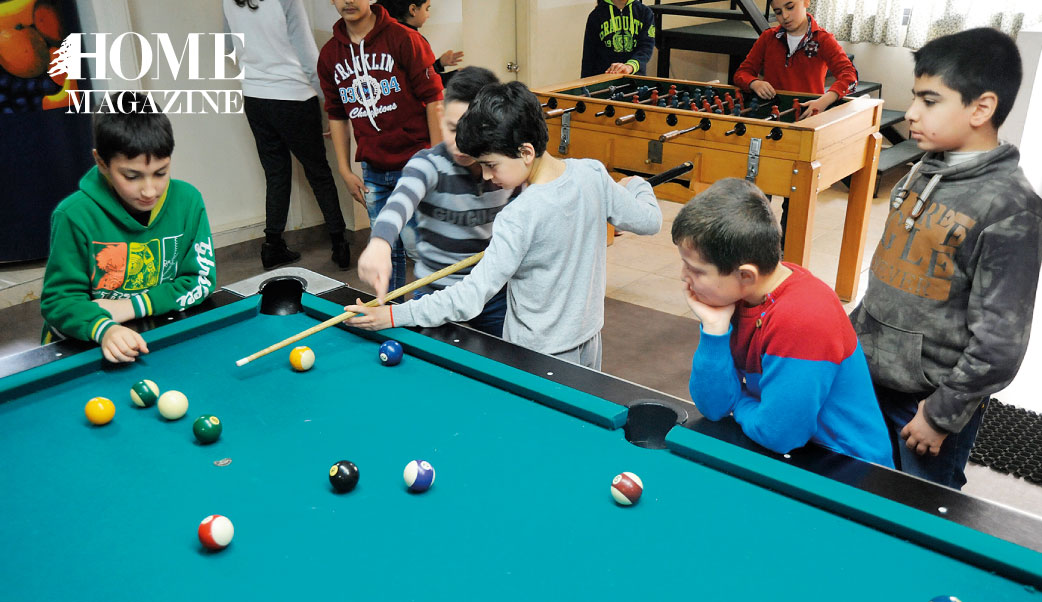
The second center, which is in Fanar, was initially set-up purely to serve the 1200 refugees displaced from their HOMEs in Damour (Chouf) during the Lebanese Civil War (These Lebanese families had settled in an underprivileged area in the village of Fanar). Today, the center serves the greater community and focuses primarily on medical care offering a polyclinic. The residents can get quality outpatient consultations from two dentists, a family doctor, gynecologist, pediatrician, and cardiologist at a very low cost. The Fanar Center also offers a wide range of social and family services, after school scholastic help and a youth club ‘Al Nadi’, designed for young adults to hang out and use its facilities, such as billiards, computers, ping pong etc., and engage in classes offered, in an attempt to reduce juvenile delinquency and drug use.
Some of the people whom the center helped when they were children are now coming back as volunteers and even as donors, in few exceptional cases. “We are extremely touched to see these people giving back, “ says Azar who also heads the Fanar Center. “These people are so grateful. Meeting them makes our work even more rewarding.” It just goes to show how acts of kindness come full circle…
“Acts of kindness come full circle”
VFL organizes one major cultural event each year where the proceeds help towards financing its activities. In 2016 they welcomed “Garde Alternée, ” a play from France. Set in a psychiatrist’s office, it tackled the issue of divorce and its impact on young teenagers’ life. Written by a French pediatrician Dr Edwige Antier and Louis-Michel Colla, the play was performed by six actors including renowned French TV journalist and writer Patrick Poivre D’Arvor. The play, which received rave reviews, took place on October 28th and 29th at the Amphitheater of l’Ordre des Médecins in Beirut.
For more information:
ksfeir@dm.net.lb
Tel.: +961 3 24 71 51

HOMEland THEMES
Coming Soon
HOMEland Events & Collaborations
Coming Soon
 Signature Boutique