


HOMEland THEMES
Coming Soon
HOMEland Events & Collaborations
Coming Soon
 Signature Boutique

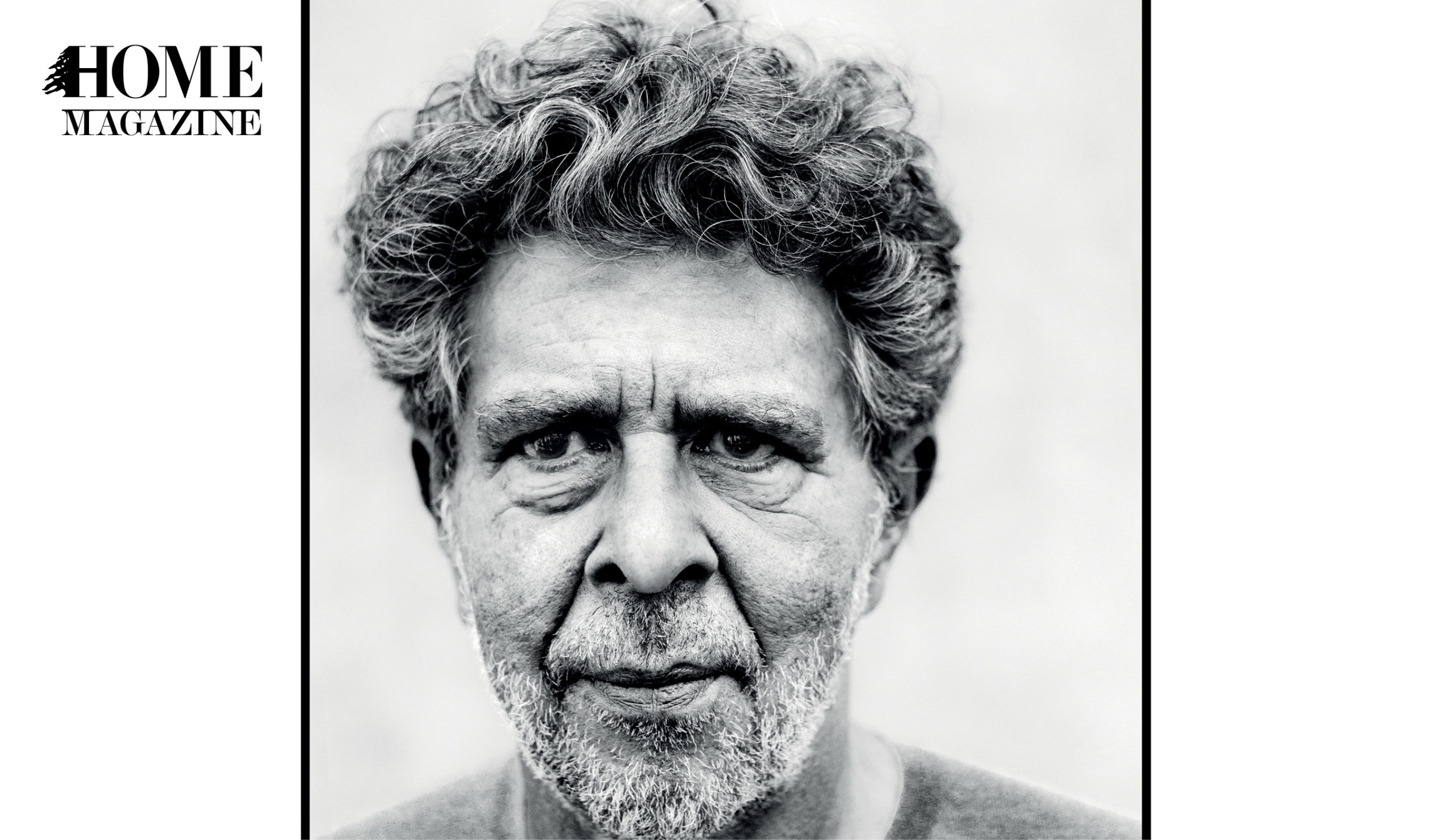
Sitting in a chair in a gently lit corner of his living room, the last living member of the Rahbani Brothers still enjoys humming his own melodies, the very melodies that spoke to our hearts and stuck in our minds forever. Although not loud in his discourse, he is powerful in his achievements. Elias Rahbani shared with HOME his favorite anecdotes, from when he was first introduced to music inside his mother’s womb to what keeps him going strong at 78.
The First Notes of Rahbani’s Life Symphony
Rahbani’s love for music was inherited from his mother, who would frequently listen to French classics, and developed with him listening to French soldiers clients humming their songs at his father’s restaurant in Antelias as a kid. Little did he know he would one day grow up to become the musical ambassador for French songs in his HOME country.
Growing up, his older brothers Assi and Mansour saw his talent and insisted that he learnt from the best French instructors. He studied piano and composition with Bertrand Robillard for four years and later under virtuoso pianist Michel Bourgeot with whom he trained with for eight years. “Bourgeot was such an exceptional musician from whom I learnt a lot. And although he did not compose his own music, no one could play the piano like him,” Rahbani told HOME.
At the age of 18, he composed 11 pieces of classical music and started a new wave of French chanson interpreted by Lebanese artists with songs like ‘Je te jure’, ‘Que sera ma vie sans toi’, ‘Valse la valse’ and ‘La dernière danse’ among others.
He was among the first Lebanese musicians to compose and arrange foreign music in the Arab region, and composed the “Hymne du Liban à la francophonie” with lyrics written by Jean-Claude Boulos for the 9th Francophonie Summit in 2002.
An Endless Library of Talent
Over the course of his career, Rahbani composed over 6,500 pieces of music, including more than 3,500 advertisement songs (who doesn’t recall the famous “Shou betariytak? Rayovac!” advert or “La vache qui rit” for instance?). “I was 19 years old when the BBC approached me to write 40 songs for them. That was my first salary, 400 L.L., and with that I bought my first ever Fiat,” he explained.
In addition to working for major international companies like Philips, Parlophone, Polydor Decca and Capitole, Rahbani served as the Musical Advisor for Recordings and Chief of the Occidental Music Section at Radio Lebanon between 1962 and 1972 and his music won prizes at a number of festivals including the International Song Festival of Athens in 1969, and the 19th International Festival of Publicity Film in Venice in 1972.
And while he does not follow a particular creative process, he firmly believes that inspiration comes from above and is not afraid to follow his intuition. Talking about his song Mory Mory, he recalled: “I was sitting with some friends in Bikfaya when Sammy Clark joined and asked me if I could write a song for him to compete with in Germany, I didn’t want to at first but then I sat in front of the piano and the melody came together in less than 6 minutes.”
“We then wrote the lyrics the next day and Sammy went to Germany in 1979, performed the song and it placed first in the competition,” he explained, adding that it is such moments of inspiration that make him believe in God, in the existence of a subtle voice inside that enlightens and inspires. “God and music go together like twins.”
“God and music go together like twins.”
On Lebanon and Belonging
When war broke out in Lebanon, Rahbani flew to Paris with his wife Nina and their two sons Jad and Ghassan. There he met prominent artistic director André Willemin who fell in love with his music and was thrilled to work with him. “By the time I was about to sign the contract, Mansour called me to make sure everything is okay, we miss you, he said to me.”
Que sera ma vie sans toi, que sera ma vie si tu pars
Pour un nouveau pays, pour une nouvelle vie
Et pour un autre amour et pour d’autres beaux jours
Que sera ma vie sans toi, Que sera ma vie si un soir
Au bord de cette mer, je cherche tes yeux verts
Et je ne trouve plus qu’ un souvenir perdu.
Signature Boutique 

HOMEland Magazine
We firmly believe that the internet should be available and accessible to anyone, and are committed to providing a website that is accessible to the widest possible audience, regardless of circumstance and ability.
To fulfill this, we aim to adhere as strictly as possible to the World Wide Web Consortium’s (W3C) Web Content Accessibility Guidelines 2.1 (WCAG 2.1) at the AA level. These guidelines explain how to make web content accessible to people with a wide array of disabilities. Complying with those guidelines helps us ensure that the website is accessible to all people: blind people, people with motor impairments, visual impairment, cognitive disabilities, and more.
This website utilizes various technologies that are meant to make it as accessible as possible at all times. We utilize an accessibility interface that allows persons with specific disabilities to adjust the website’s UI (user interface) and design it to their personal needs.
Additionally, the website utilizes an AI-based application that runs in the background and optimizes its accessibility level constantly. This application remediates the website’s HTML, adapts Its functionality and behavior for screen-readers used by the blind users, and for keyboard functions used by individuals with motor impairments.
If you’ve found a malfunction or have ideas for improvement, we’ll be happy to hear from you. You can reach out to the website’s operators by using the following email
Our website implements the ARIA attributes (Accessible Rich Internet Applications) technique, alongside various different behavioral changes, to ensure blind users visiting with screen-readers are able to read, comprehend, and enjoy the website’s functions. As soon as a user with a screen-reader enters your site, they immediately receive a prompt to enter the Screen-Reader Profile so they can browse and operate your site effectively. Here’s how our website covers some of the most important screen-reader requirements, alongside console screenshots of code examples:
Screen-reader optimization: we run a background process that learns the website’s components from top to bottom, to ensure ongoing compliance even when updating the website. In this process, we provide screen-readers with meaningful data using the ARIA set of attributes. For example, we provide accurate form labels; descriptions for actionable icons (social media icons, search icons, cart icons, etc.); validation guidance for form inputs; element roles such as buttons, menus, modal dialogues (popups), and others. Additionally, the background process scans all the website’s images and provides an accurate and meaningful image-object-recognition-based description as an ALT (alternate text) tag for images that are not described. It will also extract texts that are embedded within the image, using an OCR (optical character recognition) technology. To turn on screen-reader adjustments at any time, users need only to press the Alt+1 keyboard combination. Screen-reader users also get automatic announcements to turn the Screen-reader mode on as soon as they enter the website.
These adjustments are compatible with all popular screen readers, including JAWS and NVDA.
Keyboard navigation optimization: The background process also adjusts the website’s HTML, and adds various behaviors using JavaScript code to make the website operable by the keyboard. This includes the ability to navigate the website using the Tab and Shift+Tab keys, operate dropdowns with the arrow keys, close them with Esc, trigger buttons and links using the Enter key, navigate between radio and checkbox elements using the arrow keys, and fill them in with the Spacebar or Enter key.Additionally, keyboard users will find quick-navigation and content-skip menus, available at any time by clicking Alt+1, or as the first elements of the site while navigating with the keyboard. The background process also handles triggered popups by moving the keyboard focus towards them as soon as they appear, and not allow the focus drift outside it.
Users can also use shortcuts such as “M” (menus), “H” (headings), “F” (forms), “B” (buttons), and “G” (graphics) to jump to specific elements.
We aim to support the widest array of browsers and assistive technologies as possible, so our users can choose the best fitting tools for them, with as few limitations as possible. Therefore, we have worked very hard to be able to support all major systems that comprise over 95% of the user market share including Google Chrome, Mozilla Firefox, Apple Safari, Opera and Microsoft Edge, JAWS and NVDA (screen readers).
Despite our very best efforts to allow anybody to adjust the website to their needs. There may still be pages or sections that are not fully accessible, are in the process of becoming accessible, or are lacking an adequate technological solution to make them accessible. Still, we are continually improving our accessibility, adding, updating and improving its options and features, and developing and adopting new technologies. All this is meant to reach the optimal level of accessibility, following technological advancements. For any assistance, please reach out to