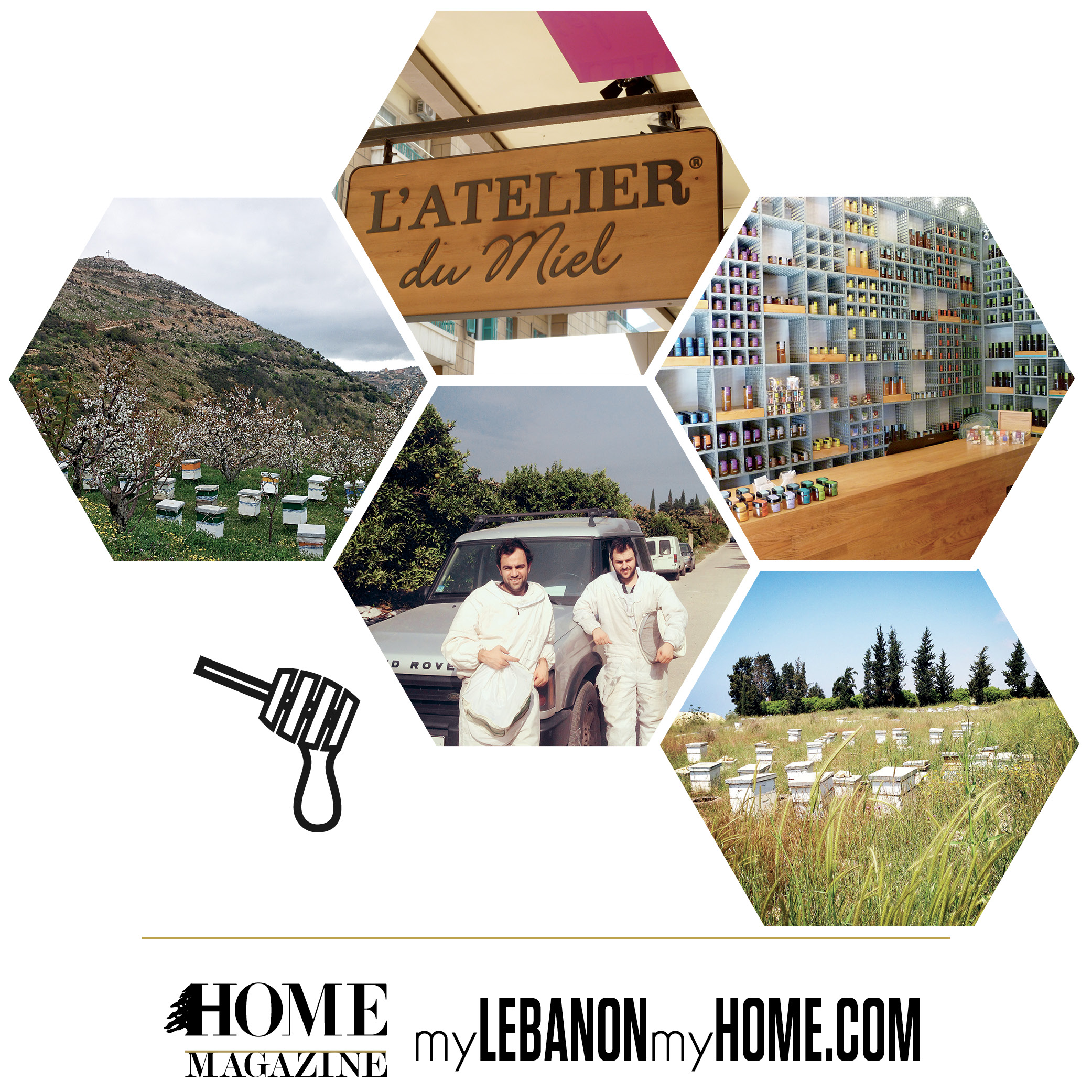
L’Atelier du Miel is using the Lebanese countryside to its full potential, with interesting and innovative techniques to create a huge range of tantalizing honeys. While cementing its place in the market, it is also building the future of beekeeping and honey production in Lebanon.
Anyone who believes that all honeys are the same, should think again. L’Atelier du Miel’s stylish boutique in Ashrafieh is a haven for honey lovers, specializing in honey and honey products. Setting them aside from other honey producers, they use the Lebanese countryside to create unique flavors all year round. Beekeeping is not new to Lebanon, there is evidence of it from as early as 1000 B.C., but it is L’Atelier du Miel’s methods that are helping to revitalize the industry in Lebanon.
“We have a very special production method, which consists of moving our beehive all year long to follow the flower blossom. This is possible in Lebanon, because in a very small geographical area you have blossoming season all year long, explains Marc Abi Nassif, former interior architect and one of the founders of L’Atelier du Miel. Despite the small size of Lebanon, the wide variety of environmental conditions allow for over 3,000 different varieties of flora, allowing for a rich variety in pollen available for the bees to pick from. Each pollen creates a honey with a different taste. Neither Nassif or any of the other founders have a background in beekeeping. They choose beekeeping because of their love for nature and their desire to work with it. Beekeeping is a skill that is traditionally passed down through the family, however Nassif believes that having to learn everything for themselves has helped to create their unique brand.
“Moving our beehive all year long to follow the flower blossom.”
From the north of the country to the south, each region has a different blossoming plant from which the bees harvest pollen. Each creates a different honey with its own unique color, texture and taste. The mountainous forests area near Batroun produces a classic oak honey, with a darker hue and woody, slightly sweet taste. The lighter fleur d’oranger honey, comes from the pollen of the orange trees near the southern city of Tyre.
Due to their unique method of production, all of the honey that they produce is completely natural. The bees will only feed on natural sources, all year round, meaning that unlike some other producers, they don’t need to feed the bees sugar during the winter months. During the cold winter months the honey that bees make will crystallize; many producers use thermal treatments to keep the honey in a liquid form. However, L’Atelier du Miel don’t use such methods. Nassif clarified by saying that, “Heating the honey affects the benefits of the honey and affects the taste; it becomes less pronounced … honey contains enzymes, and those enzymes die over 40 degrees, and heating the honey would kill those enzymes so you’re losing most of the qualities of honey.”
Since they started Nassif and his partners have proven to be committed to creating innovative flavors, by using nature as their ally. But they are also committed to creating sustainability, both within their company and across the country. L’Atelier du Miel has provided training for a number of young university graduates. “We made agreements with five beekeepers, young beekeepers, freshly graduated from university, agricultural students, that would have otherwise started working in an office … we collaborated together, and now we sell their honey.
” The training that L’Atelier du Miel provides ensures that the honey bought from these beekeepers is in line with the high standard of quality that is expected from one of its jars.
 Training up and working with the next generation of beekeepers is not the only way that L’Atelier du Miel is reaching out to communities across the country. Displayed in its Tabaris boutique are a number of honey dippers, each with exquisitely crafted handles. “Beekeeping is a crafts profession, and in the nature of this profession you tend to meet craftsmen in the regions where you go.” Marc explained how different craftsmen across the country have used techniques and materials that are traditional to their region to create the handles for the honey dippers. It’s these collaborations with local artisans that are helping the company expand, not just in a business sense, but also culturally.
Bees are crucial to the ecosystem, regardless of the country. They help to pollenate crops and spread wildlife, and without them we would lose large swaths of nature. L’Atelier du Miel is making efforts to spread this message of the bees importance. As Nassif sees it, “People do not tend to see nature as something beneficial to them … creating a brand and a business that takes advantage of nature in its natural setting, and making nature beneficial raises the awareness of people to conserve nature.” In Lebanon it’s clear to see that people are increasingly looking for more natural foods, and L’Atelier du Miel is catering to people’s appetite. In the future, Nassif believes that “while the quantity of honey produced will remain the same, it will be geared toward much better quality”.

HOMEland THEMES
Coming Soon
HOMEland Events & Collaborations
Coming Soon
 Signature Boutique