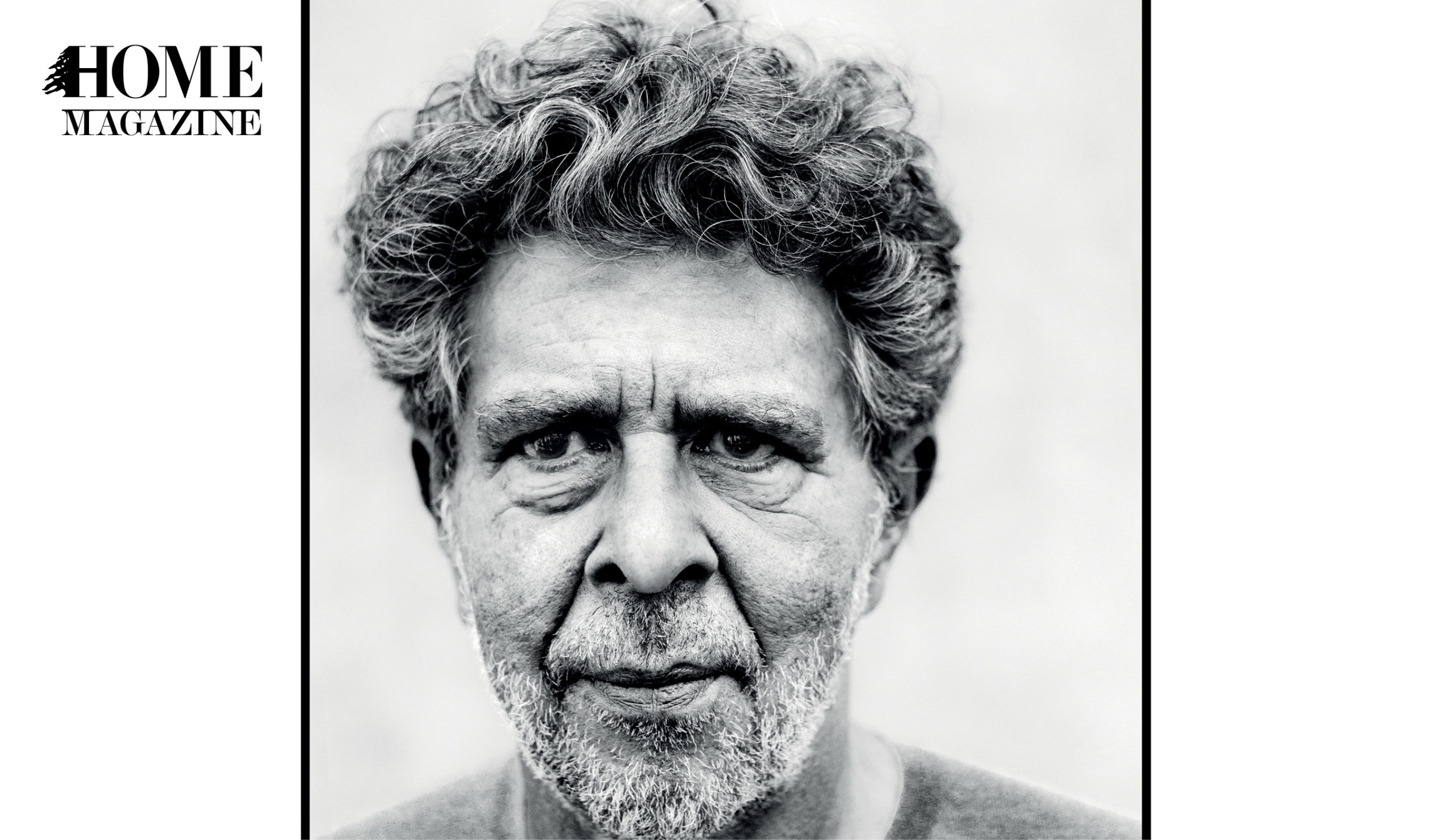
Joumana Haddad is a Lebanese author, poet, public speaker, journalist, essayist, academic, activist, mother and polyglot (yes, she speaks seven languages), and she may soon be adding politician to her extraordinary list of roles.
Article by: Alia Fawaz
Joumana Haddad is a controversial figure. She is outspoken, bold and very accomplished. In an interview with this affable and utterly charming provocatrice, HOME learned about her plans to enter the political sphere.
A prolific writer
Haddad is a prolific writer, with 15 books published and showing no sign of slowing down. She entered the professional world of prose when she joined An-Nahar, initially as a translator in 1997, then as a cultural journalist. She later became the newspaper’s cultural editor from 2005 until 2017.
However, she began writing poetry at age 12. While she writes in many tongues, her preferred language for poetry is Arabic. “Poetry for me is freedom,” said Haddad. “In perfume, you have the essence note that is the heart of the fragrance; that is what poetry is for me.”
One of her acclaimed poetry books is “Return of Lilith,” which like many of her books has been translated into multiple languages.
Lilith is an intriguing figure, portrayed in ancient mythology as the first wife of Adam (before Eve), based on the Old Testament account of two creations of woman in the Book of Genesis. As the story goes, Lilith was created entirely equal to man. For Haddad, Lilith serves as a source of inspiration and a symbol of female empowerment, the defining theme for much of her work.
Haddad may be best known for her prose, especially three nonfiction books that ingeniously tackle gender roles: “I Killed Scheherazade,” “Superman is an Arab,” and “The Third Sex.”
The first in this trilogy is a spirited call for Arab women to stand up for themselves. After its release in 2011, Haddad began traveling for the book, meeting with different audiences and readers.
These exchanges brought about many questions regarding real masculinity versus the insecure, archetypal macho man, which she found exists in all cultures. This idea inspired her to write the second book.
After “Superman is an Arab” was released in 2012, she was in Morocco on a book tour organized by the French Cultural Center. “A lot of questions came up and heated debates went on, which sparked a light bulb for me,” explained Haddad. She saw the need to go even deeper and see the fundamental issue as a human problem. “How humane are we?” asked Haddad. That is the question she explores in her third book within this series.
Haddad reveals that she is usually most productive after a good few hours of nocturnal sleep. Her creative energy flows during the thick of night when her ideas and narratives are born.
This pattern of energized napping, followed by hours of writing, is how she accomplishes most of her work, she explained. “Once my mind is washed by sleep, I can begin to channel my ideas onto paper.”

Accolades and controversy
Haddad made the Arabian Business Magazine’s list of the world’s 100 most powerful Arab women for four years in a row. She came in at 34th in 2017 for her cultural and social activism.
She has garnered many prestigious awards for her contribution to literature from all over the world. She seems to have struck a cord, in particular, with Italy and the Latin American countries, where her work has been exceptionally well received (Haddad is fluent in Italian and Spanish). She noted that the male machismo is very prevalent in Latin societies and cultures too, but unlike the Arab world, they are more open to her discourse.
Controversy, however, is not something Haddad shies away from. In 2008, she launched Jasad, the Arab world’s first erotic literary magazine. In its short life span of two years, eight issues were produced, and it received tremendous praise and plenty of fans. Ironically, however, no brand was willing to put their ad in it. In private, potential advertisers would tell Haddad how much they loved the magazine, but would not advertise in it, fearing the backlash the association would create.
“It’s typical Lebanese,” said Haddad nonchalantly. “We love in secret and we condemn in public.”
Haddad said she had wished to explore the notion of the human body, in all its forms, with Jasad.” “I grew up in a traditional family where expressing sexuality was seen as shameful or dishonoring,” said Haddad, knowing too well her situation is not unique in the Arab world.
“We love in secret and condemn in public”
Clearly, there are both fans and haters of Haddad’s work and opinions, and she confessed to not being a diplomatic person; she prefers to speak her mind. In her earlier years, she admitted she was more fervent and angry at criticism, but has since mellowed out, now in her 40s.
“I don’t feel any bitterness anymore. In fact, I’m really grateful,” she said, regarding the outpouring of love and fan letters she constantly receives. At our HOME interview meeting, she was joined by 25-year-old student and writer Malak Halabi, her “spiritual daughter,” as she affectionately refers to Halabi. The younger writer was a fan of Haddad’s work, and a mentorship relationship and camaraderie developed between them.
Haddad has two sons from her two previous marriages, Mounir and Ounsi (named after the Lebanese poet Ounsi El Hage). Both reside in London. The elder is a corporate lawyer, and the younger is a first-year university student.
When asked about their take on her work, Haddad said her children are very supportive. “I am lucky and very proud of them,” she said. “It’s surprising to have two sons who are proud of their mother writing in such a confrontational and transparent way.”

Inspired by heroes every day
Haddad was raised by strict working-class parents who instilled a strong work ethic in her. Her Lebanese father came from Yaroun, a village in South Lebanon.
From her mother’s side, her grandfather was Assyrian, from Mardin, and her grandmother was Armenian, from Aintab. “I was raised by both of my parents to never feel complacent, which is a good thing, of course,” she said.
She admitted that being an overachiever is also exhausting. Haddad attended medical school for two years and holds a master’s degree in biology/genetics. Simultaneously, she also studied various languages and later got her second master’s degree in translation.
When asked if she has any role models, she said she admires every person who stands up against violence and for justice and has had the guts to do something about it. The scores of people who tell her their own stories and challenges also inspire her. “Meeting these people saves your faith in humanity and helps you think we’re not lost,” she said.
Regarding women’s rights in Lebanon, Haddad is not entirely pessimistic and sees some progress. She mentioned how last year Lebanon finally abolished the law that allowed rapists to avoid prison by marrying their victims. However, she said she believes there are so many challenges and political issues at the forefront to deal with, both in Lebanon and regionally, that it makes it difficult to push purely for women’s rights.
“If you tell a woman who is struggling to protect or feed her kids about her right to pass on citizenship to her children or any other fundamental human right, she is not going to be able to be involved in it,” argued Haddad. “You need to be really angry to make a change, but more importantly you need to have space to do this.”
“There are also many women who are too comfortable in their bubble to shake the system and fight got others’ rights.”
Having the space to fight for issues is a privilege for many people in our part of the world, she said. She pointed out that there are also many women who are too comfortable in their own bubble to shake the system and fight for others’ rights. With the dominance of the patriarchal society and religions ruling the country, Haddad believes that a real breakthrough will take at least two decades. And it is not just for women, she added. Our society is not fair to boys and men. “Boys are not allowed to feel.”
New projects and ambitions
Haddad has just finished her 16th book, which is also her first novel. To be published in spring of 2018 in both English and Arabic, the story is loosely autobiographical. It begins with the story of her Armenian maternal grandmother, who was only 3 years old when she lost most of her family during the Armenian genocide in Gaziantep, Turkey. The novel also explores the lives of three generations of women after her.
The story begins in 1915, weaving though the different wars after the genocide: the 1948 Palestine War, the Lebanese Civil War and the present-day Syrian Civil War. “It’s a personal story of loss, love and struggle,” said Haddad.
“I want people thinking with me, not following me.”
Haddad’s biggest challenge yet may be her next one — if all goes as planned. She told HOME she is running for the Lebanese Parliament next May. Her approach will be collaborative, she said. “I want people thinking with me, not following me.”
She realizes taking on such a role means paying a big price personally, as she currently enjoys writing, traveling and managing her own schedule. “If I didn’t truly believe that we (women) could do something, I wouldn’t run for office,” Haddad said candidly.
“If I didn’t truly believe that we could do something, I wouldn’t run for office.”
And if Haddad does eventually make it into the male-dominated bastion of Lebanese politics, her fans believe it can only mean good things to come.
HOMEland THEMES
Coming Soon
HOMEland Events & Collaborations
Coming Soon
 Signature Boutique