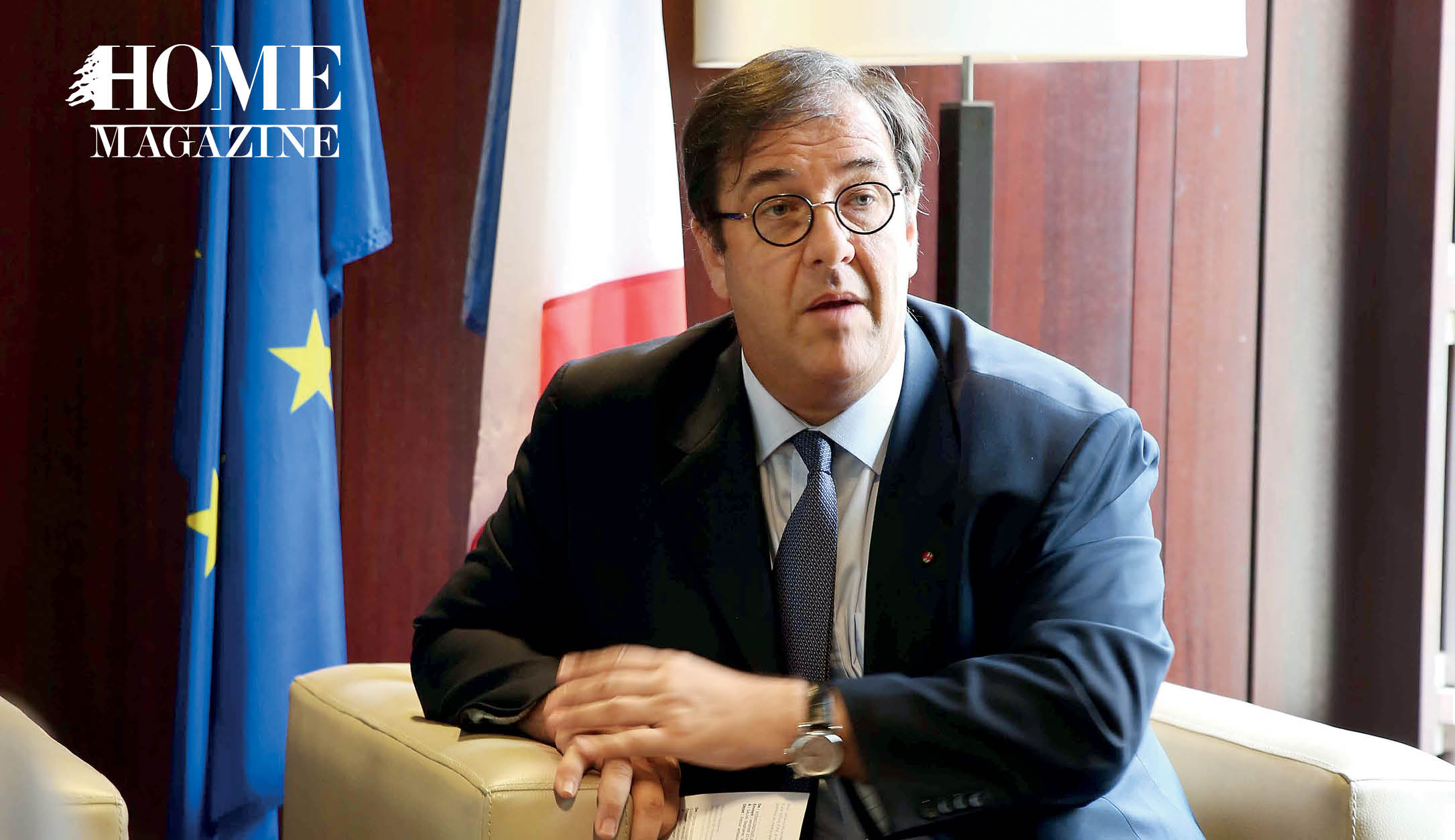
Photos by: Tea Tannoury
In an interview with HOME, the Honorable Bruno Foucher, French Ambassador to Lebanon, shares his views on the “Lebanese equation.”
After landing in Beirut in summer 2017, following years of foreign service across Iran, Saudi Arabia and Chad, French Ambassador to Lebanon Bruno Foucher has kept a keen eye on the country’s cultural climate, while also fulfilling his diplomatic duties with diligence.
Prior to assuming his post in Beirut, Foucher served as the president of the Institut Français in Paris in 2016 and 2017, responsible for all areas of cooperation and cultural action in close to 100 countries. He was responsible for France’s cultural involvement and impact abroad. He had formerly served as the first secretary at the Permanent Mission of France to the United Nations in New York from 1993 to 1997.
In his interview with HOME, he draws upon his extensive experience as a seasoned diplomat to share his perspective on the “Lebanese equation” in the fields of economy, education and culture.
Promoting Lebanon’s creative potential
“In addition to its rich touristic heritage, Lebanon is HOME to many contemporary cultural spaces. There’s a true artistic mine here that deserves to be further developed. Lebanon is a country that may be small in area, but is definitely bigger than itself.”
“There’s a true artistic mine here that deserves to be further developed. Lebanon is a country that may be small in area, but is definitely bigger than itself.”
When Foucher visited the Lebanese Pavilion during the latest edition of La Biennale di Venezia, for example, he left quite impressed. “I think it would be great for Lebanon to have a permanent exhibition space in Venice, given its position. It deserves a global platform for showcasing this country’s creative capacity in the presence of journalists and curators from every corner in the world,” he told HOME. “If Lebanon wants to show what it is capable of and promote its art abroad, then this is how it should be done.”
The ambassador’s interest in Lebanon’s art extends to the film industry, where he has examined the work of Lebanese filmmakers such as Philippe Aractinji. “Lebanese cinema has plenty to offer and we should promote it abroad,” he noted.
“Creativity is a sign of vitality and joy, of being in peace with oneself,” Foucher said. “Countries that are not doing well do not create and those going through a dark phase create less.”
“Creativity is a sign of vitality and joy. Countries that are not doing well do not create and those going through a dark phase create less.”
Foucher was particularly enthused by the new Beirut Design Fair, first held in September 2018. He had expected creativity, but not necessarily craftsmanship; he expected painters, but not excellence in the design field.
“The level of artistic craftsmanship is just excellent; there are true talents here who deserve wider exposure. We do not necessarily have an image of Beirut as a city of such creative status, although the city is widely known for its art and numerous galleries.”
Likewise, he was moved by the quality of performances he witnessed as part of the Baalbeck International Festival and the Beiteddine Art Festival.
Foucher sees Lebanon as a strong cultural partner and was recently inspired to create an artistic residency in France — the first of its kind for Lebanese artists. He chose water as a theme, given Lebanon’s fundamental link to the sea.
“We hope to maintain the long-standing, close relationship and frequent exchange between France and Lebanon in the fields of politics, economics, culture and, of course, education as per the roadmap set with the Lebanese president and prime minister a month after my arrival. It also included three international conferences held recently to help Lebanon: one in Rome to support the Lebanese Army, the CEDRE economic conference in Paris, and the Brussels conference to assist Lebanon in dealing with its ongoing refugee crisis, which has drained its resources and infrastructure.”
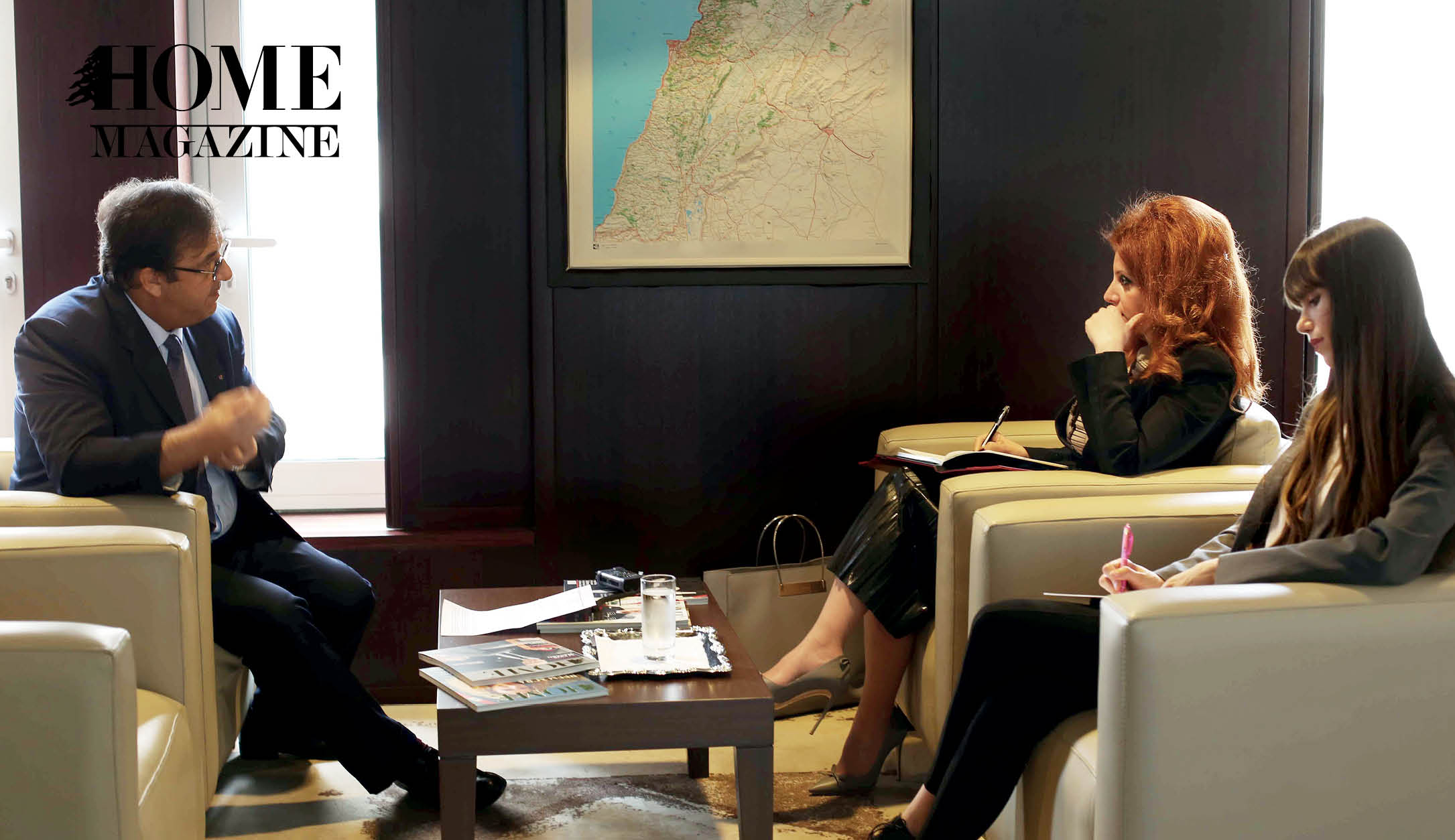
Capitalizing on cultural diplomacy
“Culture is not simply a form of entertainment, but is rather an economy that deserves to be structured and cultivated. The cultural and creative industry in France, for instance, has a turnover of €75 billion and retains more than 1 million employees. That is more than the automotive industry,” he noted.
“The cultural and creative industry in France has a turnover of €75 billion and retains more than 1 million employees. That is more than the automotive industry.”
“But nothing happens on its own. For instance, the Cannes Film Festival is not only about the glitter; it has a whole industry and effort behind it. So, as part of my work in France, I used to organize focus gatherings covering different music genres. I invited cultural managers from around the world to come and witness emerging artists. As a result, many of them have signed contracts. That’s one benefit of such fruitful artistic encounters and exchange.”
When it comes to Lebanon, Foucher pointed out that culture is found across the country, not only in Beirut. “I was surprised to see how much local educational institutions focus on cultural expression. For example, I was glad to find it across all the schools and universities I visited in Lebanon. This is a very good academic approach. Cultural experiences are closely linked to self-fulfillment,” he added.
“The government should harness this creativity and let it shine. It can be used for what we call ‘soft power’ diplomacy. This works well for Lebanon because the large diaspora is sensitive to the ‘Lebanon-ity’ of its art.”
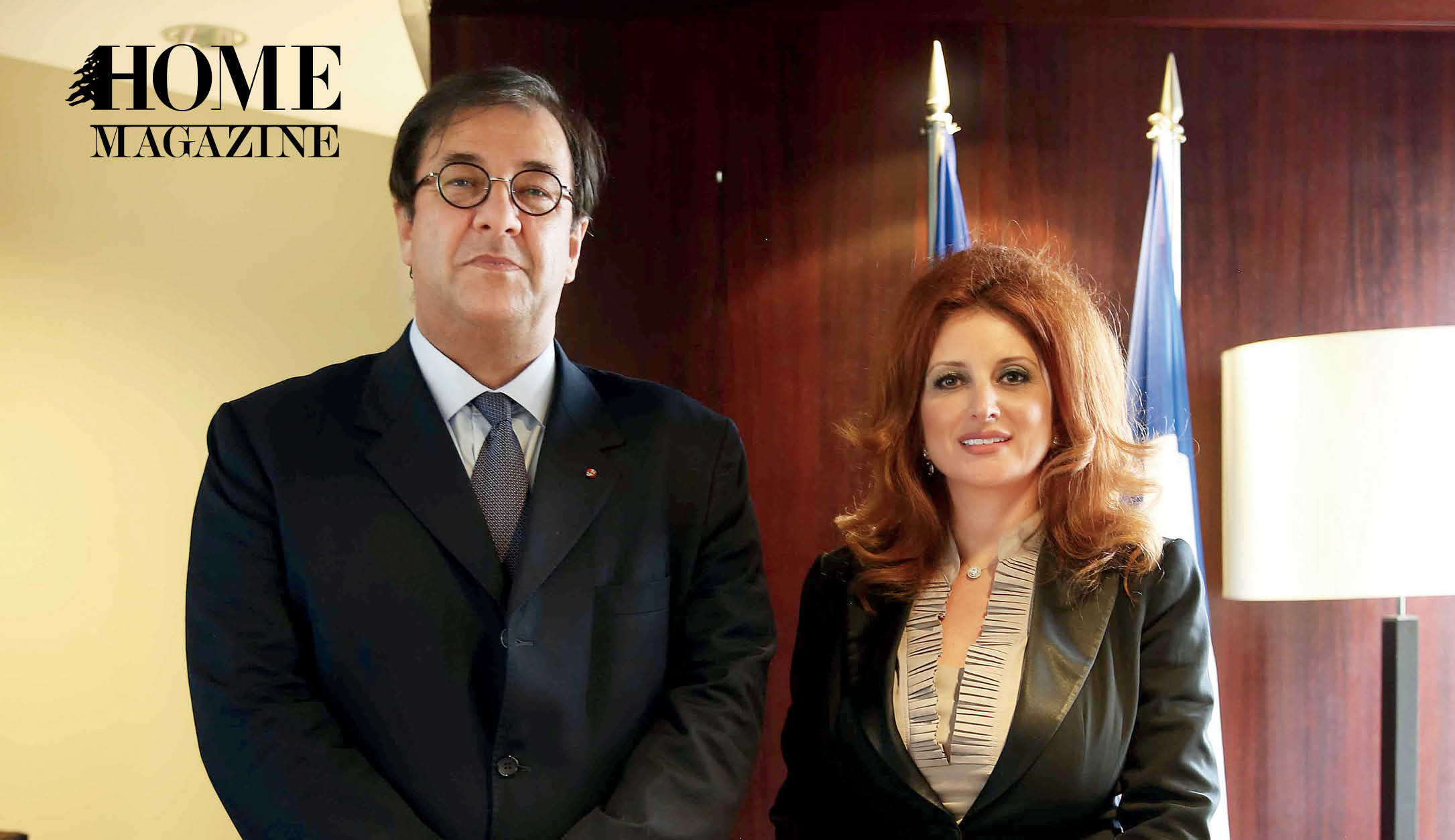
Supporting artists
Foucher has a strong track record of helping budding artists make important connections. Prior to coming to Lebanon, he put together cinema workshops during the Cannes Film Festival that welcomed talented young filmmakers to special masterclasses with skillful industry professionals.
It resulted in more than 70 percent of these young talents finding a suitable financial or technical partner for their film projects on the spot.
“French is the language of communication; it is the language of the heart.”
The French ambassador also supports academic exchanges between Lebanon and France. “More than 55 percent of Lebanese students study French as their first language and there are 60,000 students who currently follow the French curriculum, making Lebanon the first country to reach this number, followed by Morocco, which is still far behind with 37,000 students,” Foucher said.
“Our objective is to double this number, especially since Lebanese youth are highly educated. Lebanon is self-sufficient in its supply of French instructors, contrary to other countries. You provide your own teachers whether in terms of French language or other subjects that are taught in French. This is why we are working on consolidating existing training under a single institution, which will be the first of its kind in the world.”
Despite the global domination of English, Foucher noted that French remains the fifth most spoken and second most studied language in the world (according to information gathered by the French Foreign Ministry.) “We are not at war with English. It is just as important as knowing how to use a computer today. But French is much more than just a practical language. French is the language of communication; it is the language of the heart. It expresses a distinct culture. You as Lebanese carry on the French language and culture well, which is what distinguishes a Lebanese from a Jordanian for example. You have the capacity to speak multiple languages and build a bridge between many cultures and continents.”
“More than 55 percent of Lebanese students study French as their first language and there are 60,000 students who currently follow the French curriculum, making Lebanon the first country to reach this number, followed by Morocco, which is still far behind with 37,000 students.”
Pioneering a culture of coexistence
“You are the fruit of your recent history – in part influenced by the Syrian occupation and, on the other side, by being a multi-confessional society of great diversity. I find that these two factors intertwine perfectly in the creative field. Art can never escape its history,” Foucher said.
“The Lebanese population stood strong and survived, despite everything it has been through. Having served in many Arab countries, I can say that this coexistence and mix of cultures and religions, this resilience, is not seen in other countries. That you were able to endure your painful history and preserve what is best in you, despite unfavorable circumstances, is what makes your particular equation.”
Lebanon won’t give Foucher his first experience with a challenging political climate. “I am always keen on developing external relations in the mutual interest of the countries involved,” he said. “Things weren’t smooth between France and Chad when I first landed there, but today Chadians are our tops allies in the African region when it comes to fighting terrorism.
The same goes for “Iran, where I wasn’t very well received at first, yet ended up leaving five years later with 22 signed contracts, in addition to the nuclear agreement.”
Given his strong experience in the complex socio-political climate of the region, the former Institut Français president did not hesitate to take the post in Beirut as soon as it became vacant. “There are more than 225,000 Lebanese in France. In addition, we are very interested in maintaining our relationship with Lebanon because our common history is a beautiful one,” he explained. “The Salon du Livre here is the third biggest in the world after Paris and Montreal, with more than 80,000 annual visitors, including 20,000 to 30,000 students.”
Incidentally, Foucher does not fear for the future of print in the digital age. “The book industry in France diminished but soon arrived to a stable level and remains huge, with a total of €6 billion in annual turnover, 67,000 employees, 450 million copies sold per year and 80,000 titles (including 68,000 new titles) printed annually, with only 20 percent of them being academic books,” he specified. “Asterix is the most printed ever,” he said of the popular series of French comics, with a nod and a smile.
“The book industry in France remains huge, with 450 million copies sold per year.”
As the interview neared its end, the ambassador shared some inspiring words to the Lebanese population. “You have always been a pluralistic society, a living example of tolerance and coexistence, a society perfectly adapted to today’s increasingly globalized world.
“We need to welcome the other who is different from us. Such an open spirit is not innate, but is rather acquired. The more tolerance we show, the less violence has a chance of taking over.
“It is good for everyone to be inspired by the Lebanese model of coexistence, which has rightfully been commended by the Pope as a message of peace in the heart of a boiling Middle East.”
France’s Book Industry
€6 billion annually
67,000 employees
450 million copies sold per year
80,000 titles published per year
68,000 new titles per year
HOMEland THEMES
Coming Soon
HOMEland Events & Collaborations
Coming Soon
 Signature Boutique