WAW portrays an artistic image of Lebanon with its scrupulous designs. Influences from Lebanon and other Arabian countries are weaved into beautiful collections revealing the soul of Lebanon.
Article by: Maryam Ghaddar
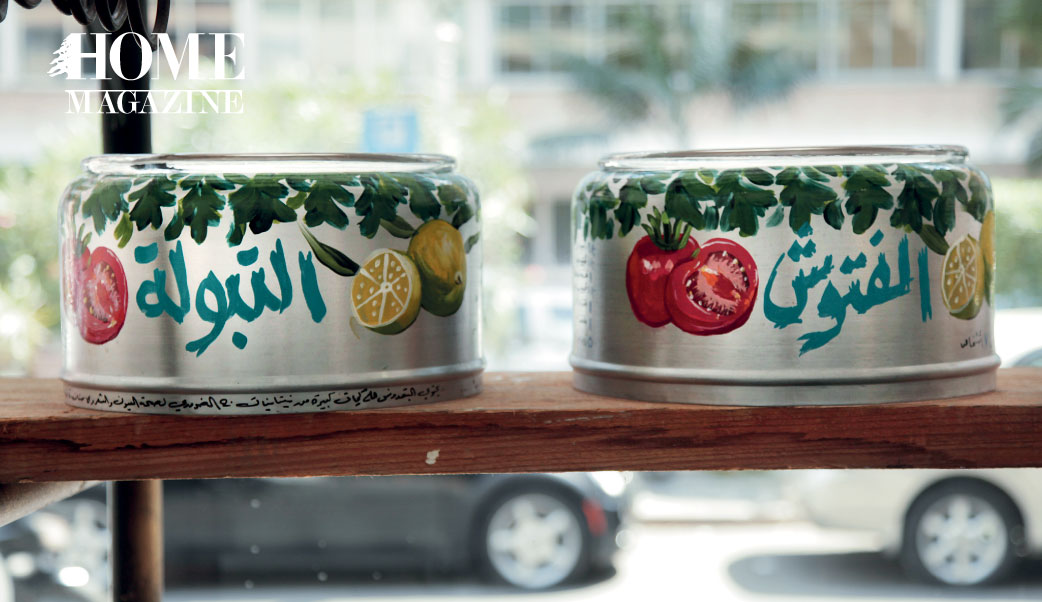
On a well-known, yet quiet, street in Beirut known as Clemenceau rests a small boutique, brimming with eye-catching paraphernalia. Several vibrantly stitched kamis and traditional kaftan robes adorned with beads and sequins are displayed in the windows. Ornamental pots and pans, wooden end tables, metal bowls and copper trays line the shelves and are painted with subtle pastel colors. Shapes of Arabic calligraphy abound. The meticulous design and exact art of many of the items are often made up of the letters of the Arabic alphabet. The entire design often comprises the weaving of one letter through the next in lovely, succinct curvaceous lines. The soul of Lebanon is reawakened in WAW Designs, and we are brought back HOME.
The letter “waw” is the 26th character of the Arabic alphabet, and is often used as a unifying force in scripture. Just as the boutique’s name suggests, it brings together the past and present, lightness and darkness, nostalgia and pride. It unites Lebanese people from every sect in Lebanon and abroad with one common goal: to embrace our intriguing heritage and art as our spiritual guide.
WAW Designs specializes in handmade HOME décor, metallic and pottery-based kitchenware, traditional costumes, and intricately patterned furniture. They also have a line of bath salts, herbal soaps and essential oils, as well as coffee, spiced candies and chocolates presented in designer boxes, with their signature logo stamped on every article. Hand-sewn handbags, threaded accessories, and kab kabs (traditional clog-like shoes) can be seen scattered around the shop. It melds the visually mesmerizing appearance of the Arabic language with delicate Ottoman styles and Oriental motifs. Maysaa Sultan and Maysaa Berri are the founders of this concept store – the brains behind the operation.
“The soul of Lebanon is rewakened in WAW Designs, and we are brought back HOME.”
In 2010, the two Maysaas put their heads together and put pen to paper for this project. They aimed to do something that embodied the image of Lebanon and Lebanese art in a specific way using raw materials. They draw inspiration from specific themes, local tastes, and Middle Eastern culture. Influences from Morocco, Egypt, Syria, Turkey, and of course their HOME country, Lebanon, play a significant role in their creations in terms of the colors used, the identities recognized, and the ancient heritage remembered. Everything in the shop is hand-painted and crafted in workshops, every intimate detail completed with loving care. There is a genuine feel to each individual piece, a story to tell, a theme to follow in the calligraphic arches.

WAW offers collections that are useful at HOME or can be given as unique gifts. Using historical ideas and artifacts of the past, the designers try to modernize them with exquisite silhouettes and figures. Sometimes, they may take ideas from architectural forms from years ago and expand on them. There are no restrictions as to how the many hues of red, blue, yellow, and green balance or the direction that each assortment takes in its execution; creativity knows no bounds.
While WAW Designs has a stable and solid range of items that remains fixed throughout the year, there are also some seasonal varieties that cater to the dynamic aspects of Lebanon. Some holidays and special occasions play a part, particularly Ramadan, when their food trays and dishware seem to become even more extravagantly designed. Some changes are also witnessed in the fabrics they use for their fashionwear; they use cotton and embroidery, for instance, that is more compatible with the heat and humidity inherent in Beirut’s summer months.
The many textures symbolize the message they are trying to impress upon their visitors.
This concept store is a reminder of our roots, our passions. It is a way to keep an extraordinary piece of Lebanon in our HOMEs and to represent our tiny Mediterranean country in the best way possible and show the world who we truly are.
For more info: www.wawdesigns.com
Instagram: wawdesigns

HOMEland Magazine
We firmly believe that the internet should be available and accessible to anyone, and are committed to providing a website that is accessible to the widest possible audience, regardless of circumstance and ability.
To fulfill this, we aim to adhere as strictly as possible to the World Wide Web Consortium’s (W3C) Web Content Accessibility Guidelines 2.1 (WCAG 2.1) at the AA level. These guidelines explain how to make web content accessible to people with a wide array of disabilities. Complying with those guidelines helps us ensure that the website is accessible to all people: blind people, people with motor impairments, visual impairment, cognitive disabilities, and more.
This website utilizes various technologies that are meant to make it as accessible as possible at all times. We utilize an accessibility interface that allows persons with specific disabilities to adjust the website’s UI (user interface) and design it to their personal needs.
Additionally, the website utilizes an AI-based application that runs in the background and optimizes its accessibility level constantly. This application remediates the website’s HTML, adapts Its functionality and behavior for screen-readers used by the blind users, and for keyboard functions used by individuals with motor impairments.
If you’ve found a malfunction or have ideas for improvement, we’ll be happy to hear from you. You can reach out to the website’s operators by using the following email
Our website implements the ARIA attributes (Accessible Rich Internet Applications) technique, alongside various different behavioral changes, to ensure blind users visiting with screen-readers are able to read, comprehend, and enjoy the website’s functions. As soon as a user with a screen-reader enters your site, they immediately receive a prompt to enter the Screen-Reader Profile so they can browse and operate your site effectively. Here’s how our website covers some of the most important screen-reader requirements, alongside console screenshots of code examples:
Screen-reader optimization: we run a background process that learns the website’s components from top to bottom, to ensure ongoing compliance even when updating the website. In this process, we provide screen-readers with meaningful data using the ARIA set of attributes. For example, we provide accurate form labels; descriptions for actionable icons (social media icons, search icons, cart icons, etc.); validation guidance for form inputs; element roles such as buttons, menus, modal dialogues (popups), and others. Additionally, the background process scans all the website’s images and provides an accurate and meaningful image-object-recognition-based description as an ALT (alternate text) tag for images that are not described. It will also extract texts that are embedded within the image, using an OCR (optical character recognition) technology. To turn on screen-reader adjustments at any time, users need only to press the Alt+1 keyboard combination. Screen-reader users also get automatic announcements to turn the Screen-reader mode on as soon as they enter the website.
These adjustments are compatible with all popular screen readers, including JAWS and NVDA.
Keyboard navigation optimization: The background process also adjusts the website’s HTML, and adds various behaviors using JavaScript code to make the website operable by the keyboard. This includes the ability to navigate the website using the Tab and Shift+Tab keys, operate dropdowns with the arrow keys, close them with Esc, trigger buttons and links using the Enter key, navigate between radio and checkbox elements using the arrow keys, and fill them in with the Spacebar or Enter key.Additionally, keyboard users will find quick-navigation and content-skip menus, available at any time by clicking Alt+1, or as the first elements of the site while navigating with the keyboard. The background process also handles triggered popups by moving the keyboard focus towards them as soon as they appear, and not allow the focus drift outside it.
Users can also use shortcuts such as “M” (menus), “H” (headings), “F” (forms), “B” (buttons), and “G” (graphics) to jump to specific elements.
We aim to support the widest array of browsers and assistive technologies as possible, so our users can choose the best fitting tools for them, with as few limitations as possible. Therefore, we have worked very hard to be able to support all major systems that comprise over 95% of the user market share including Google Chrome, Mozilla Firefox, Apple Safari, Opera and Microsoft Edge, JAWS and NVDA (screen readers).
Despite our very best efforts to allow anybody to adjust the website to their needs. There may still be pages or sections that are not fully accessible, are in the process of becoming accessible, or are lacking an adequate technological solution to make them accessible. Still, we are continually improving our accessibility, adding, updating and improving its options and features, and developing and adopting new technologies. All this is meant to reach the optimal level of accessibility, following technological advancements. For any assistance, please reach out to