

HOMEland THEMES
Coming Soon
HOMEland Events & Collaborations
Coming Soon
 Signature Boutique

“I am the son of the road, my country is a caravan and my life is the most unexpected of voyages. I belong to Earth and to God and it is to them that I will one day soon return.”
Amin Maalouf ’s voyage started here, in a quintessential Lebanese HOME in Ain el Kabou, a village high in the snowy mountains of Metn, Mount Lebanon. In early June, the cherry trees flush crimson. In September, apples. Then the leaves turn fiery and fall. Now only the pine green remains.
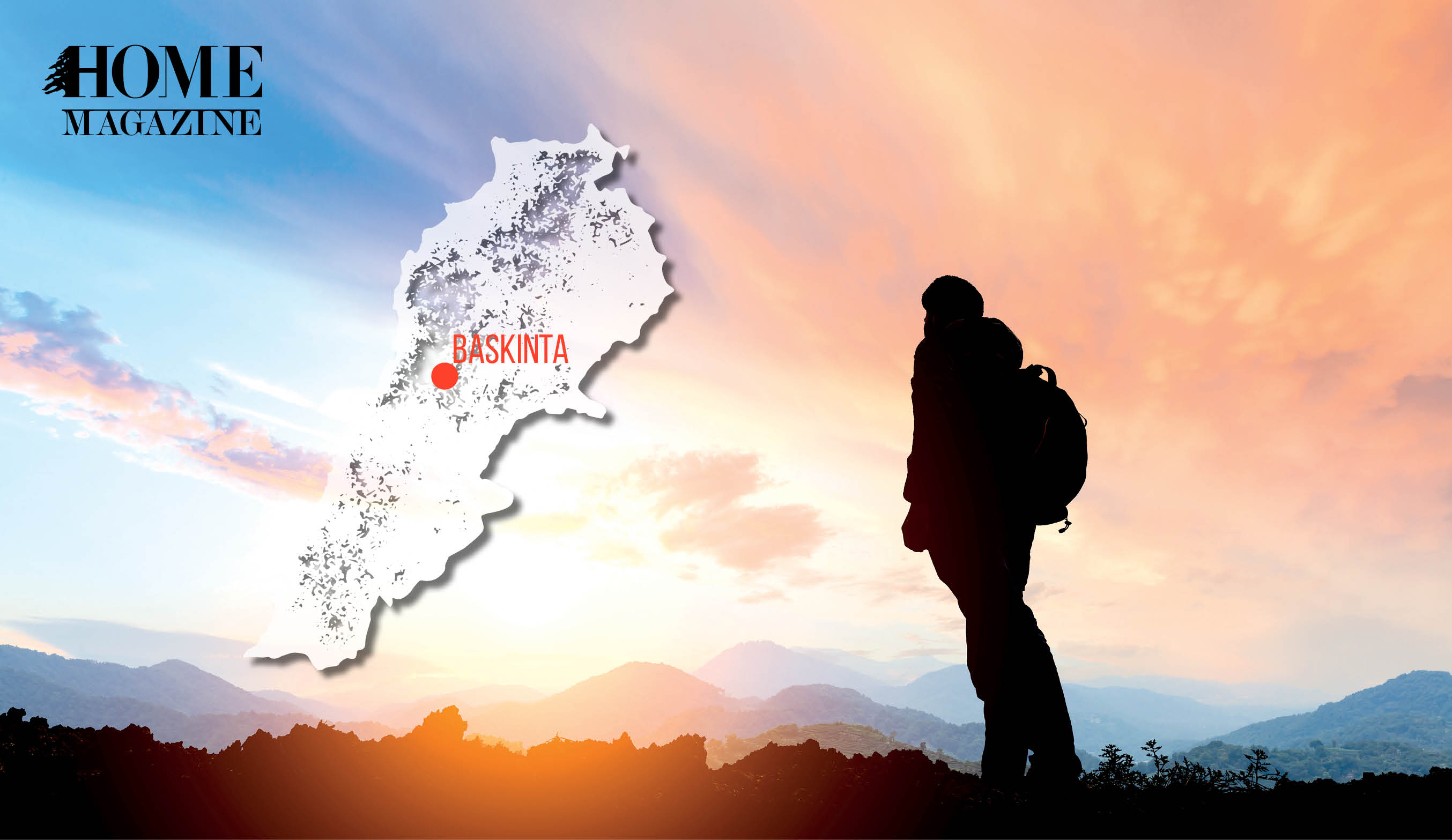
The snow that surrounds us and blankets Mount Sannine will make the village streams gush and bubble loudly with fresh water in March. But all is quiet now. December. Even the villages: Ain el Kabou, Kfar Aqab, Wadi el Karam, Boqaatat Kenaan, and Baskinta, where this journey starts.
We are a group of five friends, half awake, fully cold but ready for this: a hike 24 kilometers long, the Baskinta Literary Trail.
This walk is one of the 27 sections of the Lebanon Mountain Trail, a 470-kilometer adventure of a lifetime. The whole journey would take almost a month to make, from the country’s north to its south, as lovers of nature and culture walk and take in the breathtaking sights.
For those who, like us, have only a day or two, the Baskinta Literary Trail is the perfect escape. The path runs along winding streets, forests, orchards, stopping at 22 landmarks. Each relates to a great Lebanese poet or novelist.
At one stop, a writer’s HOME. At another: a verse carved in stone, in memoriam. Further, a statue, then an art studio and center, a favored vantage point or writing spot. Here, at one point or another, lived and wrote such names as Mikhail Naimy, Amin Maalouf, Abdallah Ghanem, Suleiman Kettaneh, Rachid Ayoub, Georges Ghanem and the painter, George Aroyan.
Tourists in khaki shorts and thick hiking boots flock to the area in spring, summer, and early autumn to discover the places that inspired scenes of novels they read, snapshots of views that made them dream.
Sannine, overlooking the sea, “with a front broad, steep and craggy.” To Naimy’s words, Ghanem’s act as a complement: “Upon my heart she tapped…” From Naimy’s house, where a 600-yearold oak he loved still stands, to Maalouf ’s, then the Ain el Kabou spring and village square he immortalized in The Rock of Tanios.
Voices, pens, and brush strokes that defined Lebanese culture and recorded the country’s history come alive on this hike. We discover a meditation garden, a poet’s final resting place, Roman inscriptions and an artist’s workshop. Dozens of paintings are displayed. Also, appropriately, a cave named Sayf el Dawla after a 10th century Arab ruler who encouraged learning and was known to love poetry.
The mountain’s nature still inspires poetry. Its quiet and noble setting, which once drew rulers, missionaries and monks, now attracts writers and pilgrims. They built schools and monasteries, stories and philosophies. We walk from one stop to the next on the map, absorbing, not speaking.
We are shivering but enthralled at the beauty created here. We look around: the sun on the mountain flanks, the smell of frost in the air, the thick trees and silence, and because the sky is clear, far away, the Mediterranean.
The road is ours; the rest of world is huddled indoors for warmth. Those mad enough to also be outside are further up, skiing on the slopes. We loop back to Baskinta, where most of the shutters are closed, but Amo Krikor’s furn is open! A feast of Bonjus and manakish. Well earned.
Most of the members of our happy, tired, crew no longer live in Lebanon. Like many of the writers we came across, life has taken us abroad. We carry some things with us, however: sights, smells, foods, spices, words. Portraits of Lebanon captured in memories of a day like this one.
Well fed, overfed, our heads filled with verse and prose, we are offered coffee in short porcelain cups.
Ma’ hel aw bala hel?
With cardamom, please.
He and his rakwe then pull up a chair.
Now let me tell you a story.
The Baskinta Literary Trail can be hiked independently, or with the Lebanese Mountain Trail Association and other Lebanese NGOs and travel organizations. These groups offer regular guided hikes along this path and other fascinating landscapes of Lebanon. Dates, details, and registration information may be found on their website.
For more info: https://www.lebanontrail.org
Signature Boutique 

HOMEland Magazine
We firmly believe that the internet should be available and accessible to anyone, and are committed to providing a website that is accessible to the widest possible audience, regardless of circumstance and ability.
To fulfill this, we aim to adhere as strictly as possible to the World Wide Web Consortium’s (W3C) Web Content Accessibility Guidelines 2.1 (WCAG 2.1) at the AA level. These guidelines explain how to make web content accessible to people with a wide array of disabilities. Complying with those guidelines helps us ensure that the website is accessible to all people: blind people, people with motor impairments, visual impairment, cognitive disabilities, and more.
This website utilizes various technologies that are meant to make it as accessible as possible at all times. We utilize an accessibility interface that allows persons with specific disabilities to adjust the website’s UI (user interface) and design it to their personal needs.
Additionally, the website utilizes an AI-based application that runs in the background and optimizes its accessibility level constantly. This application remediates the website’s HTML, adapts Its functionality and behavior for screen-readers used by the blind users, and for keyboard functions used by individuals with motor impairments.
If you’ve found a malfunction or have ideas for improvement, we’ll be happy to hear from you. You can reach out to the website’s operators by using the following email
Our website implements the ARIA attributes (Accessible Rich Internet Applications) technique, alongside various different behavioral changes, to ensure blind users visiting with screen-readers are able to read, comprehend, and enjoy the website’s functions. As soon as a user with a screen-reader enters your site, they immediately receive a prompt to enter the Screen-Reader Profile so they can browse and operate your site effectively. Here’s how our website covers some of the most important screen-reader requirements, alongside console screenshots of code examples:
Screen-reader optimization: we run a background process that learns the website’s components from top to bottom, to ensure ongoing compliance even when updating the website. In this process, we provide screen-readers with meaningful data using the ARIA set of attributes. For example, we provide accurate form labels; descriptions for actionable icons (social media icons, search icons, cart icons, etc.); validation guidance for form inputs; element roles such as buttons, menus, modal dialogues (popups), and others. Additionally, the background process scans all the website’s images and provides an accurate and meaningful image-object-recognition-based description as an ALT (alternate text) tag for images that are not described. It will also extract texts that are embedded within the image, using an OCR (optical character recognition) technology. To turn on screen-reader adjustments at any time, users need only to press the Alt+1 keyboard combination. Screen-reader users also get automatic announcements to turn the Screen-reader mode on as soon as they enter the website.
These adjustments are compatible with all popular screen readers, including JAWS and NVDA.
Keyboard navigation optimization: The background process also adjusts the website’s HTML, and adds various behaviors using JavaScript code to make the website operable by the keyboard. This includes the ability to navigate the website using the Tab and Shift+Tab keys, operate dropdowns with the arrow keys, close them with Esc, trigger buttons and links using the Enter key, navigate between radio and checkbox elements using the arrow keys, and fill them in with the Spacebar or Enter key.Additionally, keyboard users will find quick-navigation and content-skip menus, available at any time by clicking Alt+1, or as the first elements of the site while navigating with the keyboard. The background process also handles triggered popups by moving the keyboard focus towards them as soon as they appear, and not allow the focus drift outside it.
Users can also use shortcuts such as “M” (menus), “H” (headings), “F” (forms), “B” (buttons), and “G” (graphics) to jump to specific elements.
We aim to support the widest array of browsers and assistive technologies as possible, so our users can choose the best fitting tools for them, with as few limitations as possible. Therefore, we have worked very hard to be able to support all major systems that comprise over 95% of the user market share including Google Chrome, Mozilla Firefox, Apple Safari, Opera and Microsoft Edge, JAWS and NVDA (screen readers).
Despite our very best efforts to allow anybody to adjust the website to their needs. There may still be pages or sections that are not fully accessible, are in the process of becoming accessible, or are lacking an adequate technological solution to make them accessible. Still, we are continually improving our accessibility, adding, updating and improving its options and features, and developing and adopting new technologies. All this is meant to reach the optimal level of accessibility, following technological advancements. For any assistance, please reach out to